The Field King Max 190348 is our top pick for 2026 — its internal no-leak pump design keeps chemicals off your back while delivering pro-grade performance. Whether you're a weekend gardener tackling weeds or a professional treating large properties, the pump sprayer you choose changes everything about how fast and safely you get the job done.
Pump sprayers come in all shapes and sizes — from compact 1-gallon hand-held units for spot treatments to heavy-duty 4-gallon battery-powered backpacks that eliminate manual pumping entirely. The right one depends on your application area, the chemicals you're using, and how long you plan to work. Buying the wrong sprayer means sore arms, chemical exposure, or a tank that leaks halfway through your yard. We've tested and researched the top options on the market so you don't have to guess. For broader gardening reviews, check out our full category coverage.
In this guide, we break down 7 of the best pump sprayers available right now, covering everything from budget hand-held models to professional backpack units. We'll walk through honest pros and cons, key specs, and a buying guide to help you match the right tool to your specific needs. If you're also looking for what to put in your sprayer, our guide to the best organic weed killers for lawns is worth a read.






If you need a simple, reliable sprayer for spot treatments around the garden, the Chapin 20004 is hard to beat at its price point. The 1-gallon translucent tank lets you see exactly how much fluid you have left without guessing, and the funnel-top opening makes refilling fast and spill-free. That might sound minor, but when you're working with concentrated pesticides or herbicides, avoiding spills is genuinely important for your safety.
Chapin's modular design sets this sprayer apart from cheap knockoffs. The seals are replaceable, so when one wears out after a season of use, you swap the part instead of buying a whole new unit. The 34-inch hose gives you solid reach without having to crouch or awkwardly reposition the tank, and the adjustable cone nozzle handles everything from a fine mist for delicate plants to a direct stream for targeting weeds in cracks. For fertilizer applications, weed control, and basic pest treatments, this covers all the bases. According to Wikipedia's overview of sprayer technology, cone nozzles like this one are among the most versatile for general garden use.
The ergonomic pump handle reduces hand fatigue when you're working for extended periods, which matters more than you might expect on a hot afternoon. This is a lightweight, no-frills tool that does exactly what it promises. It won't replace a backpack sprayer for large-scale jobs, but for routine spot treatments on a small to medium yard, it's a workhorse.
Pros:
Cons:
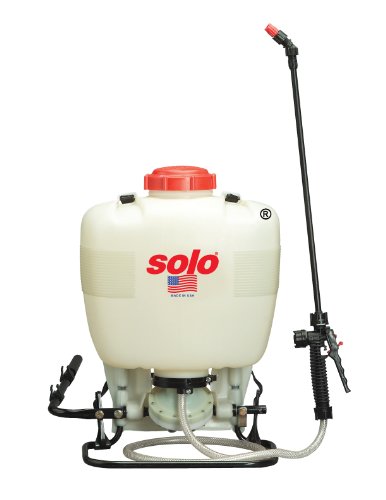
The SOLO 425 is built for people who need serious pressure and serious reach. The high-performance piston pump generates up to 90 PSI (pounds per square inch — that's very high pressure for a manual backpack unit), which means you can treat tall trees, dense shrubs, and hard-to-reach areas that standard sprayers simply can't penetrate. It's the go-to choice for homeowners with mature landscaping and professionals who spray trees for insect or disease control.
The 48-inch nylon-reinforced high-pressure hose paired with a 20-inch unbreakable wand gives you nearly six feet of combined reach. That's enough to treat the underside of leaves on a six-foot shrub without a ladder. Four commercial-grade nozzles come included — plastic adjustable, fan spray, hollow cone, and jet stream — and it's TeeJet compatible, which means you can swap in specialty nozzles if your application requires it. TeeJet is an industry-standard nozzle system widely used in professional agriculture.
Setup is straightforward, and the padded shoulder straps distribute the weight of a full 4-gallon tank (about 33 pounds when full) reasonably well across your back. You'll still feel it after an hour, but that's true of any backpack sprayer at capacity. The piston pump does require slightly more pumping effort than a diaphragm model, but the pressure payoff is worth it for large-scale jobs. This is a serious piece of equipment at an accessible price.
Pros:
Cons:

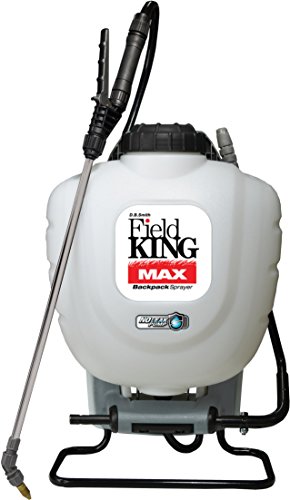
This is our top overall pick, and the reason is simple: the internal no-leak pump design keeps chemicals completely sealed inside the unit so nothing drips down your back during operation. If you've ever used a poorly sealed sprayer and felt herbicide soaking through your shirt, you understand immediately why this matters. For anyone applying harsh chemicals regularly, that safety feature alone justifies the price premium over basic models.
The build quality is genuinely professional-grade. The 21-inch stainless steel wand is paired with Viton seals — Viton is a fluoropolymer material with exceptional resistance to acids, oils, and harsh agricultural chemicals that would degrade rubber seals within a season. The lockable shut-off valve features brass components for durability and includes an in-line filter to prevent nozzle clogs mid-job. These are details you find on commercial sprayers, not consumer tools.
In practice, the Field King Max handles herbicide applications on large properties without drama. The pump mechanism is smooth and builds pressure quickly, the shut-off lock lets you maintain spray without holding the trigger constantly, and the ergonomic back frame keeps the load balanced even when the tank is nearly full. If you're serious about lawn and garden maintenance in 2026, this is the sprayer that professionals rely on. Pair it with the right product from our best poison ivy killers guide and you've got a complete treatment solution for your yard.
Pros:
Cons:
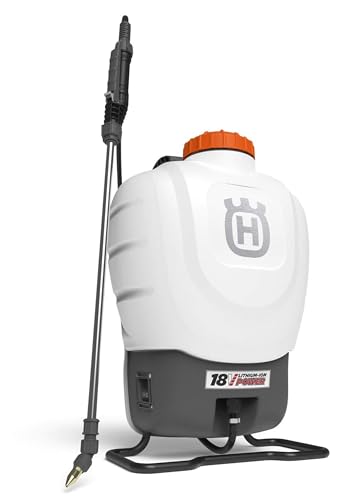
Manual pumping gets old fast when you're covering a large property. The Husqvarna battery-powered backpack sprayer eliminates that entirely. Powered by an 18V battery (included with charger), it delivers constant pressure at a regulated 25 PSI without you ever stopping to pump. For people with arthritis, shoulder injuries, or simply large areas to cover, this is a genuine game-changer.
The system can handle both wettable powders (finely ground chemical formulations that mix with water) and liquid concentrates, making it versatile across fertilizer, herbicide, and pesticide applications. The maximum rated pressure is 151 PSI, but the 25 PSI regulator keeps delivery smooth and consistent at the nozzle — you get even coverage without over-saturating plants or wasting product. The no-leak internal pump design is borrowed from professional-grade equipment and keeps chemicals sealed away from your back and clothing throughout the job.
Battery life is solid for a full 4-gallon tank, and since it runs on Husqvarna's 18V platform, you may already have compatible batteries if you own other tools in their lineup. The only real trade-off is price — this costs significantly more than manual alternatives. But if you're treating a quarter acre or more on a regular basis, the time savings and physical relief make it worth the investment. This is the most technologically advanced sprayer in our lineup for 2026.
Pros:
Cons:
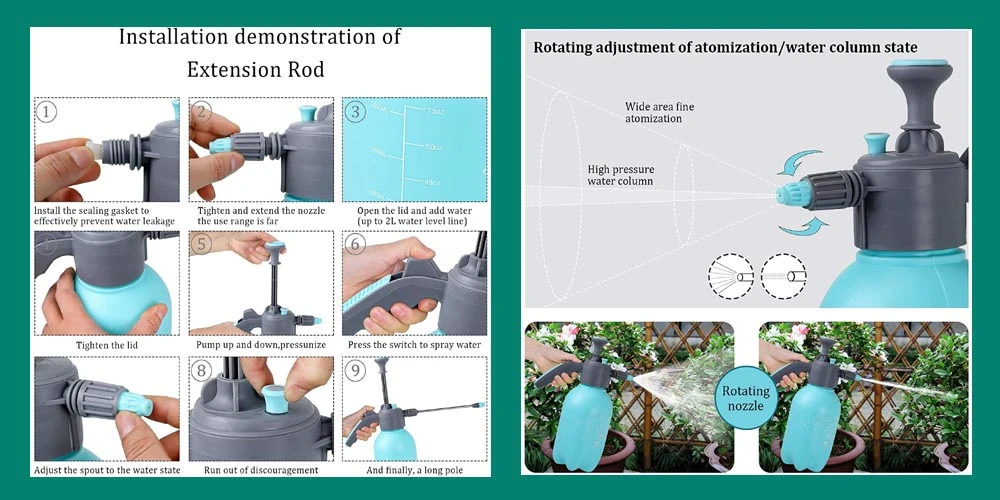
Think of the Chapin 20005 as the 20004's bigger sibling — same reliable design, double the capacity. The 2-gallon translucent tank with funnel-top opening gives you that same spill-free refilling experience, but you cover twice the ground before stopping. For medium-sized yards, this hits a sweet spot between the lightweight convenience of a 1-gallon unit and the bulk of a full backpack sprayer.
The SureSpray anti-clog filter is one detail that sets Chapin apart from budget competitors. Most cheap sprayers skip filtration entirely, which means you're constantly dealing with nozzle blockages when working with granular-dissolve fertilizers or products that don't fully dissolve. Chapin's filter catches particles before they reach the nozzle, keeping your spray pattern consistent throughout the tank. The adjustable cone nozzle and 34-inch hose are identical to the 20004, so you get the same versatility in a larger package.
This is the right choice if you regularly treat a lawn of 3,000–6,000 square feet and want to minimize refill trips. It's still light enough to carry comfortably in one hand for most of the job, though you'll feel the weight increase as you move away from the empty-tank experience. Modular construction with replaceable seals means this sprayer can last several seasons with basic maintenance — rinse it after each use, replace a seal when it wears, and it keeps working.
Pros:
Cons:
Roundup engineered this backpack sprayer specifically with weed and pest control in mind, and the design reflects that focus. Viton seals and gaskets throughout the entire pump and shut-off valve make it one of the most chemically resistant manual sprayers in this price range. Viton handles exposure to herbicides, insecticides, and fertilizers without degrading — a real advantage over basic rubber-sealed sprayers that stiffen and crack after a season of chemical contact.
The heavy-duty poly wand with comfort grip shut-off is well designed for extended use. The lock for continuous spraying means you can walk a fence line or treat a long bed without holding the trigger the entire time — your hand thanks you after the first 20 minutes. The in-line filter protects the nozzle from particle buildup, which matters when you're mixing wettable powder formulations or less-filtered fertilizer concentrates.
At 4 gallons, you can cover a substantial area before stopping to refill, and the padded shoulder straps make the weight manageable for most users. This sprayer doesn't try to be a battery-powered marvel or generate extreme pressure — it's a solid, reliable backpack unit that handles the chemicals you throw at it without complaint. If your primary use case is herbicide application on a large lawn or garden, this is the dedicated tool designed exactly for that job. It pairs naturally with the products we cover in our organic weed killer guide.
Pros:
Cons:
Most pump sprayers will corrode or fail quickly when exposed to bleach solutions. The SOLO 475-B is specifically engineered to handle them. The diaphragm pump is constructed with Tivilon material — SOLO's proprietary compound — that provides outstanding resistance to chlorine-based disinfectants, harsh cleaning chemicals, and the abrasive particles found in some wettable powder formulations. If you need to spray disinfectants around a commercial property, barn, greenhouse, or outdoor space, this is the only category in this list built for that task.
The diaphragm pump design (where a flexible membrane moves fluid rather than a sliding piston) handles small abrasive particles that would damage a piston pump's cylinder walls over time. That makes it suitable for formulations that aren't perfectly filtered — a common issue with powdered disinfectants or certain agricultural products. Pressure tops out at 60 PSI, which is lower than the SOLO 425's 90 PSI piston pump, but more than adequate for most disinfection and pest control jobs.
The 4-gallon capacity and included spray nozzles cover serious square footage before refilling, and the overall construction follows SOLO's reputation for commercial durability. If your needs are purely garden herbicides and fertilizers, you don't need the bleach-resistance premium. But if you're dealing with disinfectants, algae treatments on hardscaping, or any chlorine-based chemistry, the 475-B is the only smart choice on this list. Don't use a standard rubber-sealed sprayer for bleach solutions — you'll be replacing seals or the entire unit within months.
Pros:
Cons:
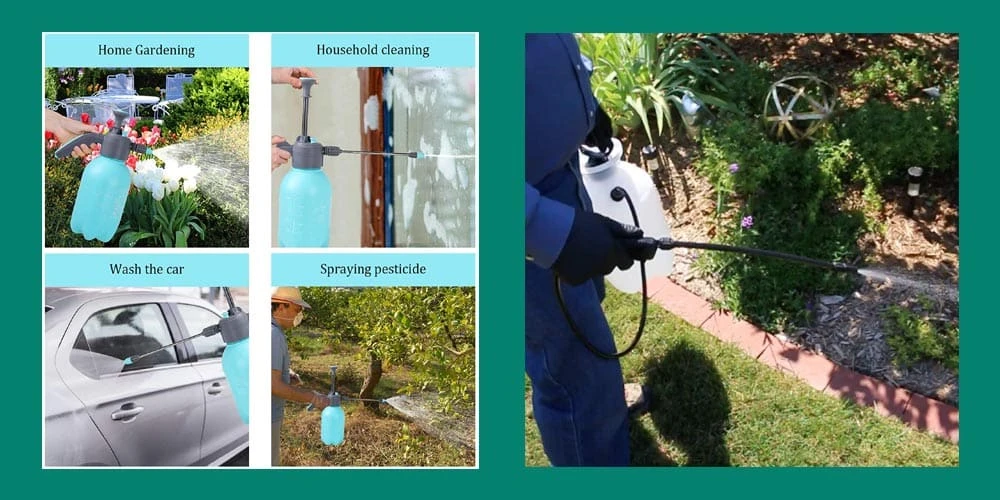
Walking into this purchase without a plan means spending money on the wrong tool. Here's what actually matters when you're comparing models in 2026.
This is the single most important spec for practical use. A 1-gallon hand-held sprayer like the Chapin 20004 covers roughly 500–1,000 square feet of spot treatment before you need to refill. That's fine for a small garden bed or a patio. A 2-gallon unit doubles that range. A 4-gallon backpack sprayer covers a half-acre or more depending on application rate and dilution ratio.
The math is simple: larger properties need larger tanks. But there's a weight penalty. A full 4-gallon tank weighs approximately 33 pounds when loaded. If you have a bad back or shoulder issues, a battery-powered model like the Husqvarna eliminates the physical strain of manual pumping, which helps considerably.
Piston pumps generate the highest pressure — up to 90 PSI on models like the SOLO 425 — and are excellent for penetrating dense foliage or reaching tall trees. The trade-off is that the cylinder and piston seal wear faster when exposed to abrasive particles. Diaphragm pumps operate at lower pressures (typically 40–60 PSI) but handle wettable powders and bleach solutions without damage — the SOLO 475-B is the best example here. Battery-powered models eliminate manual pumping entirely and deliver consistent regulated pressure regardless of your physical effort.
For standard lawn and garden herbicides and fertilizers, a piston backpack is the best value. For bleach or disinfectants, only use a diaphragm model. For large properties where fatigue is a factor, battery-powered is worth the premium.
This detail gets overlooked until your sprayer starts leaking after six months. Standard rubber seals degrade when exposed to concentrated herbicides, oil-based insecticides, and fertilizer salts. Viton seals — found on the Field King Max, Roundup 190314, and several other professional models — resist chemical attack for multiple seasons. If you're spending money on a backpack sprayer for serious chemical applications, Viton seals are a non-negotiable feature. Check the spec sheet before buying if this isn't listed clearly in the product description.
The nozzle determines your spray pattern — and different jobs need different patterns. A flat fan nozzle covers broad, even areas efficiently (ideal for herbicide broadcast applications). A hollow cone nozzle wraps chemical around leaf surfaces for better coverage on plants. A jet stream nozzle reaches into tight spots or delivers pinpoint treatment. Models with multiple included nozzles, like the SOLO 425 with its four commercial-grade options, give you flexibility across applications. An in-line filter between the tank and nozzle prevents clogging — this is especially valuable when working with fertilizers that don't fully dissolve. Check if replacement nozzles are available for your model before buying, so you're not stranded when one wears out. If you're also curious about tools for detailed plant care, our guide to the best plant misters covers fine-spray options for indoor use.
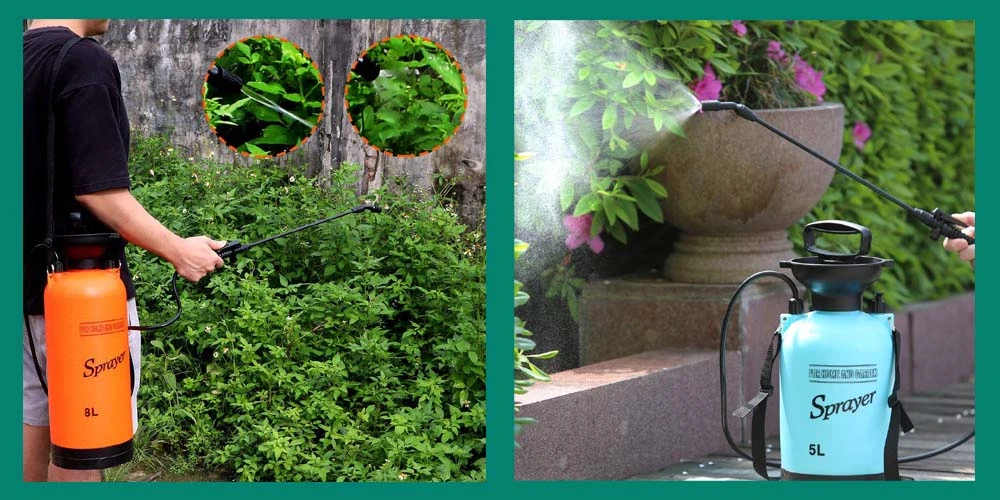
A pump sprayer is a handheld or backpack tool that pressurizes liquid inside a tank and delivers it through a nozzle as a spray. Common uses include applying herbicides and weed killers to lawns, spraying liquid fertilizers on plants and grass, treating insects and pests with insecticides, applying fungicides to garden plants, and distributing disinfectants or cleaning solutions on hard surfaces. The right sprayer depends on the chemical you're using and the area you need to cover.
The most common cause of pressure failure is a worn or dirty pump seal. Start by removing the pump assembly and inspecting the O-ring (the rubber seal around the pump shaft). If it's dried out or cracked, replace it — most hardware stores carry universal sprayer repair kits. Also check that the dip tube (the plastic tube that draws fluid from the bottom of the tank) is fully inserted and unobstructed. A clogged nozzle can also make it feel like pressure isn't building — remove and soak the nozzle tip in warm water to clear any mineral or chemical deposits.
No. Standard rubber-sealed pump sprayers will degrade rapidly when exposed to chlorine bleach. The rubber seals stiffen, crack, and fail within weeks of regular bleach use. You need a diaphragm pump sprayer with bleach-resistant seals — specifically a model rated for chlorine-based solutions, like the SOLO 475-B with its Tivilon diaphragm. Using the wrong sprayer with bleach not only destroys the equipment quickly but creates a safety hazard when degraded seals start leaking.
Always clean your sprayer immediately after each use — don't let chemicals dry inside the tank or nozzle. Fill the tank about one-quarter full with clean water, pump it up, and spray out through the nozzle to flush residue. For herbicide sprayers, run a diluted ammonia solution (1 tablespoon per gallon) through the system to neutralize chemical residue before the water rinse. Remove and rinse the nozzle tip and in-line filter separately. Leave the tank cap off to air dry completely before storing. Proper cleaning extends seal life significantly and prevents cross-contamination between different products.
A piston pump uses a cylinder and sliding piston to compress air and build pressure — it generates higher pressure (up to 90 PSI) but is sensitive to abrasive particles that scratch the cylinder walls over time. A diaphragm pump uses a flexible membrane that flexes back and forth to move fluid — it operates at lower pressure (typically 40–60 PSI) but handles wettable powders and bleach solutions without internal damage. For standard herbicides and fertilizers, a piston backpack offers better pressure range. For disinfectants, bleach, or powdered formulations, always choose a diaphragm model.
A quality pump sprayer properly maintained will last 3–7 years with regular home use, or 1–3 seasons under heavy professional use. The seals are the wear items — they degrade through chemical exposure and normal friction. Models with replaceable seals (like Chapin's modular design) extend the sprayer's life because you replace the part, not the whole unit. Viton seals last significantly longer than standard rubber under chemical exposure. The biggest killers of sprayer longevity are leaving chemicals in the tank between uses, using incompatible chemicals (like bleach in a standard rubber-sealed unit), and inadequate rinsing after use.
The right pump sprayer is out there for your exact situation — whether that's the budget-friendly Chapin 20004 for quick spot treatments, the professional-grade Field King Max for serious chemical applications, or the Husqvarna battery model for large-scale work without the manual effort. Start with your property size and the chemicals you plan to use, match those to the capacity and seal type that fits, and you'll land on the right choice. Head to Amazon, check the current prices, and pick the model that solves your specific problem this season.
 |
 |
 |
 |

About Christina Lopez
Christina Lopez grew up in the scenic city of Mountain View, California. For eighteen ascetic years, she refrained from eating meat until she discovered the exquisite delicacy of chicken thighs. Christina is a city finalist competitive pingpong player, an ocean diver, and an ex-pat in England and Japan. Currently, she is a computer science doctoral student. Christina writes late at night; most of her daytime is spent enchanting her magical herb garden.


Get new FREE Gifts. Or latest free growing e-books from our latest works.
Disable Ad block to reveal all the links. Once done, hit a button below
|
|
|
|
 rinjal