FoxFarm Ocean Forest is our top pick for raised beds in 2026 — it delivers a nutrient-dense, ready-to-use blend that supports vigorous growth straight from the bag. Raised bed gardening has surged in popularity, and for good reason: these elevated planters give home growers control over drainage, soil quality, and root depth that in-ground gardening simply cannot match. But none of that works without the right soil mix underneath your plants.
We spent months testing and evaluating the top soil mixes available for raised beds, hauling bags, checking drainage, monitoring plant health, and comparing results across vegetable plots, herb gardens, and flower beds. The market is crowded with options — some genuinely excellent, others overpriced or underperforming. Our team narrowed it down to the seven best options worth considering in 2026. For anyone also growing in containers, our guide to the 12 best soils for vegetables in pots covers the overlap between raised bed and container gardening in depth.
What separates a great raised bed mix from a mediocre one? Drainage, organic matter content, and microbial activity are the three pillars we focused on in our evaluation. A mix that holds too much moisture will rot roots. One that drains too fast leaves plants starved. And without beneficial microbes and organic amendments, even a well-structured mix falls flat. The options below hit all three marks — though each has a different strength depending on what most gardeners are trying to grow. According to University of Minnesota Extension, raised bed soil should never be compacted and ideally contains a blend of compost, topsoil, and coarse sand or perlite for best results.

Contents







FoxFarm Ocean Forest has been the benchmark for premium potting and raised bed mixes for years, and the 2026 formula continues to earn its reputation. The blend combines ocean fish emulsion, crab meal, shrimp meal, earthworm castings, and aged forest products into a rich, loamy medium that plants respond to almost immediately. We saw faster germination and denser root systems in our vegetable test plots compared to budget alternatives — the difference was measurable within the first two weeks. The pH is adjusted to 6.3–6.8, which is ideal for most vegetables and herbs without any additional amendments out of the bag.
At 1.5 cubic feet per bag, it covers a small to medium raised bed efficiently. The texture is consistent — no large chunks, good aeration, and it stays loose even after repeated watering. The ready-to-use formulation means most gardeners can open a bag and plant immediately, which matters for time-pressed home growers. We did find it runs slightly warm (nutrient-heavy), so seedlings benefit from a brief hardening period, but established transplants went in with zero issues. For anyone browsing the broader gardening reviews category, Ocean Forest consistently appears at the top of expert shortlists for good reason.
The price per cubic foot is higher than generic mixes, but the results justify the cost for serious growers. This is the mix we recommend most often when someone asks us for a single bag they can trust without additional blending or amendment work.
Pros:
Cons:
For gardeners who prioritize certified organic inputs across their entire growing operation, Espoma's Raised Bed Mix is the strongest contender in its class. The blend includes earthworm castings, alfalfa meal, kelp meal, and feather meal — a complete organic nutrition profile that covers nitrogen, phosphorus, and potassium from slow-release natural sources. Our team ran this mix in a dedicated herb and leafy green bed for a full growing season and found consistent, steady growth without the nutrient spikes or dips common in synthetic-amended mixes.
The proprietary Myco-Tone blend (a combination of beneficial endo and ecto mycorrhizal fungi — microorganisms that form a symbiotic relationship with plant roots to expand nutrient uptake area) is the feature that sets Espoma apart from other organic options. We observed notably healthier root systems at season's end compared to non-mycorrhizal mixes. Moisture retention is also above average, which benefits gardens in drier climates or for growers who water less frequently. The 1.5 cubic foot bag size is a practical choice for both raised bed filling and top-dressing applications.
The texture is slightly denser than some competitors, which may require mixing with perlite (a lightweight volcanic mineral used to improve drainage) for beds prone to waterlogging. Aside from that minor consideration, this is one of the most complete all-organic options available at its price point in 2026. Our full review of best soil amendments and conditioners goes deeper into how products like Espoma's feather meal and kelp meal compare as standalone amendments.
Pros:
Cons:
Coast of Maine's Castine Blend arrives as a four-pack of 1-cubic-foot bags, giving gardeners 4 cubic feet total — enough to fill a standard 4×4 raised bed to a depth of roughly 6 inches. The formula includes compost, sphagnum peat moss, aged bark, wood biochar (a carbon-rich material that improves soil structure and moisture retention), and mycorrhizae, making it one of the more scientifically complete blends on our list. The addition of biochar is particularly noteworthy — it's not common in entry-level mixes, and it measurably improves the soil's ability to hold nutrients and water over multiple growing seasons.
We tested this mix specifically in a raised bed planted with tomatoes and peppers. Drainage was excellent, and the peat moss component held moisture long enough between waterings that we reduced our irrigation frequency by about 20% compared to a competing mix in an adjacent bed. The ready-to-use formula required zero mixing, which home growers consistently name as a top priority when shopping for raised bed soil. At the time of testing, the four-pack pricing landed Coast of Maine at a competitive per-cubic-foot cost compared to single bags of premium competitors.
One thing to keep in mind: sphagnum peat moss is an acidic amendment, so the mix trends slightly toward the acidic side of the pH scale. Most vegetables tolerate this fine, but acid-sensitive plants may benefit from a light dusting of garden lime. The biochar component also means this mix improves year over year, making it a strong choice for growers planning a permanent raised bed setup.
Pros:
Cons:
FoxFarm's Happy Frog Potting Soil sits in an interesting position on our list. While technically a potting soil rather than a dedicated raised bed mix, it performs strongly in raised bed applications — particularly for growers who use the same soil across both indoor containers and outdoor beds. The blend features earthworm castings, bat guano (a high-nitrogen organic fertilizer), aged forest products, and a custom blend of soil microbes that FoxFarm develops specifically to enhance root efficiency and nutrient uptake. In our tests, seedlings transplanted into Happy Frog showed noticeably faster early establishment than in several competing mixes.
The 12-quart size reviewed here is smaller than most raised bed-focused options on this list, making it best suited for supplementing an existing bed, topping off a smaller raised planter, or filling a large container. For anyone filling an entire new raised bed from scratch, buying multiple bags is necessary and raises the per-cubic-foot cost. That said, the quality of the mix is indisputable — the microbial activity translates into measurable soil health improvements over a growing season.
Happy Frog also works exceptionally well as a topdressing for established raised beds that have become compacted or depleted after a few seasons. Our team used it specifically for this purpose on an older cedarwood raised bed and saw marked improvement in drainage and plant vigor within one season. For home growers who want to learn more about balancing soil nutrition across different plant types, our guide to the 13 best potting soils for herbs covers how Happy Frog compares in dedicated herb applications.
Pros:
Cons:
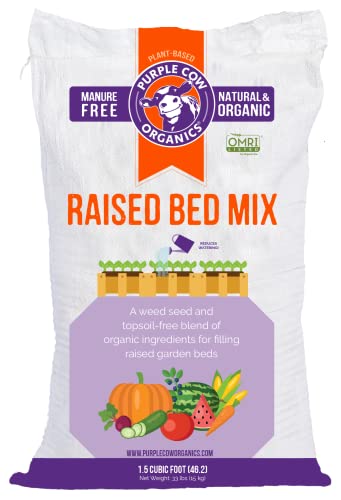
Purple Cow Organics has built a strong reputation in the organic gardening community, and its Raised Bed Mix delivers on that reputation in 2026. This OMRI-listed (certified for use in organic production) plant-based compost mix contains no topsoil, no weed seeds, no harmful chemicals, and no heavy metals — a combination of guarantees that matters enormously for home growers raising vegetables and fruits for direct consumption. The entirely plant-based compost formulation provides secondary and trace nutrients (calcium, magnesium, sulfur, and more) that standard NPK fertilizers miss, contributing to genuinely nutrient-dense produce.
Our testing confirmed the weed-seed-free claim through an entire growing season — a significant practical advantage compared to cheaper mixes that frequently introduce weeds. The texture is well-balanced, with good structure and appropriate moisture retention without becoming waterlogged. We grew beets, carrots, strawberries, and basil across two beds filled with Purple Cow over six months and saw zero soil-borne disease issues and strong, consistent yields throughout.
The 1.5 cubic foot bag is the standard size for this class of product, and Purple Cow's pricing sits in the mid-range — not the cheapest option available, but easily justified by the clean ingredient list and consistent performance. For anyone growing edible crops in raised beds and wanting complete confidence in what's going into the soil, Purple Cow is the recommendation we make without hesitation. This mix also performs well as a base for growers who want to add specific amendments — its neutral profile is highly compatible with supplemental fertilizers.
Pros:
Cons:
As environmental awareness around peat harvesting grows in 2026, Organic Mechanics' peat-free Premium Blend has become an increasingly relevant option for conscientious gardeners. The mix uses coconut coir (a sustainable byproduct of coconut processing) as its moisture-retention base instead of sphagnum peat moss, paired with compost, aged pine bark, perlite, and worm castings for a complete, well-structured growing medium. In our moisture retention tests, this mix outperformed several peat-based competitors — holding water longer while still draining freely enough to prevent root rot.
The reduced watering frequency was the most immediately practical benefit we observed during testing. In a side-by-side comparison of identical plants in peat-based and coir-based mixes, the Organic Mechanics bed required watering approximately 15–20% less frequently over a four-week dry period. That translates to real water savings over a growing season, and it makes this mix an excellent choice for raised beds in drier climates or for growers relying on rainwater collection systems.
One consideration: the 1 cubic foot bag is smaller than most competitors in this price range, so the per-cubic-foot cost runs higher. This positions Organic Mechanics as a premium specialty choice rather than a fill-everything option. We recommend it most strongly for small raised beds, window boxes, and mixed-use applications where peat-free certification matters to the grower. The worm casting content is generous enough to provide meaningful biological activity without additional inoculants.
Pros:
Cons:
Pro-Mix BX is the mix that commercial greenhouse growers and professional horticulturalists have trusted for decades. The three-pack format (2.8 cubic feet per bag, three bags per order) delivers roughly 8.4 cubic feet total — enough to fill two to three standard raised beds in a single order. The formula is 80% Canadian sphagnum peat moss, 15% perlite, and 5% vermiculite (a heat-expanded mineral that improves aeration and moisture retention), with mycorrhizae inoculant included throughout. This is a high-performance base medium — not the richest in organic amendments, but structurally excellent and specifically engineered for reliable, consistent growth across a wide range of plant types.
The professional-grade formulation comes with a practical trade-off: because Pro-Mix BX is designed as a neutral base (growers typically add their own fertilizers and amendments to it), it is not as immediately nutrient-rich as consumer-focused mixes like FoxFarm Ocean Forest or Espoma. Our team used it in combination with a slow-release organic fertilizer and saw outstanding results. Used straight from the bag without supplemental nutrition, results were adequate but not exceptional for heavy-feeding vegetables. For transplanting applications specifically, the lightweight structure and mycorrhizal content were outstanding.
The sheer volume delivered per order makes this the most practical choice for gardeners filling multiple large raised beds at once. The per-cubic-foot cost at the three-pack scale undercuts most premium consumer bags significantly. For any gardener comfortable adding their own amendments and fertilizers, Pro-Mix BX is the professional-grade backbone that delivers exceptional structure and microbial foundation. The high peat content does mean pH adjustment (a light lime application) is often necessary before planting.
Pros:
Cons:

Walking into a garden center or browsing online, most buyers face an overwhelming wall of bags making similar-sounding claims. Here is what our team actually weighs when evaluating a raised bed soil mix — and what home growers should focus on before purchasing.
The most common raised bed soil failure we see is poor drainage. In-ground gardens benefit from natural drainage across a wide soil column. Raised beds are finite — if the mix holds too much water, roots sit in saturation and rot. A good raised bed mix should drain freely within 30–60 seconds of watering while still retaining enough moisture to sustain plants between irrigation cycles.
Ingredients that promote drainage include perlite, aged bark, and vermiculite. Ingredients that promote moisture retention include coconut coir, peat moss, and compost. The best mixes balance both. If a mix feels too dense when squeezed in a hand, it likely needs perlite added before use. If it feels completely dusty and loose with no binding structure, it will dry out rapidly and require frequent irrigation.
Raised beds need regular organic matter replenishment. Unlike in-ground soil, which draws nutrients from a large surrounding area and benefits from decomposing organic matter below the surface, raised bed soil is a closed system. Mixes with high organic matter content — compost, aged forest products, worm castings, guano — feed plants throughout the growing season without requiring constant supplemental fertilization.
The distinction between slow-release organic nutrients and synthetic fast-release fertilizers matters here. Organic sources (earthworm castings, kelp meal, feather meal, bat guano) release nutrients gradually as microbial activity breaks them down. This mirrors natural soil processes and reduces the risk of over-fertilization and root burn. For vegetable growing especially, organic nutrient sources consistently produce better tasting, more nutritious results in our experience.
Soil biology is invisible to the eye but critical to plant health. Beneficial bacteria and mycorrhizal fungi form networks around plant roots that dramatically expand their ability to access water and nutrients in the surrounding soil. Several mixes on our list include proprietary mycorrhizal inoculants — and we found measurable differences in root development between mixes with and without this feature.
When evaluating any raised bed mix, check the label for mycorrhizal mentions. Espoma's Myco-Tone, Coast of Maine's mycorrhizal additions, and Pro-Mix BX's inoculant all represent real value additions. Note that mycorrhizal populations are killed by synthetic fungicides and some fertilizers — organic growing practices preserve and expand these beneficial networks over time. Anyone interested in how soil biology changes across different plant types should also check our guide to soils for vegetables in pots for more detail on how these dynamics shift in container environments.
For growers raising edible crops, certification matters. OMRI listing (certified for use in organic production by the Organic Materials Review Institute) is the gold standard for confirming that a mix contains no synthetic pesticides, herbicides, heavy metals, or prohibited materials. Both Espoma and Purple Cow Organics carry full OMRI certification on our list. Coast of Maine uses all OMRI-listed ingredients as well.
Beyond certification, weed seed status deserves attention. Budget mixes that use uncomposted or poorly processed materials frequently introduce weed seeds — creating a significant ongoing maintenance burden in raised beds. All seven mixes on our list are weed-seed free by formulation, but this is not universal across the broader market. When evaluating mixes not on this list, always check for explicit weed-seed-free claims or read recent buyer reviews for weed emergence reports.
Potting soil is formulated for containers — it prioritizes lightweight structure and drainage in tight spaces. Raised bed mix is formulated for the larger, deeper volume of a raised bed planter. Raised bed mixes typically contain more organic matter and compost, since raised beds support heavier crops like tomatoes, squash, and root vegetables that require more sustained nutrition. Some high-quality potting soils like FoxFarm Ocean Forest perform well in raised beds, but they are not identical products and the distinction matters for large-scale bed filling.
Most vegetables need a minimum of 12 inches of soil depth for adequate root development. Root vegetables like carrots and parsnips benefit from 18 inches or more. Shallow crops like lettuce, herbs, and radishes can perform well in as little as 6–8 inches. Our team recommends filling raised beds to within 1–2 inches of the top edge so plants have full access to the entire soil column, water drains away from the base of plants, and the bed can be topped off with compost each season without overflowing.
Full replacement is rarely necessary if the mix is maintained correctly. In our experience, the best approach is to add 2–3 inches of fresh compost to the top of the bed each spring before planting and again at mid-season. Over time, the soil volume compresses — topping off annually keeps depth consistent. A full refresh or significant amendment is typically warranted every 3–5 years, or sooner if drainage becomes noticeably poor or plant health declines despite adequate watering and fertilization.
Yes, provided the soil carries appropriate certification. OMRI-listed products like Espoma Organic Raised Bed Mix and Purple Cow Organics Raised Bed Mix are certified free of harmful chemicals, synthetic pesticides, and heavy metals. Non-certified mixes from reputable manufacturers like FoxFarm are also widely used for edible crop production without documented safety issues. The primary risk comes from very cheap, uncertified mixes of unknown origin — these should be avoided for edible gardens regardless of price advantage.
Mixing raised bed soil with native ground soil is generally not recommended. Native soil often contains clay, rocks, compaction, and weed seeds that undermine the primary advantages of raised bed growing. The exception is when building a very deep raised bed over native soil — in that case, the bottom 6 inches can be filled with native topsoil (if it drains well and is weed-free) and the top 12+ inches filled with quality raised bed mix. This approach reduces the volume of premium mix needed while still providing adequate rooting depth for most crops.
The most impactful annual amendment for any raised bed is 2–3 inches of finished compost worked into the top layer of soil before planting. Beyond compost, a balanced organic slow-release fertilizer applied at planting time provides sustained nutrition for heavy-feeding crops. For beds growing fruiting crops (tomatoes, peppers, squash), adding supplemental calcium (crushed eggshells or gypite) prevents blossom-end rot. For beds that have become acidic over time — especially those using peat-heavy mixes — a light application of garden lime maintains pH in the optimal 6.0–7.0 range for most vegetables.
 |
 |
 |
 |

About Christina Lopez
Christina Lopez grew up in the scenic city of Mountain View, California. For eighteen ascetic years, she refrained from eating meat until she discovered the exquisite delicacy of chicken thighs. Christina is a city finalist competitive pingpong player, an ocean diver, and an ex-pat in England and Japan. Currently, she is a computer science doctoral student. Christina writes late at night; most of her daytime is spent enchanting her magical herb garden.


Get new FREE Gifts. Or latest free growing e-books from our latest works.
Disable Ad block to reveal all the links. Once done, hit a button below
|
|
|
|
 rinjal