You're standing in the lawn care aisle — or scrolling through Amazon at midnight — staring at a wall of fertilizer bags with NPK ratios that might as well be written in code. Bermuda grass has specific nutritional demands, and picking the wrong product means burned turf, wasted money, or a lawn that stays thin and pale all season. Getting this right in 2026 comes down to understanding what Bermuda actually needs and matching that to the right formula.
Bermuda grass is a warm-season turf that thrives on nitrogen. It goes dormant in cool months and explodes with growth from late spring through early fall. During that active window, it demands consistent feeding — particularly with nitrogen-forward fertilizers that support dense lateral spread and deep green color. The challenge is balancing quick green-up with sustained feeding so you're not applying every two weeks just to keep up.
Below you'll find detailed reviews of the top fertilizers for Bermuda grass tested across different lawn conditions, plus a buying guide to help you decide between granular and liquid, synthetic and organic, and slow-release versus quick-release formulations. Whether you're feeding a quarter-acre residential lawn or a sprawling Bermuda turf in the Deep South, there's a pick here for your situation. You can also browse our full gardening reviews section for more lawn care recommendations.
Contents
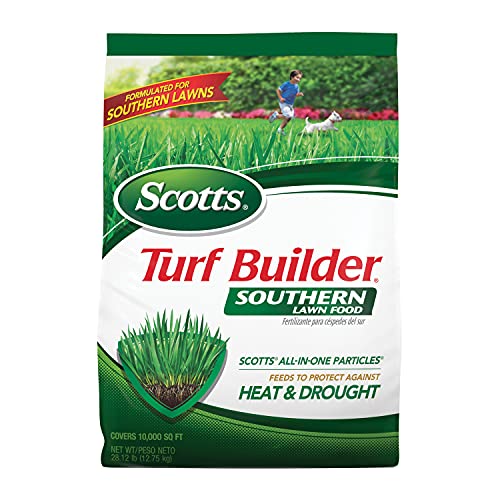






If you've got a Bermuda grass lawn in the South, Scotts Southern Turf Builder is the obvious starting point. This granular formula is purpose-built for warm-season Southern turf, and that specificity shows in real-world results. The proprietary All-in-One Particles technology ensures you're not getting hot spots or streaks — each particle contains a balanced mix of nutrients so distribution is uniform even when your spreader technique isn't perfect. That matters a lot in late spring when Bermuda breaks dormancy and you need consistent feeding across the entire lawn, not just where you happened to walk twice.
What separates this from generic lawn food is the heat and drought protection component. Southern summers are brutal, and Bermuda — while heat-tolerant — still suffers when soil moisture is inconsistent. Scotts addresses this by improving the lawn's water and nutrient absorption capacity versus unfed turf. In practice, this means your Bermuda recovers faster after a dry stretch and maintains density through the hottest part of the season. One 10,000 sq. ft. bag is a solid value for mid-size residential properties, and the results at week three are reliably impressive — darker color, tighter blade density, and noticeably better fill-in on thin spots.
The formula is not organic and does contain synthetic nitrogen, so you'll want to water it in well after application to prevent any risk of burn on dry turf. Follow the label timing — don't apply during a drought without irrigation. For most homeowners with standard Bermuda lawns, this is the product that delivers the most predictable, visible improvement.
Pros:
Cons:
The Andersons PGF 16-0-8 is what serious lawn enthusiasts reach for when they've graduated beyond the big-box basics. This is a professional-grade granular formula that comes in a 40 lb. bag covering 10,000 sq. ft., and it brings two standout features that justify its price point: phosphorus-free formulation and Humic DG technology. The phosphorus-free ratio is intentional — Bermuda grass in established lawns rarely needs supplemental phosphorus, and eliminating it reduces runoff risk and keeps your nutrient program lean. The 16-0-8 ratio delivers meaningful nitrogen alongside potassium for root strength and stress tolerance.
Humic DG granules are the real differentiator here. Humic acid improves soil biology, increases cation exchange capacity, and helps nitrogen bind more efficiently so less is lost to leaching. In sandy Southern soils where Bermuda is common, this is genuinely valuable. You'll see the difference in the quality of root development and the lawn's ability to stay green between feeding cycles. The super-fine particle distribution — twice the particles per square foot compared to standard granular products — means exceptional coverage uniformity, which eliminates the patchiness that plagues coarser formulas.
The quick- and slow-release nitrogen blend provides an immediate green-up within days while feeding extends up to eight weeks. For Bermuda growers who want to reduce their application frequency without sacrificing results, that extended feeding window is a genuine advantage. This is the fertilizer you choose when you're treating your lawn like a project, not just a chore.
Pros:
Cons:
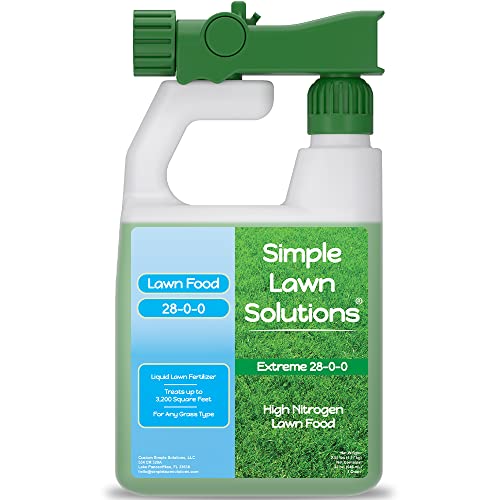
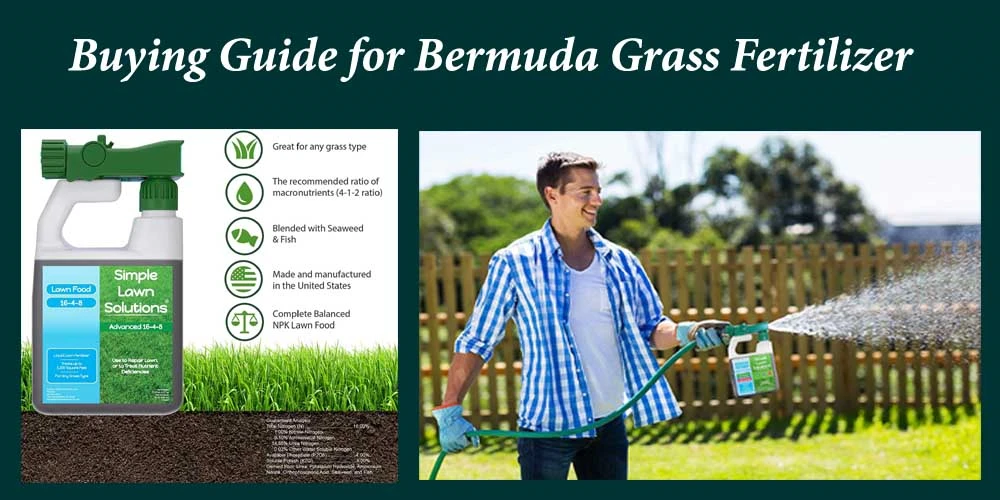
When you need your Bermuda lawn to green up fast — before a backyard event, after a rough winter, or at the start of the growing season — a high-nitrogen liquid like this 28-0-0 from Simple Lawn Solutions is exactly what you reach for. The 28% nitrogen concentration is among the highest available in consumer liquid fertilizers, and the 70/30 quick-release to slow-release ratio hits the sweet spot between immediate visible results and sustained feeding. You'll see color improvement within 48–72 hours on active Bermuda turf. That's not an exaggeration — it's a consistent observation across warm-season lawns.
The attached hose-end sprayer makes application genuinely simple. Hook it to your hose, set the pattern, and walk at a steady pace — the product meters automatically for proper dilution. Coverage is up to 3,200 sq. ft. per 32 oz. bottle, which makes this a fit for small to mid-size lawns or targeted spot treatments on larger properties. The liquid format also means the nitrogen is immediately plant-available, bypassing the wait-for-rain-to-activate step that granular products require. On Bermuda that's actively growing, you'll notice the response within a week.
The 28-0-0 ratio contains no phosphorus or potassium, so this isn't a complete fertilizer in the traditional sense. Use it as a nitrogen boost between balanced feedings, not as your only fertilizer source. For Bermuda grass specifically — which is already a nitrogen-hungry species — this as a primary warm-season driver paired with a potassium source works well. Apply during spring green-up or when summer color starts to fade.
Pros:
Cons:
Lesco is a brand that lawn care professionals have trusted for decades, and the 16-4-8 formula is a staple in the industry for good reason. This 50 lb. bag is the kind of product that gets passed along in word-of-mouth recommendations from one serious lawn grower to another. The 3% iron inclusion is what makes this formula exceptional for Bermuda grass color. Iron doesn't feed the grass the same way nitrogen does, but it drives a deep, almost blue-green color response that synthetic nitrogen alone can't replicate. If your Bermuda looks yellow-green even after feeding, iron deficiency is often the culprit — and Lesco's formula addresses that directly.
The 25% slow-release nitrogen formulation provides a controlled feeding curve that's particularly useful on Bermuda in high-heat conditions. Rapid nitrogen release during summer can cause burst growth followed by stress — the slow-release component smooths that out. The 16-4-8 ratio is genuinely complete for most established Bermuda lawns: enough nitrogen for growth, phosphorus for root support on newer turf installations, and potassium for heat and drought resilience. For lawns that need the full package, this one delivers.
At 50 lbs., this is designed for larger properties and professional use, though serious homeowners with quarter-acre or larger Bermuda lawns will get through it in a season. If you're pairing this with a quality broadcast spreader — and you should, because Lesco granules are heavy and uniform — you'll achieve the kind of results that make the neighbors ask what you're doing differently. Worth reading our best broadcast spreader guide if you need an upgrade before applying this.
Pros:
Cons:
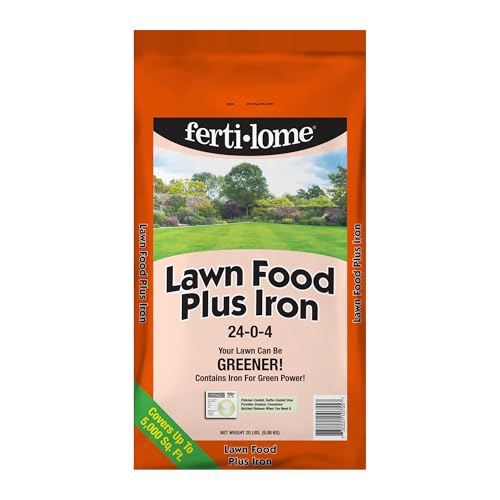
Ferti-Lome's 24-0-4 formula with added iron hits a specific performance target: fast, visible greening at a price that doesn't make you wince. The 24% nitrogen concentration puts this in high-output territory for granular fertilizers, and the iron supplement delivers that color intensity that basic lawn foods miss entirely. This is the formula you use when you want to see results within the first week without spending professional-grade money. For Bermuda lawns coming out of dormancy or recovering from stress, the quick-response nitrogen combined with iron creates a dramatic before-and-after that 6-4-0 organic formulas simply can't match in speed.
At 20 lbs. covering 5,000 sq. ft., the bag size is practical for most suburban residential lots. The granules dissolve readily after watering, and unlike some iron-supplemented products, Ferti-Lome's formulation applies without the heavy metallic odor that plagues lower-quality alternatives. Application with a standard broadcast or drop spreader is straightforward — the granules flow evenly without bridging or clumping. The 24-0-4 ratio is a solid match for Bermuda's feeding profile during the growing season: high nitrogen for growth, minimal phosphorus (appropriate for established turf), and a useful potassium contribution for cell wall strength.
One practical note: this is a quick-action formula, meaning the nitrogen is not predominantly slow-release. You'll get fast greening and fast growth, which means you also need to stay on your mowing schedule. If you're heading into a week where mowing won't happen, delay application by a few days. For aggressive Bermuda growers who want density and color without waiting, this is a best-in-class value pick.
Pros:
Cons:
Milorganite has been feeding lawns since 1926, and its formulation logic is fundamentally different from every synthetic product on this list. As a biosolid-based fertilizer, it feeds soil biology first and grass second — and on Bermuda grass, that translates to a deep, sustained green that holds up remarkably well between applications. The 6-4-0 NPK ratio looks weak on paper compared to the 24s and 28s elsewhere on this list, but Milorganite's nitrogen doesn't move through the system the same way. It's organically complexed, meaning it releases slowly as soil microbes break it down. There's no burn risk, no salt accumulation, and no risk of streaking — ever.
The iron in Milorganite is also organically complexed, which means it greens without staining concrete. That's a genuine practical advantage if your Bermuda borders a driveway, patio, or sidewalk — something iron-salt synthetic fertilizers can't claim. The 32 lb. bag is the right size for a standard residential lawn, and the slow-release behavior means you're feeding for 8–10 weeks per application rather than 4–6. Over a full season, the total number of applications is comparable to faster synthetic products, but the risk profile is far lower.
If you have kids and pets using the lawn regularly, Milorganite is the answer. Safe to re-enter immediately after application, no chemical smell that lingers, no need to water in aggressively to prevent burn. The trade-off is speed — Bermuda won't turn noticeably greener in three days on Milorganite. The green-up takes 10–14 days and builds gradually. For patient lawn care with a long-term soil health focus, no product on this list beats it. This pairs well with organic soil amendments — you can read more about soil enrichment options in our best bagged compost reviews.
Pros:
Cons:
Espoma's All Season Lawn Food takes the organic approach one step further than Milorganite by incorporating the brand's exclusive Bio-tone formula — a proprietary blend of beneficial microorganisms designed to establish and enhance soil microbial communities. For Bermuda grass, which benefits enormously from healthy soil biology for efficient nutrient uptake, this is more than a marketing claim. Lawns fed with Espoma over multiple seasons consistently show improved root depth, better moisture retention, and stronger recovery from summer stress compared to those maintained on synthetic-only programs. The Bio-tone microbe package actively improves soil structure while the fertilizer feeds the turf.
This pack of two bags is excellent value — you get enough product to cover a meaningful lawn area across multiple applications in the same season. The formulation won't burn lawns regardless of conditions, it won't leach out of sandy Southern soils as aggressively as synthetic nitrogen, and it's completely safe for children and pets. For Bermuda growers who prioritize environmental responsibility and long-term soil health over quick chemical fixes, Espoma is the logical choice. The slow-release nature means you're also less likely to contribute to nutrient runoff — a real consideration in areas with local water quality regulations.
The performance gap compared to high-nitrogen synthetics is real — if your Bermuda needs a fast recovery from dormancy or visible green-up within a week, this isn't your tool. But as part of a balanced seasonal program, or as a standalone option for lawns that are already in good condition and just need maintenance feeding, Espoma delivers reliable, sustainable results. Consider pairing it with a drip irrigation setup for consistent soil moisture — our guide on drip irrigation methods and benefits covers the fundamentals if you're new to irrigation efficiency. According to the EPA, choosing slow-release and organic fertilizers is one of the most effective ways to reduce nitrogen runoff into waterways.
Pros:
Cons:
Bermuda grass is a nitrogen-dominant feeder. When you look at fertilizer labels, the three numbers represent nitrogen (N), phosphorus (P), and potassium (K) respectively. For established Bermuda lawns, you typically want a high first number (nitrogen) and a low middle number (phosphorus), since phosphorus builds up in soil over time and excess creates runoff problems. The third number — potassium — supports root strength, heat tolerance, and disease resistance, so you want meaningful K content especially heading into summer. A ratio like 16-0-8, 24-0-4, or 28-0-0 fits Bermuda's profile well. For new sod installations where root establishment is the priority, a small amount of phosphorus (like the 16-4-8 in Lesco's formula) provides early support.
Don't fall into the trap of thinking more nitrogen is always better. Bermuda grows aggressively — over-fertilization creates thatch, increases mowing frequency, and can weaken the turf's stress tolerance. In 2026, most soil scientists recommend following a soil test rather than guessing. Soil tests cost less than a bag of fertilizer and tell you exactly what your lawn needs rather than what the label assumes.
This is the single most important decision after NPK ratio. Quick-release nitrogen (water-soluble urea) delivers fast visible results — your Bermuda will green up within days — but it's gone from the root zone in 2–4 weeks, requiring more frequent applications. It also carries a higher burn risk if over-applied or applied to dry turf. Slow-release nitrogen (polymer-coated, sulfur-coated, or organically bound) releases over 6–10 weeks, reduces burn risk significantly, and evens out growth so you're not mowing every three days. Most professional formulas blend both — quick-release for immediate results, slow-release for sustained feeding. Products with 25–50% slow-release content hit the ideal balance for residential Bermuda lawns.
Both forms work effectively on Bermuda grass, but they suit different situations. Granular fertilizers are easier to store, apply over large areas with a broadcast spreader, and typically offer better slow-release options. Liquid fertilizers act faster since the nutrients are already in solution and immediately available to roots. They're excellent for spot treatments, quick green-up situations, and smaller lawns where a hose-end sprayer makes more sense than hauling a spreader around. If your primary goal is convenience and fast results on a modest-sized lawn, liquid wins. For seasonal maintenance feeding on larger properties, granular is more economical and requires fewer trips across the yard. If you need a reliable spreader for granular products, our broadcast spreader buying guide covers the top options for 2026.
Neither is universally better — they serve different goals. Synthetic fertilizers deliver more nitrogen per pound, act faster, and cost less per square foot covered. Organic fertilizers improve soil biology over time, reduce burn risk to zero, and contribute to long-term lawn health in ways that synthetic programs don't. Many experienced Bermuda growers use a hybrid approach: synthetic nitrogen in the active growing season for performance, organic amendments in early spring and fall to improve soil structure. If you're managing a lawn with clay soil compaction issues, organic inputs that feed microbial communities will deliver better long-term results than a pure synthetic program. If you're starting from thin or stressed Bermuda that needs rapid recovery, synthetic nitrogen is the practical choice for that phase.
For established Bermuda grass, look for a high nitrogen, low phosphorus ratio such as 16-0-8, 24-0-4, or 28-0-0. Bermuda is a heavy nitrogen feeder during its active growing season from late spring through early fall. Phosphorus builds up in most soils and is rarely deficient in established lawns — eliminating it from your fertilizer reduces runoff risk. Potassium (the third number) supports root health, heat tolerance, and disease resistance, so a meaningful K content like 4 or 8 is beneficial.
Begin fertilizing Bermuda grass after it fully breaks dormancy and soil temperatures reach 65°F consistently — typically late April to mid-May in most Southern regions. Continue on a 4–6 week schedule through the peak growing season. Stop fertilizing 6–8 weeks before your expected first frost date to avoid pushing tender growth that can't harden off before cold arrives. In 2026, with warmer-than-average late springs in many Southern states, many growers started their first application in mid-April.
Yes, and the consequences are significant. Over-fertilization with nitrogen causes excessive top growth at the expense of root depth, accelerates thatch buildup, and increases the lawn's susceptibility to fungal diseases. It also creates a cycle of dependency — the grass becomes reliant on high inputs to maintain color rather than developing robust root systems. Follow label rates, conduct a soil test before your first application of the season, and resist the temptation to apply more frequently than recommended just because the lawn looks good.
For granular synthetic fertilizers, watering in after application is essential. The granules need to dissolve and move into the root zone where Bermuda can access the nutrients. Without irrigation or rainfall within 24–48 hours, granular fertilizer sitting on dry turf can cause burn, particularly with high-nitrogen formulas. Liquid fertilizers are already in solution, so watering-in timing is more flexible — though light irrigation after application still aids uptake. Organic granular products like Milorganite and Espoma are far more forgiving and won't burn even if watering is delayed.
Milorganite is an excellent choice for Bermuda grass, particularly for homeowners who prioritize safety, soil health, and environmental responsibility over rapid green-up. Its organically complexed iron provides deep color without staining, and the slow-release nitrogen feeds consistently over 8–10 weeks. The trade-off is speed — Milorganite won't produce the same dramatic 3-day color change that a 28-0-0 liquid delivers. Use it as your primary maintenance fertilizer during the growing season, or pair it with a higher-nitrogen product early in the season for faster establishment.
The core difference is the NPK ratio and the nitrogen release profile. Bermuda grass-specific formulas — like Scotts Southern Turf Builder — are optimized for warm-season Southern turf, with higher nitrogen concentrations, lower phosphorus, and heat-stress management components. General all-purpose lawn fertilizers may include higher phosphorus ratios suited for cool-season grasses or overseeded lawns. Using a cool-season formula on Bermuda isn't catastrophic, but you're paying for nutrients your turf doesn't need while potentially under-delivering on the nitrogen that drives Bermuda's growth and color. Also, be cautious about weed killers in combo products — some are formulated for cool-season turf and can damage Bermuda.
 |
 |
 |
 |

About Truman Perkins
Truman Perkins is a Detroit-based SEO consultant who's been in the business for over a decade. He got his start helping friends and clients get their websites off the ground, and he continues to do so today. In his free time, Truman enjoys learning and writing about gardening - something he believes is a natural stress reliever. He lives with his wife, Jenny, and their twins in Detroit.


Get new FREE Gifts. Or latest free growing e-books from our latest works.
Disable Ad block to reveal all the links. Once done, hit a button below
|
|
|
|
 rinjal