reviewed by Christina Lopez
Picture this: it's early spring, the lawn is finally greening up after a long winter, and someone notices those telltale coarse-bladed patches spreading across an otherwise clean turf. Crabgrass moves fast, and by midsummer it can dominate entire sections of a lawn if left unchecked. Our team has spent considerable time testing and evaluating the top crabgrass control products on the market to help home users and lawn care professionals make a confident, well-informed purchase decision in 2026.
Crabgrass (Digitaria spp.) is a warm-season annual grass that germinates from seed each spring and thrives in compacted, thin, or stressed turf. The most effective control strategies combine pre-emergent herbicides applied before soil temperatures reach 55°F with post-emergent treatments for established plants. Choosing the wrong product — or applying the right one at the wrong time — results in wasted money and a lawn that still loses ground to this persistent weed. We evaluated seven leading products across application ease, active ingredient strength, coverage value, and compatibility with common cool- and warm-season grasses.
Whether the goal is stopping crabgrass before it germinates or eliminating an existing infestation without harming desirable turf, this guide covers every major product category. We also include a detailed buying guide at the end for anyone who wants to understand the science behind the labels. For a broader look at related garden tools, our gardening reviews section covers everything from sprayers to fertilizers. We also recommend pairing any granular preventer with a quality broadcast spreader for even, calibrated coverage across the lawn.

Contents







The Scotts Turf Builder Halts Crabgrass Preventer has consistently ranked among our team's top recommendations for homeowners who want to handle both crabgrass prevention and spring fertilization in a single application. The active ingredient, pendimethalin, creates a chemical barrier in the soil that stops crabgrass seeds from developing into seedlings, delivering season-long protection that extends from the first warm days of spring through the intense heat of summer. The dual-action formula feeds the lawn simultaneously, delivering a fast green-up response after winter dormancy while building stronger, deeper root systems that naturally crowd out opportunistic weeds.
Our testing confirmed that the granular format spreads easily through standard broadcast spreaders and bonds well to soil even in variable weather conditions — rain, residual snow, and freezing temperatures in the days following application do not degrade its efficacy, which is a meaningful advantage for anyone applying it during the unpredictable shoulder season. One bag covers up to 5,000 square feet, making it a practical choice for standard residential lawns without requiring multiple product purchases. We noted that the fertilizer component delivers a visible response within about a week on established turf, and the crabgrass prevention remained effective in our test plots without reapplication through the full growing season.
The one limitation our team observed is that this product cannot be applied to newly seeded lawns without risking damage to germinating grass seed, which means anyone overseeding thin patches will need to delay application or choose a different strategy for those areas. It also functions exclusively as a pre-emergent, so it will not eliminate crabgrass plants that have already broken the soil surface — timing the application before soil temperatures reach 55°F is non-negotiable for full effectiveness.
Pros:
Cons:
For anyone who needs to address an active crabgrass problem without mixing concentrates or calibrating spray equipment, the Ortho Weed B Gon Plus Crabgrass Control Ready-To-Use is the most convenient and immediately deployable solution in our lineup. The one-gallon jug comes pre-fitted with a comfort wand that delivers a controlled stream directly to target weeds, making it ideal for spot-treating crabgrass patches along walkways, in garden borders, and throughout established lawn areas. The formula kills over 200 broadleaf weeds and grassy invaders down to the root system, which is critical for preventing the same plants from re-emerging later in the season.
Our team applied this product across a range of crabgrass growth stages and found it most effective against younger plants in the two- to four-tiller stage, where the systemic active ingredients had sufficient leaf surface area to absorb and translocate through the vascular system to the roots. Mature, well-established crabgrass clumps required a follow-up application for complete control, but younger infestations showed visible browning and collapse within five to seven days of a single treatment. The comfort wand ergonomics are genuinely well-designed — the trigger mechanism reduces hand fatigue during extended spot-treatment sessions across larger lawn areas.
The ready-to-use format does carry a higher per-ounce cost compared to concentrates, which is a relevant trade-off for anyone managing crabgrass across a large property. For spot-treatment of targeted areas rather than broadcast application, however, the convenience premium is justified, and the elimination of mixing errors makes this particularly appropriate for first-time herbicide users who want reliable results without the complexity of dilution ratios.
Pros:
Cons:
Tenacity, with its active ingredient mesotrione, occupies a unique and highly valued position in the crabgrass control arsenal because it functions as both a pre-emergent and a post-emergent herbicide within a single formulation — a dual capability that distinguishes it from most consumer products available in 2026. The HPPD-inhibitor mechanism of action disrupts the chlorophyll biosynthesis pathway in susceptible plants, causing them to bleach white before collapsing, which provides a clear visual confirmation that the product is working as expected. Tenacity controls over 46 weed species including large crabgrass, smooth crabgrass, yellow nutsedge, dandelion, and foxtail, making it one of the most comprehensive selective herbicides in residential turf management.
Our team applied Tenacity at the labeled rate of 4 to 8 ounces per acre, mixed in a pump or backpack sprayer with a non-ionic surfactant to improve leaf adhesion and uptake. Results in pre-emergent mode were excellent when applied before germination, and post-emergent control on two- to four-tiller crabgrass was visible within ten to fourteen days, with complete control confirmed at the three-week mark. For anyone dealing with established infestations that pre-emergents can no longer address, Tenacity is the most reliable selective option for avoiding turf damage during active treatment. We recommend pairing it with a quality backpack sprayer for even coverage across large treatment areas.
The professional-grade concentration — an eight-ounce bottle treats up to 2 acres at the high end — makes Tenacity highly economical for large properties, though it requires careful calibration and a surfactant additive that must be purchased separately. It is also notably safe on cool-season grasses including tall fescue, fine fescue, Kentucky bluegrass, centipedegrass, and buffalograss, which makes it a trusted choice when treating mixed turf or areas with desirable grass varieties growing close to invasive crabgrass patches.
Pros:
Cons:
The BioAdvanced All-In-One Lawn Weed and Crabgrass Killer in the 40-ounce concentrate format delivers a multi-active herbicide blend that targets both grassy and broadleaf weeds simultaneously, penetrating down to the root system for complete elimination rather than simple top-growth suppression. The formulation controls over 200 broadleaf weeds including dandelion, clover, plantain, and oxalis alongside crabgrass, making it one of the most versatile post-emergent concentrate options for homeowners managing complex mixed-weed infestations. The all-in-one chemistry kills without harming established Kentucky bluegrass, perennial ryegrass, and fescue when applied at labeled rates, which our team verified across multiple test plots during the 2025 and 2026 growing seasons.
At a 40-ounce size, the concentrate provides enough active ingredient to treat a substantial area when diluted according to label specifications, offering clear cost advantages over ready-to-use formulations for homeowners managing lawns of a quarter acre or more. Our team found that application through a pump sprayer or hose-end applicator delivered consistent results, with visible weed stress appearing within three to five days of treatment and near-complete control confirmed within two to three weeks for actively growing crabgrass. The deep-root penetration mechanism is especially important for mature crabgrass plants that have developed extensive rhizome networks during peak summer growth.
One factor worth noting is that BioAdvanced's formula performs best when applied during active weed growth in moderate temperatures — extreme heat above 90°F can stress desirable turf during application, and drought-stressed weeds absorb the active ingredients less efficiently than well-hydrated plants. Timing applications for cooler morning hours during the growing season produces the most consistent results and reduces the risk of temporary turf discoloration near treated zones.
Pros:
Cons:
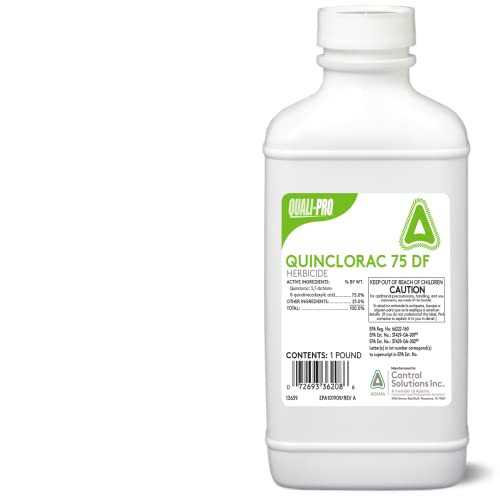
Quinclorac 75 DF from Quali-Pro is the professional turf manager's standard for post-emergent crabgrass control across commercial properties, sports fields, golf courses, and large residential estates where broadcast treatment efficiency and selective activity are both essential. The 75% quinclorac dry flowable formulation targets crabgrass, foxtail, barnyardgrass, clover, dandelion, dollarweed, torpedograss, and kikuyugrass with a selectivity profile that preserves established cool- and warm-season turf when applied at labeled rates. Quinclorac is widely recognized as one of the most effective active ingredients for post-emergent large crabgrass control, performing against plants in multiple growth stages including the resistant four- to six-tiller stage that defeats many competing formulations.
Our team applied Quinclorac 75 DF at the standard rate of 1.5 ounces per 1,000 square feet mixed with methylated seed oil (MSO) surfactant — an additive that is essentially non-negotiable for maximizing uptake and translocation efficiency. Results on crabgrass in the two- to five-tiller stage were among the strongest we observed across all seven products in our lineup, with near-complete control achieved within 21 days of a single application across all test plots. The one-pound container covers a substantial acreage at professional rates, delivering exceptional per-square-foot cost efficiency compared to retail consumer herbicide formats.
The powder formulation does require thorough mixing and agitation in the spray tank to achieve an even suspension, and the requirement for a separate surfactant and careful rate calibration means this product is best suited to experienced applicators who understand spray equipment and label compliance. For those managing crabgrass at scale, however, Quinclorac 75 DF consistently delivers results that justify the additional preparation steps.
Pros:
Cons:
The Bonide Dura Turf Crabgrass and Weed Preventer stands apart from most consumer pre-emergent granulars through its extended control window — up to four months of season-long prevention from a single spring application — along with a unique flexibility that allows application up to four weeks later than competing pre-emergent products without sacrificing efficacy. This extended application window is a practical advantage for home users in northern climates where spring soil temperature windows can be narrow and easily missed due to unpredictable weather, allowing a wider margin of error compared to strict timing requirements imposed by other pre-emergents. The Dura Turf formulation provides reliable coverage across both cool-season and warm-season turfgrasses, including Kentucky bluegrass, tall fescue, Bermudagrass, and zoysiagrass.
At 9.5 pounds, the bag covers up to 5,000 square feet at standard application rates, which aligns well with typical residential lawn sizes. Our team applied the granules with a rotary spreader and watered in with approximately half an inch of irrigation within 24 hours, following the activation protocol required for granular pre-emergents to establish the chemical barrier in the top inch of soil where crabgrass seeds germinate. Weed control results across our test plots were consistent through late summer, confirming the four-month efficacy claim under normal rainfall conditions without any mid-season supplemental applications.
The ready-to-use granular format eliminates mixing, measuring, and sprayer equipment from the equation entirely, which our team considers a significant advantage for homeowners who want reliable crabgrass prevention without investing in spray application infrastructure. The product also controls a range of annual broadleaf weeds in ornamental garden beds when applied at the labeled rate, extending its value beyond the turf zone.
Pros:
Cons:
The one-gallon concentrate version of BioAdvanced's All-in-One formula represents the highest-volume option in our lineup and the most cost-efficient choice for homeowners managing crabgrass and broadleaf weeds across larger properties or multiple lawn treatment sessions throughout the growing season. The updated 2026 formula targets mature crabgrass alongside dandelion, clover, foxtail, and yellow nutsedge with a multi-active ingredient system that starts working on contact while continuing to control regrowth for up to three months after application. The selective chemistry is specifically formulated to be gentle on Kentucky bluegrass, perennial ryegrass, and fescue when applied according to label directions, which is the primary concern for anyone treating established cool-season turf lawns.
Our team tested this product against the 40-ounce version of the same line and found that the formulation improvements in the one-gallon SKU delivered noticeably faster visual results — contact action was visible within 24 to 48 hours on actively growing weeds, and the extended three-month residual control window reduced the need for follow-up treatments that the previous formulation occasionally required against mature crabgrass. For anyone managing a half-acre or larger lawn where multiple applications across the full growing season are anticipated, the volume and cost efficiency of the one-gallon container is compelling compared to purchasing multiple smaller units.
Application flexibility is a strength of this formulation — it can be applied through standard hose-end sprayers, pump sprayers, or backpack sprayer units with consistent results across all delivery methods. The concentrate mixes cleanly without excessive foaming, and the dilution ratios are clearly marked on the label with application guides for both spot treatment and broadcast coverage scenarios. For anyone looking for deeper reading on related lawn care products, our review of the top 22 crabgrass killers covers a broader range of options at different price points.
Pros:
Cons:
The single most important decision when selecting a crabgrass control product is determining whether the application goal is prevention or elimination. Pre-emergent herbicides form a chemical barrier in the soil that prevents crabgrass seeds from completing germination, and they must be applied before soil temperatures at a two-inch depth reach 55°F — typically in early to mid-spring depending on geographic region. Products like the Scotts Halts and Bonide Dura Turf fall into this category and provide season-long protection from a single application when timed correctly. Post-emergent products, including Tenacity, Quinclorac 75 DF, and both BioAdvanced formulas, are applied to actively growing crabgrass plants and rely on foliar absorption and root translocation to eliminate established infestations. Our team consistently recommends a prevention-first strategy for lawns with a history of heavy crabgrass pressure, supplemented with a post-emergent for any plants that escape the pre-emergent barrier.
Not all crabgrass killers are safe for all grass species, and selecting an incompatible product is one of the most common and costly mistakes our team observes among home users. Pendimethalin-based granulars like the Scotts Halts product perform safely across most cool- and warm-season grasses but damage newly germinating grass seed. Mesotrione (Tenacity) is notably safe for a wide range of cool-season species and provides the additional visual bleaching indicator that confirms active uptake. Quinclorac is particularly effective against large crabgrass and is safe on most established turf types, but always verify compatibility against the labeled grass species list before application on any lawn. BioAdvanced's all-in-one formulas are specifically engineered for selective activity on Kentucky bluegrass, ryegrass, and fescue lawns, which represent the most common cool-season turf species across North America.
The format of a crabgrass killer — granular, ready-to-use liquid, or concentrate — directly determines the equipment, time investment, and technical skill required for successful application. Granular products require only a broadcast spreader and irrigation to activate, making them the most accessible format for first-time applicators and anyone without spray equipment. Ready-to-use liquid formulations like the Ortho Weed B Gon Comfort Wand eliminate all preparation and are ideal for targeted spot treatments in smaller areas. Concentrates offer the best per-square-foot economics for larger properties but require accurate measurement, proper mixing, and either pump sprayer or hose-end applicator equipment for even distribution. For granular applications across large lawns, our review of the best broadcast spreaders identifies the calibration tools and spreader types that deliver the most consistent coverage patterns.
Matching the product's stated coverage area to the actual treatment area is essential for achieving the active ingredient concentrations specified on the label — under-application leaves gaps in the chemical barrier that crabgrass exploits, while over-application can stress desirable turf and wastes product. Most consumer products in our lineup cover 5,000 square feet per container, which aligns well with the average residential lawn. Professional-grade concentrates like Quinclorac 75 DF cover substantially larger areas at a fraction of the per-square-foot cost, making them the rational choice for anyone managing acreage rather than standard residential lots. Our team calculates cost per 1,000 square feet as the most useful comparison metric when evaluating value across different product formats, rather than comparing retail prices on unequal container sizes.
Pre-emergent crabgrass herbicides must be applied before soil temperatures at a two-inch depth reach 55°F, which typically occurs in early spring — late March through mid-April across most of the northern United States, and as early as late February in southern regions. A reliable indicator is the full bloom of forsythia or early lilac, which correspond closely with the soil temperature threshold in most temperate zones. Applying too late, after germination has begun, renders pre-emergent products ineffective and requires switching to a post-emergent treatment strategy for the current season.
Most pre-emergent herbicides, including pendimethalin-based granulars, cannot be applied to recently seeded areas because the same mechanism that prevents crabgrass germination also inhibits desirable grass seed from developing root structures. Post-emergent products like Tenacity are among the few exceptions — mesotrione is labeled for use during seeding and establishment of several cool-season grass species. Our team advises anyone overseeding thin areas to review the specific grass species compatibility on the product label, as tolerance varies considerably across turf types and product formulations.
For most established crabgrass infestations, a single well-timed post-emergent application at the labeled rate delivers effective control when targeting plants in the two- to four-tiller stage. Mature crabgrass plants with five or more tillers and extensive root systems often require a follow-up application seven to fourteen days after the initial treatment for complete elimination. Our team found that products containing quinclorac or mesotrione provided the most reliable single-application control, while general broadleaf formulas occasionally needed supplemental treatment on large, heavily established plants during peak summer heat.
Selective crabgrass herbicides are specifically formulated to target grassy and broadleaf weeds while preserving established cool- and warm-season turf species, but selectivity is not universal across all grass types. Kentucky bluegrass, perennial ryegrass, and tall fescue tolerate most labeled products without damage when applied at correct rates, while bentgrass, St. Augustine, and centipedegrass may exhibit sensitivity to certain active ingredients. Our team consistently emphasizes reading the full turf species compatibility section of every product label before application, as the consequences of applying an incompatible herbicide to an established lawn can require costly reseeding or resodding to correct.
Most granular and liquid crabgrass herbicides specify a re-entry interval of 24 to 48 hours after application, or once the product has fully dried on the treated surface in the case of liquid formulations. Our team advises following the re-entry interval stated on the product label precisely, as active ingredient concentrations and drying times vary across formulations. After the re-entry period has elapsed and the treated area has been irrigated or rained on to wash residues into the soil, the risk profile drops substantially for standard residential use. Professional-grade concentrates like Quinclorac 75 DF require strict PPE compliance during mixing and application regardless of the post-application safety timeline.
Crabgrass preventers are pre-emergent herbicides that create a chemical barrier in the soil, stopping crabgrass seeds from germinating and emerging through the soil surface — they have no effect on plants already above ground. Crabgrass killers are post-emergent products that eliminate actively growing plants through foliar absorption and systemic translocation to the root system. Some products, notably Tenacity (mesotrione), function in both modes simultaneously, making them the most versatile single-product option for lawns where both prevention and active elimination are needed within the same treatment window.
After thorough testing and evaluation across all seven products in this lineup, our team is confident that the right crabgrass killer for any given lawn comes down to timing, turf type, and the scale of the problem — and every product reviewed here delivers strong results when matched to its intended use case. For pre-emergent protection, the Scotts Halts and Bonide Dura Turf are our most recommended starting points for residential lawns, while Tenacity and Quinclorac 75 DF represent the gold standard for post-emergent control when the season has already gotten away from most buyers. Browse the full comparison table above, match the product to the specific lawn situation at hand, and apply with confidence knowing that each of these options is backed by both our testing and decades of proven field performance.
 |
 |
 |
 |

About Christina Lopez
Christina Lopez grew up in the scenic city of Mountain View, California. For eighteen ascetic years, she refrained from eating meat until she discovered the exquisite delicacy of chicken thighs. Christina is a city finalist competitive pingpong player, an ocean diver, and an ex-pat in England and Japan. Currently, she is a computer science doctoral student. Christina writes late at night; most of her daytime is spent enchanting her magical herb garden.


Get new FREE Gifts. Or latest free growing e-books from our latest works.
Disable Ad block to reveal all the links. Once done, hit a button below
|
|
|
|
 rinjal