Picture someone standing in front of a wall of LED panels at their local hydroponics shop, completely overwhelmed by lumens, PPFDs, and watt claims that all seem to contradict each other. That scenario plays out thousands of times a day in 2026, and it leads a lot of home growers to either overspend on a commercial fixture they don't need or underspend on a budget panel that stalls their plants at week three. We've been testing grow lights across multiple tent setups and grow rooms for years, and we put together this list to cut through the noise and give straight answers on what actually performs.
LED grow lights have largely replaced HPS and fluorescent setups for home and small-commercial growers because the efficiency numbers are simply no longer close. Modern quantum board and bar-style LEDs regularly hit 2.7–3.1 µmol/J, which means less heat, lower electricity bills, and quieter grow rooms. That said, not every LED is created equal — diode quality, driver efficiency, and reflector design still separate standout lights from mediocre ones, even at similar price points. We've focused our reviews on the gardening and growing category that sees the most repeat purchases: enclosed tent grows from 2×2 all the way up to 5×5.
Whether the goal is a compact herb setup, a serious vegetable garden, or a high-yield flowering operation, the seven lights below represent the best options we've found at their respective wattages and coverage sizes. We also recommend pairing strong lighting with good nutrition — our breakdown of worm castings as a fertilizer is worth reading for anyone building an organic soil grow, and growers interested in water-based systems should check our overview of the difference between hydroponics and aquaponics before committing to a setup.

Contents





The MARS HYDRO TS1000 earns its place at the top of the small-tent category not by being the cheapest option in the 150W range, but by being the most thoughtfully engineered. The patented white reflector hood is the feature that sets it apart — with a 120° refraction angle, MARS HYDRO claims a 25% increase in light utilization compared to standard reflectorless designs, and in our testing that translates to noticeably better edge coverage in a 2.5×2.5 ft footprint. The 354 SMD diodes are arranged in a gradient pattern, denser at center and more spread toward the perimeter, which addresses one of the most common complaints about single-panel lights: hotspots in the middle and weak edges.
At 150 watts, the TS1000 is genuinely comparable to a 250W single-ended HPS in terms of usable plant light, which is a claim MARS HYDRO has backed up consistently across product generations. The five-level dimmer and daisy chain support make it practical for growers who want to run multiple units or scale down intensity during early seedling stages. Build quality is solid — the aluminum heat sink runs warm but never hot, and passive cooling handles the thermal load without a fan. For anyone running a 2×2 or compact 3×3 tent, this is the most complete small-tent light on the market in 2026 at its price point.
One honest caveat: the TS1000 is optimized for its stated coverage area, and pushing it to the full 3×3 max spec will show diminishing returns at the corners during flowering. For a dedicated flowering setup at 3×3, consider stepping up to the TS3000 reviewed later. But for the grower running a 2×2 to 2.5×2.5 tent through all growth stages, the TS1000 is our top pick and a genuine bargain.
Pros:
Cons:
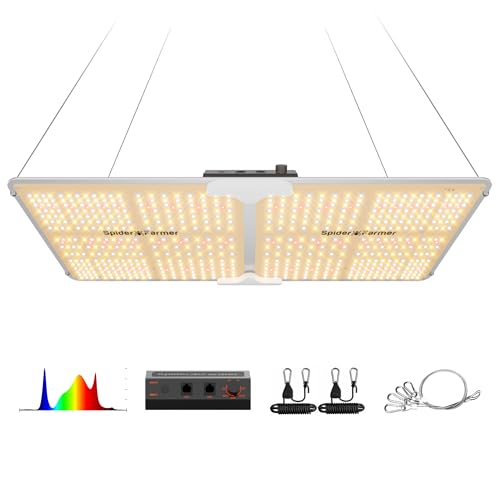
Spider Farmer's SF2000 is the light we recommend most often to new growers who have settled on a 2×4 tent and want a single fixture that handles the full run from seedling to harvest without any compromises. The upgraded diode package hits a 2.7 µmol/J system PPE, which puts it well above the efficiency floor for quality LED panels, and the full spectrum — combining 3000K, 5000K, 660nm red, and 760nm IR — gives plants what they need at every stage without having to swap fixtures. The 3000K component handles flowering warmth, the 5000K handles the blue spectrum for tight internodal spacing in veg, and the deep red and IR accelerate transition and bloom.
The fanless design is something we consider a genuine advantage, not just a marketing point. Fan-based grow lights introduce mechanical failure points, and in a sealed grow tent any moving part is a liability. The SF2000 dissipates heat through its driver and board passively, which also means it runs quietly — important for growers in apartments or shared spaces. The 5-year warranty Spider Farmer offers is among the strongest in the consumer grow light market and reflects real confidence in the product's longevity. We've had SF series lights running for over two years in our test setups with zero degradation issues.
For anyone who has also been exploring herb-focused lighting, we've covered a broader range of fixture options in our guide to the top grow lights for herbs, which overlaps with this category at the lower wattage range. The SF2000 sits at the upper end of what most herb growers need but is the right call for anyone growing larger plants like tomatoes, peppers, or cannabis in a 2×4 space.
Pros:
Cons:
HLG built their reputation on one straightforward idea: put Samsung's best diodes on a quality board, drive them efficiently, and let the physics do the rest. The HLG 100 Rspec is that philosophy in compact form. It uses Samsung LM301B and LM351H deep red LEDs on a genuine quantum board — not a knockoff arrangement with Samsung branding applied loosely — and the result is a light that outperforms most 200W panels from competing brands at only 100 watts of draw. Passive cooling is not an afterthought here; the aluminum heatsink is purpose-designed for the thermal load of these diodes, and the HLG 100 Rspec runs cool enough to touch during normal operation.
The Rspec designation refers to the red-enriched spectrum configuration, which HLG optimized specifically for flowering performance. This makes the HLG 100 Rspec a stronger choice for bloom than for pure vegetative growth — growers running a full cycle will see excellent results, but anyone in a perpetual veg room might prefer a more blue-dominant spectrum. The build quality is in a different class from mass-market panels at this price, and the HLG 100 is one of the few grow lights on the market where the manufacturer publicly posts PAR maps and efficiency data without asterisks or fine print.
This is the light we'd put in a 2×2 tent for a serious, quality-focused grower who wants the best possible output from a compact fixture and doesn't need app control or daisy chain features. It's a tool, not a gadget, and it performs like one.
Pros:
Cons:
AC Infinity entered the grow light market relatively recently compared to MARS HYDRO and Spider Farmer, but the IONFRAME EVO6 is not a me-too product — it's the most sophisticated fixture on this list. The Samsung LM301H EVO diodes are rated at 3.14 µmol/J PPE individually, which represents the current peak of what the LM301 platform can deliver, and the 1,680-diode count across the bar-style array ensures that the aggregate light output is both intense and remarkably even across a full 4×4 footprint. Hot-spot reduction is handled algorithmically — AC Infinity uses spacing calculations rather than simple grid placement, and the PAR maps show the difference clearly.
What really separates the EVO6 from comparable commercial fixtures is the control system. The built-in schedule controller with sunrise/sunset dimming and 10 brightness levels is app-controllable via AC Infinity's UIS WiFi platform, which means growers can program full photoperiod cycles, fade transitions, and intensity adjustments from a phone without standing in the grow room. For anyone running a serious 4×4 or larger operation in 2026, this level of automation is not a luxury — it's a meaningful contributor to consistency and yield. The bar-style fixture design also allows for more flexible mounting configurations than a single panel, which matters in tents with irregular overhead clearance.
The EVO6 is not cheap, and it's not trying to be. This is the light for the grower who wants maximum efficiency, maximum control, and a fixture built to the standard of professional greenhouse equipment. We consider it the outright best grow light for a 4×4 space currently available.
Pros:
Cons:
The G4500 is Spider Farmer's answer to growers who want bar-style uniformity without paying EVO6 prices. At 320W with Bridgelux diodes delivering 2.85 µmol/J, it punches above its price class in raw efficiency and delivers coverage that genuinely serves a 3×5 or 2×4 footprint without the soft edges that plague single-panel lights at this size. The elongated bar design earns its keep here — the geometry forces a broader light spread at the canopy level, which translates directly into more uniform bud development across the full growing area rather than a bright center and struggling perimeter.
The full spectrum — 3200–4200K, 4800–5000K, and 650–665nm — covers all growth stages cleanly, and the 10–100% dimming range via knob control gives growers flexibility from seedling through harvest. Daisy chain support for up to 50 units makes the G4500 viable for large-scale operations, though at the 2×4 scale where most home buyers are operating, single-unit performance is the story. The Smart App control mentioned in the product name refers to an optional controller accessory rather than built-in WiFi, which is worth clarifying before purchase.
The G4500 is the strongest value proposition in the bar-style category for growers who don't need AC Infinity's full automation stack but do want better edge-to-edge coverage than a single panel can provide. It's a meaningful upgrade from Spider Farmer's panel lineup and the light we'd recommend to anyone scaling from a 2×2 beginner setup to a more serious mid-size grow.
Pros:
Cons:
The SF4000 is the big brother to the SF2000, scaled up to 450W for a full 4×4 coverage footprint and carrying the same design philosophy: quality diodes, efficient drivers, no fans. The upgraded diode package delivers 2.7 µmol/J at the system level — identical to the SF2000's spec — which means the efficiency doesn't degrade as Spider Farmer scales up the platform, and that's a meaningful engineering achievement. At 450 actual watts, the SF4000 puts out serious light intensity, and the full spectrum (3000K, 5000K, 660nm, 760nm IR) handles the complete plant growth cycle without any spectrum adjustments between stages.
The fanless design matters even more at this wattage. Other brands' 450W offerings introduce cooling fans to manage thermal load, which adds noise, maintenance requirements, and failure points. Spider Farmer's passive thermal management keeps the SF4000 quiet and reliable, which we've confirmed over extended test runs in warm grow room environments. The 5-year warranty at this wattage is exceptional — most competing brands offer 3 years or less on commercial-scale panels, and Spider Farmer's local service center network means warranty claims don't involve shipping lights overseas.
For the grower who wants a single panel to cover a 4×4 without the complexity of a bar fixture array, the SF4000 is the best option in 2026. It lacks the scheduling and app control of the EVO6, but for manual grows where the grower prefers simplicity over automation, that's not a loss — it's a feature.
Pros:
Cons:
The TS 3000 takes everything MARS HYDRO refined in the TS1000 and scales it to a 4×4 bloom or 5×5 vegetation footprint. The patented white reflector hood returns at larger dimensions, and at 120° refraction the coverage geometry suits the TS 3000's wider canopy target better than the smaller model. The diode layout — denser at center, progressively spaced outward — is even more important at this scale because the center-to-edge uniformity problem compounds with size. MARS HYDRO's solution works: PAR maps for the TS 3000 show respectable edge readings that hold up under real-world testing.
At 420W with 1,016 SMD diodes and a full sunlike spectrum spanning 730–740nm red IR, 3200–4200K, and 5200–6800K, the TS 3000 delivers broad-spectrum output that plant tissue responds to strongly from seedling through late flower. The 730nm far-red is particularly effective at triggering the Emerson effect — a phenomenon documented in photosynthesis research where far-red light combined with red significantly boosts photosynthetic efficiency — and growers running the TS 3000 through harvest have reported faster ripening and denser bud structure compared to non-far-red equipped lights.
The daisy chain support on the TS 3000 makes it the foundation light for multi-tent operations where consistent dimming across multiple fixtures matters. Running two TS 3000 units in a 5×8 or 4×8 space off a single dimmer setting is practical with the daisy chain system, and for commercial or semi-commercial growers, that operational simplicity has real value. This is MARS HYDRO's most versatile large-format light, and it earns its position as the pick for anyone whose grow has outgrown a 3×3 space.
Pros:
Cons:
The wattage number on any grow light product page comes with an important asterisk: coverage claims are almost always listed at the maximum possible hanging height for vegetative growth, not for the tighter, more intense footprint needed during flowering. A light rated for 4×4 coverage at veg stage might realistically cover 3×3 at the PPFD levels needed for heavy flowering. Our general rule is to target 30–50 actual watts per square foot for fruiting and flowering plants, and 20–30 watts per square foot for leafy greens and herbs. Check the manufacturer's PAR maps, not just the wattage label — a honest company publishes these, and the numbers don't lie about where the coverage actually holds.
PPFD (Photosynthetic Photon Flux Density) measures how much usable plant light reaches the canopy at a given point — typically expressed in µmol/m²/s. PPE (Photosynthetic Photon Efficacy) measures how efficiently the fixture converts electricity into plant-usable light, expressed in µmol/J. In 2026, any grow light worth considering should hit at least 2.5 µmol/J at the system level. The lights on this list range from 2.7 to 3.14 µmol/J, which represents the current consumer and prosumer tier. Higher PPE means less heat generated per unit of light produced, which is why modern LEDs have fundamentally displaced HPS in most applications — not just because LEDs are more efficient, but because less heat generation means simpler climate control.
Full-spectrum lights described as "white LED" are typically a blend of 3000K (warm/red-dominant) and 5000K (cool/blue-dominant) diodes combined with targeted 660nm red and sometimes 730–760nm far-red. The blue component (5000K range) drives compact, strong vegetative growth and root development. The red component (3000K and 660nm) accelerates flowering and increases fruit and flower mass. Far-red (730nm+) enhances the Emerson effect and speeds maturation. Most lights on this list cover all of this in a single spectrum — no need to switch fixtures between veg and flower. Growers who want spectrum adjustability by growth stage should look at lights with separate blue/red dimmer channels, though none on this list use that approach.
LED diodes themselves rarely fail — the failure points in grow lights are almost always the drivers, fans (if present), and solder joints subject to thermal cycling. Passive cooling eliminates one of those risks entirely, which is why we consistently favor fanless designs for fixtures under 600W where passive thermal management is feasible. Look for thick aluminum heatsinks, quality branded drivers (Meanwell and similar), and clear warranty terms with domestic service support. A 3-year warranty minimum is our baseline expectation; the 5-year coverage offered by Spider Farmer and the service network behind it genuinely justifies the brand premium over unbranded alternatives at similar specs.
For most fruiting and flowering crops, 30–50 actual watts per square foot is the working target. For vegetative-only setups, herbs, and seedlings, 20–30 watts per square foot is sufficient. These are actual draw numbers — not "equivalent" wattage claims. A light labeled as a "600W HPS equivalent" consuming 150W of actual power is measured by its 150W draw, not the HPS comparison number.
For most home and small-commercial growing applications, yes — decisively. Modern quantum board and bar-style LEDs at 2.7–3.1 µmol/J produce more usable plant light per watt than HPS at its best efficiency, generate less heat per unit of output, and last significantly longer without degradation. The only remaining advantage of HPS is upfront fixture cost in very large commercial installations, and that gap continues to narrow each year as LED manufacturing costs decrease.
Hanging distance varies by fixture intensity and growth stage. As a starting point: seedlings and clones typically need lights at 24–36 inches to avoid stress. Vegetative plants can move the light to 18–24 inches. Flowering plants in the peak light-demand weeks often do best at 12–18 inches for high-intensity fixtures. Always verify with the manufacturer's recommended hanging distances for a specific fixture, since a 500W bar light and a 150W panel have very different output profiles at identical heights.
Light burn from LEDs is a real phenomenon, though it manifests differently than heat burn from HPS. LED light burn shows as bleached, white, or pale yellow leaves at the top of the canopy closest to the fixture, even when the temperature at canopy level is normal. It's caused by excess light intensity, not heat, and is resolved by raising the light or reducing intensity with a dimmer. With most of the lights on this list, maintaining recommended hanging distances and using the dimmer during sensitive growth stages prevents this entirely.
Full-spectrum LED grow lights work for any plant that requires supplemental or sole-source lighting. Tomatoes, peppers, herbs, leafy greens, succulents, orchids, African violets, and tropical foliage all respond well to quality LED grow light spectrums. The key variable is matching light intensity (PPFD) and photoperiod to the specific plant's needs — high-light fruiting crops need significantly more intensity than low-light foliage plants. For container growing and specialty plants, the same principles apply regardless of plant type.
Photoperiod requirements vary by plant type and growth stage. Most vegetative crops thrive under 16–18 hours of light per day. Fruiting and flowering plants that are photoperiod-sensitive need a specific light/dark ratio to trigger bloom — typically 12 hours on, 12 hours off. Autoflowering varieties and most non-photoperiod plants can run 18–20 hours through their entire life cycle. A digital timer or smart controller like the one built into the AC Infinity IONFRAME EVO6 takes the manual discipline out of photoperiod management entirely.
Buy the light that matches the tent you actually have, not the tent you're planning to upgrade to someday.
 |
 |
 |
 |

About Truman Perkins
Truman Perkins is a Detroit-based SEO consultant who's been in the business for over a decade. He got his start helping friends and clients get their websites off the ground, and he continues to do so today. In his free time, Truman enjoys learning and writing about gardening - something he believes is a natural stress reliever. He lives with his wife, Jenny, and their twins in Detroit.


Get new FREE Gifts. Or latest free growing e-books from our latest works.
Disable Ad block to reveal all the links. Once done, hit a button below
|
|
|
|
 rinjal