You're standing in the garden center aisle, staring at a wall of bagged soils with terms like "amended," "loamy," and "pH-balanced" printed across every bag. You grow roses — or want to — and you know the soil matters, but none of those bags say "roses" anywhere on them. That's the problem this guide solves. After testing and researching the top options available in 2026, we've ranked the best soils specifically suited to rose cultivation, whether you're growing hybrid teas in containers or knockout roses along a fence line.
Roses are not forgiving when it comes to soil. They demand a mix that drains fast enough to prevent root rot, yet retains enough moisture to support their heavy blooming cycles. The ideal soil pH for roses sits between 6.0 and 6.5 — slightly acidic — and the best mixes come pre-amended with slow-release nutrients that feed roots through the entire growing season. Get this foundation right and your roses reward you with fuller blooms, stronger canes, and far fewer disease problems. Get it wrong and no amount of fertilizer will compensate for compacted, waterlogged, or nutrient-depleted dirt. For a broader look at what goes into specialty growing media, our Best Soil Amendment and Conditioner reviews is worth bookmarking alongside this guide.
We've evaluated seven of the most widely used rose soils on the market, focusing on drainage characteristics, nutrient profiles, pH compatibility, and real-world performance data from growers across multiple climate zones. Whether you're repotting a container rose on your patio or amending a raised bed for a full garden installation, one of these picks will match your situation precisely. You can also browse our full gardening reviews section for related soil and tool recommendations.

Contents
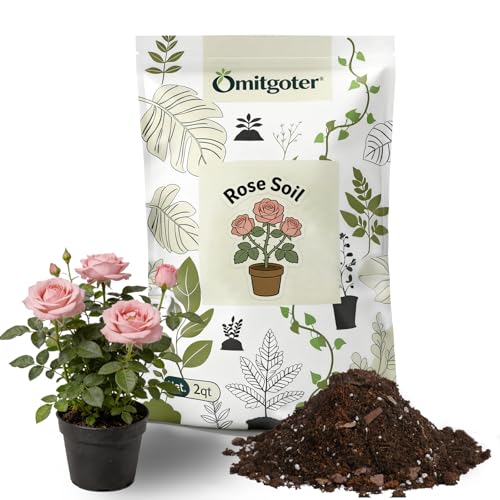





If you're growing roses in containers and want a mix built from the ground up for that specific plant, Omitgoter's rose soil is worth your attention. The formula combines peat, coconut coir, perlite, aged bark, and humus — five components that each serve a distinct purpose. Peat and coconut coir hold moisture without going waterlogged, perlite keeps the structure open for oxygen, bark adds drainage buffering, and humus delivers the slow-release organic nutrition that rose roots actively seek out. No synthetic additives appear anywhere in the ingredient list, which matters if you're integrating this into a fully organic growing program.
In practice, this mix performs exactly as its drainage specs suggest. Roses planted in Omitgoter soil show strong early root establishment because the loose structure lets young feeder roots spread laterally without resistance. Long-lasting nutrient release means you won't be chasing yellowing leaves with emergency fertilizer applications two months after planting — a common issue with cheaper mixes that front-load their nutrients and exhaust them quickly. The 1-quart size is purpose-built for container repotting rather than large-scale bed amendments, so buy multiples if you're working with anything larger than a 6-inch pot.
One consideration: the 1-quart format makes this less economical for gardeners maintaining a large rose garden with multiple containers. It's best positioned as a premium choice for a prized patio rose or a single container specimen you want to give the best possible start.
Pros:
Cons:
Perfect Plants designed this mix with a specific goal: support the full range of modern rose varieties from Drift ground covers to Knockout shrubs to heirloom climbers. The base formula uses sand and composted pine bark chunks to strike a drainage-to-retention balance that generalist potting soils consistently miss. Rose roots need moisture available between waterings, but standing water at any point in the cycle invites Phytophthora and crown gall — this mix threads that needle effectively. The 18-6-8 slow-release fertilizer pre-blended into every bag is the standout feature, delivering twelve months of continuous feeding with every watering cycle.
The nutrient profile deserves closer examination. An 18-6-8 NPK ratio with micronutrients means roses get the nitrogen boost they need for foliar development early in the season, the phosphorus for root establishment, and the potassium for flower quality and disease resistance — all calibrated for flowering shrubs specifically. You won't find this level of fertilization precision in an all-purpose mix. Growers who've switched to this soil consistently report brighter bloom color and more fragrant flowers, which aligns with what high-potassium fertilization does for rose chemistry.
The 4-quart size hits a practical sweet spot — large enough to fill two 2-gallon containers or amend a small in-ground bed section, small enough to store without dedicating a corner of your garage to it. If you're growing Knockout roses in a border planting and want a mix that works without supplemental feeding for a full season, this is the recommendation.
Pros:
Cons:
FoxFarm's Happy Frog has earned its reputation over years of consistent performance with flowering plants, and roses are no exception. The secret isn't just the nutrient list — it's the living biology inside the bag. Earthworm castings, bat guano, and aged forest products form a nutrient matrix that feeds plant roots through microbial decomposition rather than simple chemical dissolution. The custom blend of soil microbes actively improves root efficiency, meaning your rose roots absorb a higher percentage of available nutrients rather than letting them leach away with watering.
What this translates to practically: roses planted in Happy Frog establish faster, push stronger new canes in their first season, and demonstrate greater resilience to environmental stress. The aged forest products provide a structural component that keeps the mix open and airy for the long term — many cheaper soils compress under their own weight after 60 to 90 days, strangling root systems in containers. Happy Frog maintains its structure far longer. The 12-quart format also gives you real volume to work with — enough for a 5-gallon container plant or a generous bed amendment for two to three in-ground roses.
This mix works beautifully for rose growers who prioritize biological soil health over purely synthetic approaches. If you've read about the connection between mycorrhizal fungi and rose vigor, Happy Frog's microbial content supports that same ecosystem. It's a mix where the biology does the heavy lifting so you don't have to.
Pros:
Cons:
Coast of Maine built the Penobscot Blend for trees, shrubs, and perennials — exactly the plant category roses occupy. This is not a container mix. It's a planting amendment engineered for in-ground installation, raised bed preparation, and situations where you're improving native soil rather than replacing it entirely. The peat-lobster shell-aged bark combination is distinctive: the lobster shells are a regional ingredient that delivers calcium and trace minerals while the peat and bark manage structure and moisture dynamics. Calcium availability is critical for rose cane strength and disease resistance, and most generic soils don't address it at all.
The two-bag pack at one cubic foot each gives you two cubic feet total — sufficient to prepare a planting hole for four to six bare-root roses or amend a raised bed section approximately 4 feet by 4 feet to a 3-inch depth. The texture is coarser than a containerized potting mix, which is intentional. In-ground applications need a more robust structure that integrates with native soil without creating a drainage boundary that traps water at the planting hole edge — a failure mode that kills more newly planted roses than any other installation mistake.
If you're establishing a new rose bed in 2026 and want to give your plants the strongest possible root development foundation in their first season, the Penobscot Blend gives you a premium organic base to work from. The aeration and moisture retention balance it provides translates directly into stronger root systems that can sustain a heavy blooming cycle.
Pros:
Cons:

Peat extraction has become a genuine environmental concern in 2026, and a growing segment of serious gardeners is actively moving away from peat-based mixes. Organic Mechanics built their Premium Blend as a direct answer to that demand — and it delivers the moisture-retention performance that growers previously only expected from peat. The mix uses compost, aged pine bark, coconut coir, perlite, and worm castings to achieve water-holding capacity that actually exceeds peat under controlled conditions. Coconut coir is the key substitution: it holds water more consistently than peat, releases it more evenly to root zones, and doesn't acidify the soil as peat does over time.
For roses, this matters because pH stability is not a set-it-and-forget-it issue. Peat-based mixes drift increasingly acidic as the peat breaks down, eventually pushing soil pH below the 6.0 threshold where rose nutrient uptake starts to decline. Organic Mechanics' coir-based formula holds pH more consistently through multiple growing seasons — a genuine advantage for perennial plantings you intend to maintain long-term. The worm castings also provide a biological fertility base that keeps feeding roots between your regular fertilization applications.
This mix works equally well for container roses and raised bed applications. The one cubic foot size is also a smart choice for gardeners who want to blend a custom mix — for instance, combining this with additional perlite for a more aggressive drainage profile if you're in a high-rainfall climate. If you're also growing lavender or herbs alongside your roses, the moisture-retentive but well-drained profile pairs well — our guide on best soil for lavender plants in pots covers the complementary requirements in detail.
Pros:
Cons:
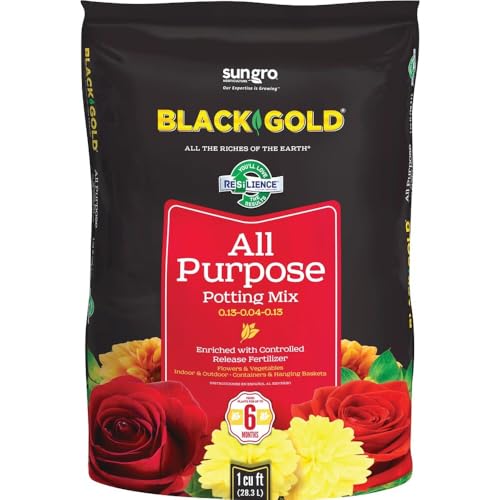
Black Gold has been a staple in garden centers for decades, and its longevity in a competitive market says something real about its reliability. This is a multi-purpose mix rather than a rose-specific formula, but its nutrient-rich composition and drainage characteristics make it a solid performer with roses — particularly for budget-conscious gardeners who need to fill large containers or amend multiple planting sites without breaking the project budget. At one cubic foot per bag, the value per unit of coverage is hard to beat among quality potting soils.
The fertilizer included in the blend provides an initial nutrition boost that supports early root establishment. Black Gold's particle size distribution gives it a loamy, workable texture that roses respond to well — not too heavy, not so light that it dries out between waterings. For patio containers and hanging baskets (common use cases for miniature and climbing roses), this mix handles the variable moisture conditions those environments create better than many lightweight mixes that dry out too aggressively in summer heat.
The honest limitation here is that Black Gold isn't engineered specifically for roses. You'll get solid results, but you won't get the rose-specific pH optimization or the 12-month slow-release nutrition that specialty mixes provide. For a gardener planting a large bed and looking for a reliable, proven base that can be supplemented with a dedicated rose fertilizer, Black Gold fills that role well. It's a workhorse, not a specialist — and sometimes that's exactly what a project calls for.
Pros:
Cons:
Burpee's Premium Organic Potting Mix addresses one of the most common failure modes for container roses: inconsistent moisture. Coconut coir is the functional engine of this formula — it holds moisture between waterings far more effectively than peat, releasing it slowly and evenly into the root zone rather than dumping it quickly or holding it in localized pockets. For roses in containers, especially those sitting on sun-exposed patios or balconies where evaporation rates are high, this moisture-management capability directly translates into fewer stress events and more consistent blooming. The OMRI certification confirms its organic integrity for gardeners who track that credential.
The included plant food component works on two timescales: an immediate-release fraction that feeds roots within days of planting, followed by a slow-release fraction that sustains nutrition for up to three months. This dual-feed approach matches the reality of how roses use nutrients — heavy early demand for establishment, then a more moderate ongoing requirement through the growing season. The 9-quart size is practical for repotting two to three small container roses or filling a single large statement pot.
Burpee's brand has been synonymous with seed and plant quality for over a century, and this potting mix reflects that same commitment to formulation precision. It's particularly well suited to gardeners in hot, dry climates where soil moisture management is the primary challenge — if you're in the Southwest or growing in a rooftop container garden, the coconut coir's moisture-holding capacity will noticeably reduce your watering frequency. For growers interested in pairing the right container with this mix, our rose pruners guide covers the complementary tools that complete a proper rose care setup.
Pros:
Cons:

Drainage is the non-negotiable requirement for rose soil. Roses are highly susceptible to crown rot and root rot when their root zone stays saturated — both conditions caused by Phytophthora and Pythium species that thrive in anaerobic, waterlogged soil. The best rose soils include structural amendments like perlite, coarse sand, or bark chunks that create macro-pores large enough for excess water to move through freely after irrigation. A well-draining soil should be fully drained within 30 minutes of thorough watering in a properly sized container.
Aeration is the companion requirement. Roots need oxygen as much as they need water, and compacted soils that lack air pockets starve roots of the oxygen they require for metabolic function. Look for mixes with visible particulate material — perlite chunks, bark fragments, or coarse sand — that keep the soil structure open. Avoid mixes that feel dense or heavy in the bag, as these will compact further under the weight of repeated waterings.
According to the University of Maryland Extension, roses grow best in well-drained soils with high organic matter content — a combination that requires deliberate formulation rather than luck. Understanding the best soil amendment options can help you improve any base soil you're working with.
Soil pH controls nutrient availability more than almost any other soil parameter. At a pH of 6.0 to 6.5 — the optimal range for roses — all essential nutrients including iron, manganese, and phosphorus remain soluble and available to root uptake. Move outside that range and individual nutrients begin to lock up in forms roots cannot absorb. Iron deficiency (interveinal chlorosis) is the most visible consequence of pH drift, producing the yellowed leaves with green veins that frustrate rose growers who can't figure out why their plants look sick despite regular fertilization.
Pre-formulated rose soils are typically calibrated to the correct pH range, but it's worth verifying with an inexpensive pH meter after the first watering season. General-purpose potting mixes often drift to pH 7.0 or above, which is acceptable for vegetables but suboptimal for roses. If you're amending native soil rather than using a containerized mix, test your existing soil pH first and adjust with sulfur (to lower) or lime (to raise) before planting.
Roses are heavy feeders. Their blooming cycles demand significant nitrogen for foliar growth, phosphorus for root and flower development, and potassium for bloom quality and disease resistance. A premium rose soil addresses this with pre-incorporated slow-release fertilizer that feeds continuously rather than delivering a single large nutrient dose that washes out after the first few waterings. Look for mixes that specify a slow-release NPK formulation with a timeline of at least 90 days — 12-month formulations like the Perfect Plants Rose Planting Mix represent the gold standard.
Organic nutrient sources — earthworm castings, bat guano, compost, bone meal — provide nutrition through biological decomposition, which means release rate tracks with temperature and microbial activity rather than simple water dissolution. This produces a more natural feeding pattern that mirrors how roses evolved to absorb nutrients in native soil conditions. For gardeners who prefer a fully organic approach, choosing a mix with these biological nutrient sources rather than synthetic fertilizer granules is the right call.
The apparent tension between moisture retention and drainage is the central design challenge of rose soil formulation. You need the soil to hold enough moisture to sustain roots between waterings without ever reaching a point of saturation. The best mixes achieve this through ingredient selection rather than compromise — coconut coir and peat hold moisture at a particle level while perlite and bark maintain macro-pore drainage channels that prevent saturation at the profile level.
Your growing context should inform which direction you bias on this spectrum. Container roses in hot climates with fast-evaporating conditions benefit from higher moisture retention — coconut coir-based mixes like Burpee's formula address this directly. In-ground roses in clay-heavy native soils need aggressive drainage amendment to prevent the clay from overwhelming the planting hole drainage. Raised bed roses represent a middle case where both factors matter equally. Matching the mix to your specific context rather than choosing a one-size-fits-all approach is the mark of an experienced rose grower.
Roses perform best in a loamy, well-draining soil with a pH between 6.0 and 6.5. The ideal mix combines good drainage to prevent root rot with adequate moisture retention to sustain heavy blooming cycles. For container roses, a specialty rose potting mix with slow-release fertilizer gives the best results. For in-ground planting, amend native soil with compost, perlite, and an organic planting mix like Coast of Maine's Penobscot Blend to achieve the right texture and nutrient base.
You can use general-purpose potting soil for roses, but you'll get noticeably better results with a rose-specific or premium amended mix. Regular potting soils often have pH levels that drift too high for roses, lack the slow-release fertilizer profile roses need for sustained blooming, and may compact over time in a way that restricts root development. If you use a general mix like Black Gold, supplement it with a dedicated rose fertilizer and monitor pH through the growing season.
Container rose soil should be refreshed or replaced every two to three years. Over time, potting soil breaks down structurally, losing the pore space that provides drainage and aeration. Salts from fertilizers also accumulate, and pH can drift. Signs that soil replacement is overdue include persistent yellowing despite correct fertilization, very slow drainage after watering, and roots visibly circling the container. When refreshing, remove the plant, trim dead roots, replace at least half the soil with fresh mix, and repot into a container one size up if the plant has grown.
The optimal soil pH for roses is 6.0 to 6.5. At this range, all essential macro and micronutrients remain soluble and accessible to root uptake. pH levels above 7.0 lock up iron and manganese, causing the interveinal yellowing (chlorosis) common in alkaline soils. Levels below 5.5 affect phosphorus and calcium availability. Test your soil or container mix annually with a basic pH meter and adjust as needed — sulfur lowers pH, lime raises it.
Whether you need additional fertilizer depends on what's already in your soil mix. A specialty mix like Perfect Plants' Rose Planting Mix includes an 18-6-8 slow-release fertilizer that feeds for 12 months — no supplemental feeding needed in the first year. General-purpose mixes with short-term fertilizer boosts will need supplementation after 60 to 90 days. Even with pre-amended mixes, a mid-season application of a bloom-booster fertilizer in June or July supports the second and third flush of flowers that heavy-blooming repeat roses produce through the 2026 season.
Organic soil mixes offer several genuine advantages for roses beyond the environmental considerations. Organic nutrient sources — earthworm castings, compost, bat guano — release nutrition gradually through microbial activity, producing a feeding pattern that mirrors natural soil conditions. They also support beneficial microbial communities in the root zone that improve nutrient uptake efficiency and can suppress certain soil-borne pathogens. Synthetic-amended mixes deliver nutrients reliably and predictably, which suits growers who want precise control. For most home rose growers, the biological complexity of a good organic mix produces healthier plants over multiple seasons.
 |
 |
 |
 |

About Truman Perkins
Truman Perkins is a Detroit-based SEO consultant who's been in the business for over a decade. He got his start helping friends and clients get their websites off the ground, and he continues to do so today. In his free time, Truman enjoys learning and writing about gardening - something he believes is a natural stress reliever. He lives with his wife, Jenny, and their twins in Detroit.


Get new FREE Gifts. Or latest free growing e-books from our latest works.
Disable Ad block to reveal all the links. Once done, hit a button below
|
|
|
|
 rinjal