Succulents are among the top-selling houseplants worldwide, with the global indoor plant market now valued at over $20 billion — and the terrarium trend is driving a huge chunk of that growth. If you want to learn how to make a succulent terrarium, you're in the right place. It's one of the easiest, most affordable weekend projects in indoor gardening. You don't need a green thumb, a large space, or expensive equipment. And if you've already tried making a closed terrarium, you'll find the open succulent version even more forgiving.
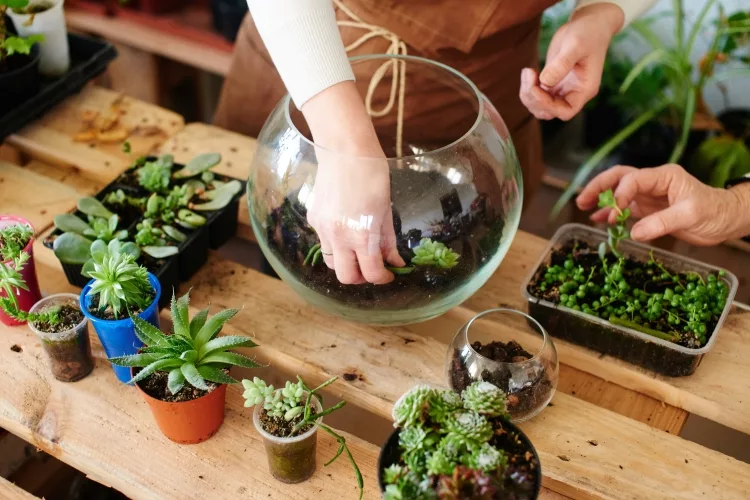
A succulent terrarium is an open-container garden filled with drought-tolerant plants layered over sand, gravel, and gritty soil. Unlike tropical terrariums, you leave it unsealed. You want airflow. Succulents are plants that store water in their leaves, stems, or roots, which makes them naturally resistant to neglect — a huge advantage when you're just starting out.
This guide covers everything from choosing your container to the exact layering method, the right plants for your experience level, and the most common mistakes beginners make. Truman Perkins has put this guide together so you can skip the trial-and-error phase entirely. For product and tool recommendations to help you get set up right, browse our gardening reviews section.
Contents
You don't need much to build your first succulent terrarium. A trip to a garden center or a quick online order is usually enough. The secret to a successful build is getting your materials right before you plant anything. Cutting corners on the base layers is where most beginners go wrong.
Your container is the foundation of the whole project. You have more options than you'd think:
The most important rule: open top or drainage hole. Succulents rot in sealed, humid environments. Avoid anything with a lid you plan to keep closed. If you're curious about the sealed-container approach, our guide on how to make a closed terrarium covers that method — but it uses completely different plants and much higher humidity.
Gather these before you start planting:
If you've filled planters or raised beds before, the layering logic carries over directly. Our guide on how to fill an outdoor planter covers the same drainage-first principle in a larger-scale context.
Not all succulents behave the same way in a terrarium. Some grow too fast and crowd out their neighbors. Some need more water than others. Match your plant choices to your experience level and you'll save yourself time and frustration.
These species are slow-growing, forgiving, and visually interesting even in a small container:
If you want to branch out into the agave family, our guide on how to grow Agave Stricta covers a compact, spiky species that works well as a centerpiece in a wider terrarium setup.
Once you're comfortable with the basics, mix plant types for richer visual texture:
Here's a quick comparison to help you decide which path fits your experience level right now:
| Skill Level | Recommended Plants | Container Size | Watering Frequency | Difficulty |
|---|---|---|---|---|
| Beginner | Echeveria, Haworthia, Sedum | Small (6–10 in wide) | Every 2–3 weeks | Easy |
| Intermediate | Aloe, Crassula, Gasteria | Medium (10–16 in wide) | Every 2 weeks | Moderate |
| Advanced | Senecio, Agave Stricta, mixed species | Large (16+ in wide) | Every 10–14 days | Challenging |
If you enjoy low-maintenance indoor plants alongside your terrarium, our guide on how to grow a money plant covers another easy-care species that thrives in the same bright indoor conditions succulents prefer.
This is the core of the whole process. Follow these steps in order and your terrarium will have the right structure from day one. Skipping the base layers is the single biggest mistake beginners make — and it almost always ends in root rot.
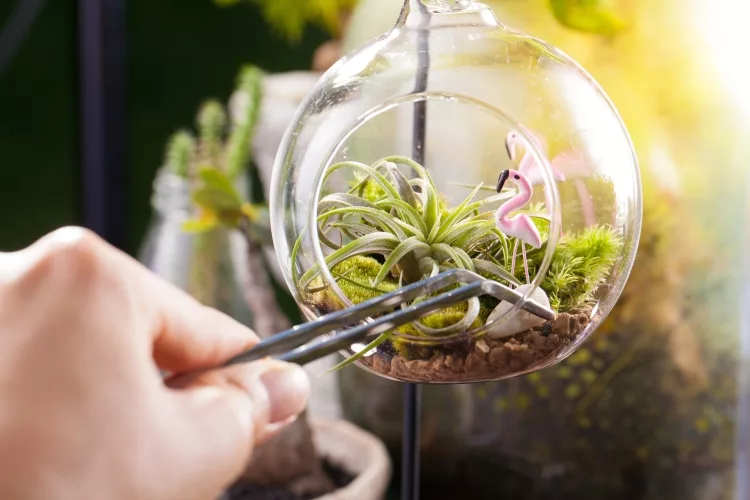
Never substitute regular potting soil here. It stays wet too long and will cause root rot within weeks. Cactus mix drains fast and mimics the dry, porous soil succulents naturally grow in.
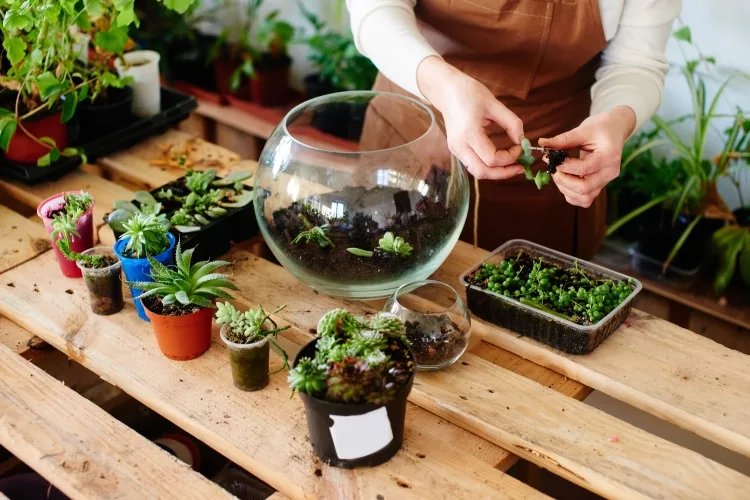
If you find yourself wanting to scale up your indoor growing setup beyond a single terrarium, our guide on how to make a small greenhouse walks you through building a controlled growing environment for a much larger plant collection.
Building it is the easy part. The harder challenge is resisting the urge to over-care for it. Succulents suffer more from too much attention than too little. Here's what sustainable, long-term care actually looks like.
Overwatering kills more succulents than any pest or disease. Stick to these simple rules:
You rarely need to fertilize succulents, but a slow-release fertilizer stick can give them a seasonal boost. Learn how to make your own in our guide to making fertilizer sticks at home.
If a plant starts to stretch out and look leggy — a process called etiolation (when a plant grows long and spindly reaching for light) — move the terrarium closer to a window or add a small grow light on a timer. Catching this early makes recovery much easier.
For more on managing indoor light conditions across different plant types, our guide to growing avocado indoors covers light and temperature principles that apply to many low-maintenance houseplants.
Most terrarium failures come down to a short list of repeatable errors. Knowing them now will save you money, time, and at least a few dead plants.
An open glass container without a lid is the top choice. Geometric terrariums, wide-mouth mason jars, shallow glass bowls, and old fish tanks all work well. The critical requirement is airflow — succulents cannot tolerate the high humidity of a sealed container.
Not necessarily, but you must build a proper drainage layer at the bottom using coarse gravel and activated charcoal. Without drainage holes, this layer acts as a reservoir for excess water so it doesn't sit against the roots and cause rot.
Water every 2–3 weeks during warm months and once a month or less in cooler months. Always check that the top inch of soil is completely dry before watering again. When in doubt, wait a few more days.
No. Regular potting soil retains too much moisture and will lead to root rot. Always use a cactus and succulent potting mix, which drains quickly and creates the dry, porous root environment succulents need to thrive.
Most succulents need 4–6 hours of bright indirect light per day. A south- or east-facing windowsill is ideal. Avoid placing the terrarium where direct afternoon sun shines through glass, which can overheat and scorch the plants.
Echeveria, Haworthia, and Sedum are the best picks for small containers. They stay compact, grow slowly, and come in a wide range of colors and textures. Haworthia is especially useful if your light conditions are less than perfect.
Watch for soft, mushy, or semi-transparent leaves — these are classic overwatering signs. If the base of the plant feels squishy or leaves turn yellow and drop easily, stop watering immediately and allow the soil to dry out completely before watering again.
Yes. Small cacti like mammillaria or gymnocalycium have the same water and light needs as most succulents and work well together in a shared container. Just protect your hands during planting — use thick gloves or wrap the cactus in folded newspaper to get a safe grip.
 |
 |
 |
 |

About Christina Lopez
Christina Lopez grew up in the scenic city of Mountain View, California. For eighteen ascetic years, she refrained from eating meat until she discovered the exquisite delicacy of chicken thighs. Christina is a city finalist competitive pingpong player, an ocean diver, and an ex-pat in England and Japan. Currently, she is a computer science doctoral student. Christina writes late at night; most of her daytime is spent enchanting her magical herb garden.


Get new FREE Gifts. Or latest free growing e-books from our latest works.
Disable Ad block to reveal all the links. Once done, hit a button below
|
|
|
|
 rinjal