The REPTI ZOO Glass Reptile Terrarium 20 Gallon earns the top spot in 2026 for its tempered glass build, dual front-opening doors, and waterproof bottom that works equally well as a desert or rainforest setup. Whether you're housing a gecko, building a lush moss garden, or crafting a decorative desktop centerpiece, picking the right terrarium matters far more than most people realize. The container you choose sets the entire tone for your setup — airflow, humidity, visibility, and how easy it is to care for the inhabitants inside all depend on it.
Terrarium kits have exploded in variety over the past few years. You'll find everything from screen cages built for tropical reptiles to tiny geometric glass houses designed purely for aesthetic appeal on a coffee table. Some kits come with soil, moss, and charcoal already included. Others are bare enclosures you fill yourself. Knowing which category you actually need before you buy saves you from wasting money on something that doesn't fit your goal. If you're new to the hobby, check out our guide to the best terrarium containers for a broader look at vessel types before committing to a full kit.
This review covers seven of the best terrarium kits available right now, spanning reptile housing, plant terrariums, and complete DIY starter kits. Every product here has been evaluated on build quality, ventilation design, ease of use, and overall value. Whether you're setting up a home for a crested gecko or building a self-sustaining moss ecosystem, there's a pick on this list that fits your situation. You'll also find a buying guide and FAQ at the bottom to help you think through the decision clearly. For broader gardening reviews and plant care guides, explore the full category for more resources to help your green hobby thrive.

Contents






This is the terrarium you'll want if your priority is housing a reptile comfortably and safely. The REPTI ZOO 20 Gallon sits at 30" x 12" x 12" and is constructed from high-quality tempered glass that holds up to the daily wear of reptile keeping — substrate digging, water splashing, and the occasional escape attempt. The patented front-opening design with two independently swinging doors is genuinely one of the most practical features on any entry-level reptile enclosure. You can open just one side to reach in with tongs or to top off the water dish without disturbing the full setup.
The top screen serves double duty: it provides steady airflow while still allowing UVB and infrared light to penetrate, which is non-negotiable for many reptiles. The raised bottom frame fits a standard under-tank heater, and the waterproof base means you're not locked into a dry desert environment — this tank handles a bioactive rainforest build just as well as a basic sand-and-rock gecko enclosure. If you're looking at reptile-specific setups, our roundup of the top reptile terrariums goes deeper into the reptile housing market across different size categories.
Setup is straightforward. The tank ships with hardware already in place, and the doors lock securely — important if you're keeping anything with an escape artist reputation. For the price point in 2026, the build quality punches above its weight. This is not a flimsy novelty terrarium. It's a functional, long-term enclosure for lizards, crested geckos, frogs, small snakes, and tortoises alike.
Pros:
Cons:
For chameleons, anoles, and other humidity-sensitive arboreal reptiles, an all-glass enclosure is actually the wrong choice. These animals need constant, cross-flowing fresh air, and the Zoo Med Reptibreeze delivers exactly that. The 24x24x48 inch all-screen design provides maximum ventilation on every side of the enclosure — something you simply can't replicate in a glass box with only a top screen. The large front door swings open wide for easy daily access, and the separate bottom door is a practical detail that makes substrate removal far less of a chore than it sounds.
The aluminum frame is black anodized, making it both attractive and corrosion-resistant. This matters if you're misting the enclosure multiple times a day, which arboreal reptiles typically require. The hardware is included in the box, and assembly requires only a basic screwdriver — no special tools, no complicated instructions. The overall footprint gives you a tall, vertical space that arboreal species use naturally, allowing you to stack branches, live plants, and hiding spots at different height levels.
Zoo Med has built this cage to last. It handles high-humidity environments without rusting, bending, or degrading. If you're specifically keeping snakes, our review of the best snake terrariums offers a comparison focused on species-appropriate enclosures. For chameleons and similar animals though, the Reptibreeze is the standard-setter in this format and price range.
Pros:
Cons:
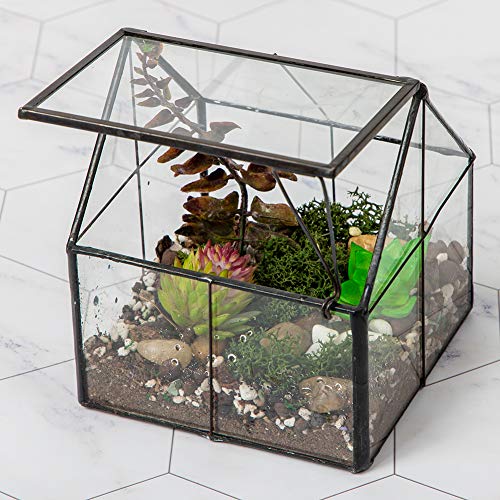
This is the terrarium for people who want something on their desk that looks intentional. The Ferrisland Wardian Case measures 4.3" x 4.3" x 5" and is built from ultra-clear sodium calcium glass with a brass frame — and critically, it's completely lead-free. That detail matters if you're placing it in a living space and want to avoid any concerns about material off-gassing near plants or people. The house-shape geometric silhouette has become one of the more popular styles in small decorative terrariums, and Ferrisland executes it cleanly with soft lines and a sturdy build that doesn't feel cheap.
The glass quality deserves special mention. Crystal-clear visibility is the whole point of a display terrarium, and this one delivers superior light transmission. Sunlight — or grow light — passes through without a greenish or yellowish tint, which keeps your succulents, air plants, ferns, or moss looking true-to-color. The small door on the front makes planting and arranging your interior straightforward, even in such a compact space. You can rotate it to whatever angle looks best without worrying about it tipping.
At this size, you're not fitting a large fern inside, but for a single succulent, a pinch of moss, or a small air plant, this terrarium is perfect. It also doubles as a table centerpiece for weddings or office desks. The brass frame adds a warm, refined look that most black-metal alternatives can't quite match. A word on pairing: if you're building a planted terrarium setup and need the right growing medium to go with it, our article on the best soils for succulents covers exactly what you'd want to layer inside this style of enclosure.
Pros:
Cons:
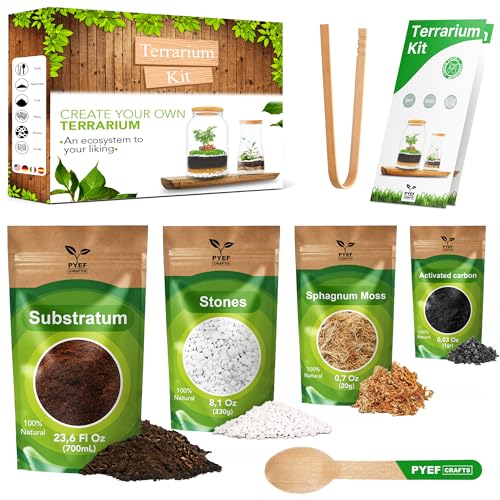
If you already have a jar or container and you want everything else to build a self-sustaining closed ecosystem, the PYEF CRAFTS DIY Kit gives you exactly that. The kit is designed for containers up to 68 oz (1–2 liters) and includes terrarium soil, moss, activated charcoal, and decorative elements — all the layered components you need to create an environment that actually sustains itself without constant watering. The step-by-step cultivation instructions walk you through the exact order each layer goes in and the correct amounts to use, which eliminates the guesswork that trips up most beginners.
This kit is explicitly designed to work with succulents, air plants (Tillandsia), and mini ferns — three of the most forgiving plant categories for enclosed ecosystems. The instructions also point you toward other compatible species like Fittonia, mini Begonias, Bromeliad pups, and baby ferns, so you have real flexibility in what you grow. Note that plants are not included — that's not a knock on the kit, it's by design. Sourcing your own plants lets you pick exactly what suits your container and your space.
The customizable nature of this kit is one of its strongest selling points. Because you bring the jar, you control the look entirely. A mason jar gives you a farmhouse feel. A wide-mouth apothecary jar creates something that looks like a display piece from a botanical shop. The included materials are high quality, and the charcoal layer in particular is critical — activated carbon filters toxins and prevents the anaerobic bacteria buildup that turns a closed terrarium foul in a matter of weeks.
Pros:
Cons:
The Cute Farms Terrarium Starter Kit is specifically designed for people who are new to terrariums and want a complete, guided experience without an overwhelming amount of complexity. The large version of this kit gives you a seriously thorough collection of materials: preserved Reindeer Moss and Forest Moss, potting soil pre-blended with activated charcoal, horticultural vermiculite, pea pebbles and river stones, plant food, bamboo tongs, a natural hair brush, and three miniature dinosaur figures for a playful touch. The comprehensive Build and Care Guide walks you through every step clearly, making this one of the most beginner-friendly packages available in 2026.
One thing that stands out is the quality of the included moss. Most budget terrarium kits stuff in low-grade preserved moss that looks dull within a few months. Cute Farms uses a preserved moss blend that maintains vivid color without any maintenance — it doesn't need water, and it won't wilt. That makes it a reliable visual anchor for your terrarium design regardless of which container you choose. You bring the container and the plants; everything else is here.
The soil blend deserves credit too. Activated charcoal mixed directly into the potting soil improves drainage and nutrient retention simultaneously, which reduces the chance of root rot in a closed or semi-closed environment. The vermiculite adds another layer of drainage management. For a beginner who doesn't yet have a library of soil knowledge, this pre-mixed approach removes one of the biggest failure points of terrarium building. If you want to dig deeper into substrate choices as your skills grow, our guide on top soil mixes for raised beds covers layering concepts that apply across all container gardening formats.
Pros:
Cons:
This kit is for you if you want to actually grow plants from scratch rather than arranging pre-established specimens in a display container. The Toys by Biosphere Tropical Rainforest kit focuses on a curated selection of tropical species — Umbrella trees, Dragon trees, China Doll trees, and Rainbow Plants — that germinate reliably and develop into genuine tropical-looking specimens inside the enclosed glass environment. The company guarantees sprouting, which is a meaningful commitment you won't see from many competitors in this category.
The terrarium features side ventilation vents and a dedicated drainage basin, which is a more sophisticated design than what you'd typically expect at this price. Side vents give you more nuanced climate control than a basic top-only vent, and the drainage basin prevents root saturation without requiring you to obsessively monitor watering frequency. The large viewing window makes watching the growth process genuinely satisfying — this is an educational kit as much as it is a decorative one, which makes it excellent for kids and adults alike.
Setup follows simple included instructions, and upkeep is minimal after the initial planting phase. The plants chosen for this kit are quick to sprout, so you're not waiting months before seeing any results. Vibrant tropical greenery starts developing within a short window, and the glass enclosure frames it beautifully against any decor. For anyone who's always wanted a small jungle in their living room but assumed it required gardening expertise — this kit proves otherwise.
Pros:
Cons:
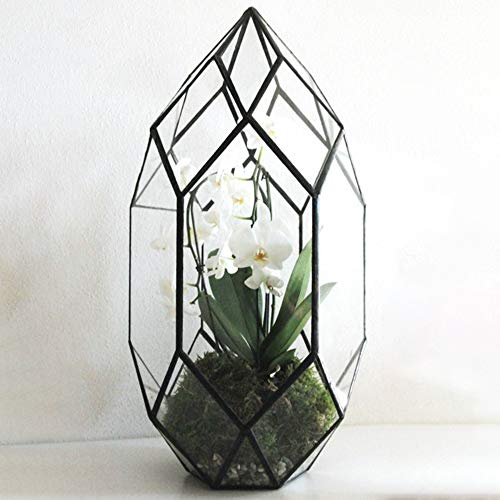
When you want a terrarium that functions as genuine home decor — something you'd see in an interior design spread — this is the one to buy. The Ferrisland Handmade 10" Irregular Geometric Terrarium combines clear glass panels with a modern black metal frame in a striking geometric silhouette that commands attention on a shelf, mantle, or side table. At 10 inches, it has enough interior volume to build a meaningful arrangement of succulents, air plants, moss, or small cacti without looking cramped.
The ventilation design on this terrarium is cleverly integrated into the geometric frame structure, allowing adequate air circulation to prevent moisture buildup — the enemy of most air plants and succulents. This keeps your plants fresh and mold-free without requiring a dedicated ventilation panel that would interrupt the aesthetic. The clear glass maintains excellent visibility from all angles, which is the whole point of a display terrarium: you want to see your plants, not look through a distorted or tinted surface.
Ferrisland built this by hand, and you can see it in the quality of the frame joints and the clean glass cutting. It feels substantial without being heavy. Whether you're growing microgreens, arranging a succulent cluster, or building a small moss landscape, this terrarium gives you a canvas that elevates whatever you put inside it. The black metal frame reads as sophisticated and minimalist — it pairs well with modern, industrial, and Scandinavian-style interiors without effort. If you're decorating with lighting alongside it, solar fairy lights can create a genuinely beautiful ambient effect around a display piece like this.
Pros:
Cons:
This is the most important distinction in the entire category. Terrarium kits designed for reptiles and those designed for plants have almost nothing in common beyond the glass. Reptile terrariums need front-opening doors for easy feeding access, secure locking mechanisms to prevent escapes, UVB-permeable top screens, waterproof bases, and specific temperature and humidity gradients. Plant terrariums, on the other hand, prioritize light transmission, drainage, and visual appeal. Buying a plant display terrarium to house a gecko is a mistake. Buying a reptile enclosure for succulents is overkill. Be clear on your intent before you look at any other specification.
For reptiles, the glass vs. screen decision comes down entirely to the species. Snakes, bearded dragons, and many gecko species do well in glass enclosures because they need retained humidity and controlled temperature. Chameleons, anoles, and veiled lizards need the constant cross-ventilation that only an all-screen cage provides — an enclosed glass tank creates dangerous stale air and respiratory problems for these animals over time. For plant terrariums, glass enclosures create a humid microclimate that benefits tropical plants and moss, while open geometric terrariums work best for succulents, cacti, and air plants that prefer drier, freely circulating air.
Terrarium kits range from complete all-in-one packages that include soil, moss, charcoal, tools, and instructions, to bare enclosures you fill yourself from scratch. Complete DIY kits are excellent for beginners who want a guided, low-friction experience. Bare enclosures give experienced keepers full control over the substrate mix, decor, and layering. Read the product listing carefully and confirm whether plants, containers, and specific substrates are included. Several kits reviewed here require you to bring your own jar or planting container — that's a feature, not a flaw, as long as you're aware of it before you buy.
Size matters differently depending on what you're terrariuming. For reptiles, minimum enclosure size is not a suggestion — it's a welfare requirement. A 20-gallon tank is appropriate for a juvenile gecko or small lizard, but you'll need to upgrade as the animal grows. For plants, the size of the terrarium determines how many plants you can accommodate and how much visual impact the display has. A 4" Wardian case holds one small succulent. A 10" geometric terrarium holds a full arrangement. A full DIY kit jar can hold an entire miniature ecosystem. Think realistically about your space and what you want to grow before committing to a size.
An open terrarium has a gap or no lid, allowing air to circulate freely. It's best for plants that prefer drier conditions like succulents, air plants, and cacti. A closed terrarium is fully sealed or nearly sealed, creating a humid self-sustaining ecosystem. It works well for moisture-loving plants like ferns, moss, and Fittonia. The choice depends entirely on the types of plants you want to grow.
Standard potting soil alone is not ideal for terrariums. Most terrarium builds require a layered substrate — typically gravel or pebbles at the bottom for drainage, activated charcoal above that to filter toxins and prevent bacterial growth, then a specialized soil mix on top. For succulents, use a fast-draining succulent soil. For tropical plants, use a moisture-retentive mix. Using the wrong soil leads to root rot, mold, and plant death within weeks.
Humidity in a glass reptile terrarium is managed through substrate choice, water features, and ventilation. Dense substrates like coconut fiber retain moisture well. Misting the enclosure daily raises humidity temporarily, and partially covering the top screen reduces evaporation if you need sustained high humidity levels. A digital hygrometer is the only way to accurately track humidity — guessing is not a reliable method for species with specific humidity requirements.
Watering frequency depends on whether the terrarium is open or closed, the types of plants inside, and the ambient conditions in your home. Closed terrariums often need watering only once every few weeks or less, because moisture cycles within the sealed system. Open terrariums with succulents need water every one to two weeks, allowing the soil to dry out fully between waterings. If the glass fogs up on the inside, your closed terrarium has adequate moisture — skip watering until condensation stops forming.
Most plant terrarium kits are safe and excellent for children. The DIY nature of building a miniature ecosystem is educational and engaging. Reptile terrariums require adult supervision because they involve live animals with specific care requirements. Always check material safety for any kit used with young children — lead-free glass and non-toxic substrates are important considerations, especially for younger kids who may handle the materials directly.
For beginners building a closed or semi-closed terrarium, Fittonia (nerve plant), moss, mini ferns, and Pileas are forgiving and grow well in humid enclosed spaces. For open terrariums, succulents, air plants (Tillandsia), and small cacti are excellent starting points because they require minimal watering and tolerate neglect well. Avoid fast-growing plants in small terrariums — they outgrow the space quickly and disrupt the balance of the whole setup.
Every terrarium kit on this list solves a real problem for a specific type of buyer — whether you're housing a gecko, growing tropical plants from seed, or simply want a beautiful glass piece on your desk in 2026. Pick the one that matches your actual use case, grab the right soil and substrate for your plants, and start building: a well-chosen terrarium is one of the most satisfying and low-maintenance ways to bring nature into your living space.
 |
 |
 |
 |

About Truman Perkins
Truman Perkins is a Detroit-based SEO consultant who's been in the business for over a decade. He got his start helping friends and clients get their websites off the ground, and he continues to do so today. In his free time, Truman enjoys learning and writing about gardening - something he believes is a natural stress reliever. He lives with his wife, Jenny, and their twins in Detroit.


Get new FREE Gifts. Or latest free growing e-books from our latest works.
Disable Ad block to reveal all the links. Once done, hit a button below
|
|
|
|
 rinjal