reviewed by Truman Perkins
Outdoor irrigation systems in the United States waste an estimated 1.5 trillion gallons of water every year — and a large share of that comes from outdated sprinkler timers running on fixed schedules regardless of weather. In 2026, smart sprinkler controllers have become one of the fastest-growing home automation upgrades precisely because they solve that problem directly. Swap your old dial timer for a WiFi-connected controller, and your yard waters itself intelligently: skipping runs before rain, adjusting for heat waves, and letting you override everything from your phone while you're on vacation.
If you're already invested in garden health — maybe you've looked into moisture meters or fine-tuned your soil setup — a smart sprinkler controller is the next logical step. It removes the guesswork from irrigation entirely. Instead of checking the forecast and manually postponing a watering cycle, the controller does it automatically. You save water, reduce your utility bill, and your lawn and garden actually look better because they're getting moisture when they need it, not just when a timer says so.
This guide covers the 7 best smart sprinkler controllers of 2026, ranked and reviewed based on features, ease of setup, app quality, zone capacity, and overall value. Whether you have a modest 6-zone residential lawn or a 12-zone multi-area landscape, there's a strong option here for you. We've also included a full buying guide and FAQ so you can pick the right controller with confidence. Browse more top picks across the garden category at our gardening reviews hub.

Contents







Rachio is the name that comes up first when anyone serious about smart irrigation starts researching options — and for good reason. The 8-zone Rachio controller runs on the free Rachio app, which is consistently rated one of the best irrigation apps available on both iOS and Android. Setup is genuinely easy: snap off your old controller's faceplate, match the wires to the labeled terminals, connect to WiFi, and you're running. Most people finish installation in under 30 minutes without calling a plumber or electrician.
What sets Rachio apart is its patented Weather Intelligence system. It doesn't just check whether it's raining — it monitors wind speed, freeze risk, humidity, and precipitation probability to decide whether each watering cycle makes sense. That granularity is rare at this price point. You can also create flex daily schedules (adaptive irrigation that recalculates soil moisture daily) or fixed schedules if you prefer manual control. Integration with Amazon Alexa, Google Assistant, Apple HomeKit, and SmartThings means it fits cleanly into whatever smart home ecosystem you already use.
Rachio also has a strong reputation for long-term app support. Updates roll out regularly, the cloud service has stayed free, and the company backs each unit with a solid warranty. If you want one controller that covers all the bases without a steep learning curve, this is your pick for 2026.
Pros:
Cons:
Rain Bird has been manufacturing irrigation equipment since 1933. That's nearly a century of experience built into every product they ship, and the ST8I-2.0 reflects that heritage. This is a controller built to last. The hardware feels solid, the terminal connections are clearly labeled and easy to wire, and the unit operates indoors only — so it's designed specifically for garages, utility rooms, or covered areas where it stays protected from the elements year-round.
The WiFi connectivity puts full control in your palm via the Rain Bird app. You can set schedules, run manual cycles, receive alerts, and adjust programming from anywhere in the world — helpful when you're traveling and your neighbor texts you that it hasn't rained in two weeks. Alexa, Google Assistant, iOS, and Android are all supported, and the interface is notably beginner-friendly. Rain Bird designed this for homeowners who want reliable, set-it-and-forget-it performance without spending hours in the app.
The ST8I-2.0 also carries WaterSense certification from the EPA's WaterSense program, which means it meets independently verified water efficiency standards. That matters if you're in a region with water restrictions or rebate programs — many municipalities offer rebates for WaterSense-certified controllers, which can offset part of your purchase price.
Pros:
Cons:
The Orbit B-hyve XR is the go-to choice if you need flexibility in where you mount your controller. Unlike the Rain Bird ST8I, the B-hyve XR is rated for both indoor and outdoor installation. That means you can mount it on an exterior wall near your valve box if there's no convenient indoor space — a real advantage for properties where running wires back to a garage isn't practical.
Orbit's B-hyve platform has matured significantly in recent years. The app now handles weather-based watering adjustments reliably, letting you set smart watering that responds to local forecast data automatically. You're not manually overriding your schedule every time rain is forecast — the controller handles it. The XR model specifically adds extended range WiFi connectivity, which helps if your controller is mounted far from your router or in a metal enclosure that tends to degrade signal.
WiFi connectivity, weather-based adjustments, and true indoor/outdoor mounting in a single package at a competitive price makes the B-hyve XR hard to beat for flexibility. If you're also managing a more complex garden setup — maybe you've been comparing options like a pump sprayer for spot treatments alongside your automated system — the B-hyve XR handles the backbone irrigation while you focus on targeted care elsewhere.
Pros:
Cons:
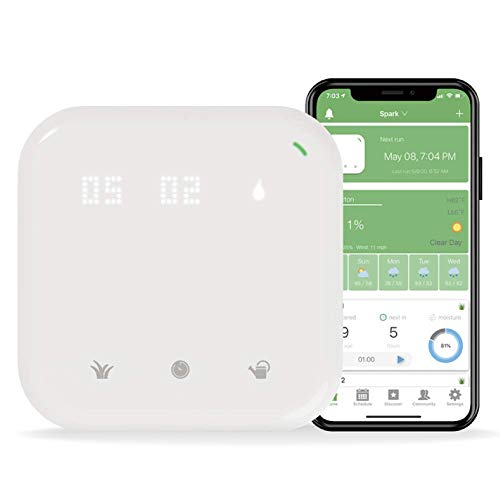
Netro takes a clean, modern approach to smart irrigation. The Spark controller features a touch control panel for manual watering right on the unit — no phone required for quick one-off runs — and an LED display that shows watering and network status at a glance. That combination of physical controls and app control gives you the best of both worlds: smart automation when you want it, direct hands-on control when you need it fast.
The standout feature is lifetime cloud service at no extra charge. Some smart home companies start free and then introduce subscription fees after a year or two. Netro commits to keeping cloud access and weather-aware scheduling free forever. That's a meaningful long-term value proposition, especially as smart home subscriptions continue to pile up. The Spark connects to 2.4GHz WiFi and is accessible via iOS (8.3 and up), Android (5.0 and up), and web browsers — so you can manage it from any device without downloading a dedicated app if you prefer.
WaterSense certification confirms that the Netro Spark's dynamic scheduling genuinely saves water compared to fixed-schedule timers. It builds and adjusts watering schedules based on your specific plants and lawn type, local weather data, and seasonal changes. You enter your plant types and soil information once, and the system recalibrates on its own from there.
Pros:
Cons:
Six zones is enough for the majority of residential yards, and the Orbit B-hyve 6-Zone is the most affordable path to smart irrigation on this list. You're not sacrificing core functionality to save money here. The controller still connects to WiFi, still lets you schedule and monitor watering remotely from the B-hyve app, and still supports both indoor and outdoor mounting. That flexibility in placement alone is worth the upgrade from a basic mechanical timer.
The B-hyve 6-Zone is built for precision and ease of use. Automatic weather-based watering adjustments are included, so your schedule adapts when rain is expected rather than soaking an already-saturated lawn. The drip irrigation mode makes it a solid match for garden beds, container setups, and anyone managing detailed plant arrangements alongside their lawn — a nice pairing if you're also investing in quality growing infrastructure like a small greenhouse for seed starting or overwintering plants.
The trade-off is straightforward: you get 6 zones instead of 8, and the B-hyve app experience is functional rather than exceptional. If your yard fits in 6 zones and you don't need the most polished app interface on the market, the savings are real and the core performance is solid.
Pros:
Cons:
If your property has more than 8 zones — multiple lawn areas, separate garden beds, a slope that needs different run times, or a commercial-grade landscape — the Hunter Hydrawise PRO-HC is the controller you need. It manages up to 12 irrigation zones with precision, and Hunter has built this unit with both residential and light commercial use in mind. The touchscreen display on the controller itself is a premium touch that many competitors don't offer — you can navigate settings and run manual tests without pulling out your phone.
Hunter's Hydrawise platform is widely regarded as one of the most capable smart irrigation ecosystems available in 2026. The predictive weather technology goes beyond simple rain skips: it factors in temperature, rainfall, wind speed, and humidity to build a complete picture of what your landscape actually needs. Scheduling adapts automatically, and the Hydrawise app delivers real-time alerts, water usage reports, and detailed zone-by-zone status so you always know what's happening across your entire system.
Remote access from smartphone, tablet, or computer gives you full control from anywhere. Hunter backs the PRO-HC with the kind of professional-grade support infrastructure you'd expect from a brand that sells to irrigation contractors. The price reflects the premium tier, but for 12-zone coverage with this level of intelligence and build quality, the value is clear.
Pros:
Cons:
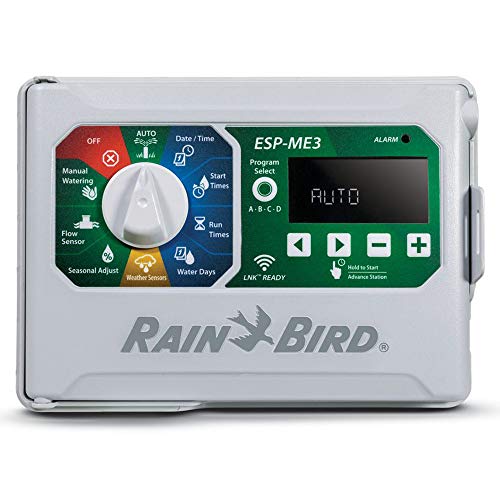
The Rain Bird ESP-ME3 takes a different approach from the rest of this list: it's modular. It starts at 4 stations and expands up to 22 stations by adding 3-station or 6-station expansion modules — without removing the controller from the wall or powering it down. That flexibility makes it the best choice if your irrigation needs are likely to grow. Installing a new garden section, adding a drip zone for raised beds, or expanding your landscape over the next few years? The ESP-ME3 scales with you.
Out of the box, the ESP-ME3 is a capable conventional controller with indoor and outdoor mounting options via its weatherproof cabinet. Smart capability is added by upgrading with the Rain Bird LNK WiFi module (sold separately) and an optional WR2 rain sensor. Once upgraded, you get full app control, remote access, and enhanced scheduling through the Rain Bird app. The modular approach means you only pay for smart features when you're ready for them — and the base unit is still a solid, reliable workhorse on its own.
This controller is the most installation-flexible option on the list. The included outdoor cabinet and power plug support a wide range of mounting configurations. For a contractor installing across multiple sites, or a homeowner who wants room to grow without replacing the entire controller down the road, the ESP-ME3 is the smart long-term investment.
Pros:
Cons:
A "zone" (a section of your irrigation system controlled by a single valve) is the most fundamental spec to match. Count your existing zones before you buy — or plan your future zones if you're building a new system. Most home systems fall in the 4–8 zone range. Here's a quick breakdown:
Don't buy more zones than you need — you'll pay for capacity you never use. But don't cut it too close either. If you're at 7 zones now and planning to expand, go straight to the 8-zone model.
This is the feature that separates a smart controller from a programmable timer. True weather intelligence does more than check whether it's raining — it analyzes a combination of factors to decide whether your scheduled watering cycle makes sense:
Rachio's Weather Intelligence is the benchmark on this list. Rain Bird and Hunter Hydrawise also offer strong weather-based scheduling. If cutting water waste is your primary motivation, prioritize this feature above most others.
You'll be living with the app every time you adjust a schedule, check a run, or get an alert. Poor app design is genuinely frustrating — and some controllers that nail the hardware fall short on software. Before buying, check recent app reviews on the App Store and Google Play for the specific controller you're considering. Look for:
Smart home integration — Alexa, Google Assistant, Apple HomeKit, SmartThings — adds voice control and automation possibilities. If you already use one of these platforms heavily, confirm compatibility before purchasing. Rachio leads on breadth of integration; Rain Bird and Orbit cover the major platforms as well.
Most controllers on this list can be mounted in a garage or utility room — the safest and most common location. But if your valve box is outside and running wires indoors is impractical, you need a unit rated for outdoor exposure. The Orbit B-hyve XR and B-hyve 6-Zone both support outdoor mounting. The Rain Bird ST8I-2.0 is indoor-only. The Rain Bird ESP-ME3 includes an outdoor-rated cabinet. Check the IP rating (a standard measure of dust and water resistance) if outdoor installation is a must for your setup. Also consider WiFi signal strength from your intended mounting location — the Orbit B-hyve XR's extended range antenna is a meaningful advantage here.
A regular sprinkler timer runs on a fixed schedule you program manually — it waters Tuesday and Friday at 6am regardless of whether it rained Tuesday morning or a frost is coming Thursday night. A smart sprinkler controller connects to your home WiFi and integrates with local weather data to make automatic adjustments. It skips or modifies scheduled runs based on rainfall, temperature, wind, and soil conditions. You control it from your phone from anywhere, receive alerts when something's wrong, and typically save 30–50% more water than a fixed-schedule timer over the course of a season.
Each zone corresponds to one valve that controls a section of your irrigation system. Count your existing valves to determine your current zone count. Typical residential yards need 6–8 zones: separate zones for front lawn, back lawn, side yards, garden beds, and drip irrigation areas. If you're installing a new system from scratch, plan zones based on plant type (lawn vs. shrubs vs. drip lines all have different water needs and should be on separate zones) and sun exposure. When in doubt, buy one zone more than you currently need — expansion is easier when you have headroom.
For most homeowners with an existing sprinkler system, swapping a controller is a straightforward DIY job. You're disconnecting wires from your old controller's terminals and reconnecting them to the labeled terminals on the new one — no plumbing or new electrical work required. The most time-consuming step is usually matching wires to zones, which is easier if you label each wire before disconnecting. Controllers like Rachio and Rain Bird are specifically designed for easy DIY installation and include setup guides in their apps. Most installs take 20–45 minutes. If you're wiring a brand-new system with no existing controller, you may want a professional for the valve and wiring runs.
Most do not charge ongoing subscription fees for core functionality. Rachio, Rain Bird, Orbit B-hyve, and Hunter Hydrawise all offer their weather intelligence and remote control features free of charge via their apps. Netro explicitly commits to lifetime free cloud service. Some brands offer optional premium tiers with advanced analytics or multi-property management, but the essential smart features — weather skips, remote access, scheduling — are free on every controller in this guide. That said, always verify the current fee structure before purchasing, as policies can change.
Yes — and the savings are well documented. The EPA estimates that smart irrigation controllers save the average household around 8,800 gallons of water per year. At typical U.S. water rates, that translates to $50–$150 annually depending on your location and system size. Most controllers pay for themselves within 2–3 seasons purely through water savings. You also reduce wear on your lawn from overwatering (a common cause of fungal problems and root rot) and avoid the fine-waste cycle of watering right before or after rain. Some utilities offer rebates of $50–$100 for installing WaterSense-certified controllers, which can bring your payback period down to a single season.
All the controllers on this list use 2.4GHz WiFi rather than 5GHz. That's the right choice for this application. 2.4GHz has significantly longer range and better penetration through walls and building materials than 5GHz — important when your controller is mounted in a garage, utility room, or on an exterior wall potentially far from your router. If your router is dual-band (broadcasts both 2.4GHz and 5GHz), your controller will connect to the 2.4GHz band specifically. If your network uses the same name (SSID) for both bands, your controller will still find and use 2.4GHz automatically on most modern routers. Signal strength matters more than raw frequency — the Orbit B-hyve XR's extended range antenna is specifically worth noting if your mounting location is more than 50 feet from your router.
 |
 |
 |
 |

About Truman Perkins
Truman Perkins is a Detroit-based SEO consultant who's been in the business for over a decade. He got his start helping friends and clients get their websites off the ground, and he continues to do so today. In his free time, Truman enjoys learning and writing about gardening - something he believes is a natural stress reliever. He lives with his wife, Jenny, and their twins in Detroit.


Get new FREE Gifts. Or latest free growing e-books from our latest works.
Disable Ad block to reveal all the links. Once done, hit a button below
|
|
|
|
 rinjal