reviewed by Christina Lopez
FoxFarm Ocean Forest is our top pick for herb containers in 2026 — its aged forest products and bat guano deliver the drainage and fertility that Mediterranean herbs like basil and rosemary demand from the very first watering. If you grow herbs in pots, the potting soil you choose matters far more than the fertilizer schedule you follow, because roots confined to a container depend entirely on what you pack around them for moisture, oxygen, and nutrients.
Herb roots are unforgiving of compacted, waterlogged, or nutrient-depleted media. Unlike garden beds, a container has no reservoir of soil biology to fall back on, so the mix you buy is the entire ecosystem your plants get. Explore our full gardening reviews to see how potting soil fits into the broader picture of container gardening success. The wrong bag leaves you with leggy, bitter-tasting herbs; the right one gives you dense, fragrant growth through an entire growing season.
We tested and evaluated seven leading potting soils specifically against the demands of culinary and ornamental herbs — drainage speed, nutrient longevity, microbial activity, and pH range. Whether you are growing a windowsill pot of thyme or an outdoor tiered planter packed with basil, mint, and parsley, the options below cover every budget and growing scenario you will encounter in 2026. Pair whichever mix you choose with containers that have adequate drainage holes; our guide to the 15 Best Pots for Herbs is a logical companion read once you have settled on a soil.

Contents







FoxFarm Ocean Forest earns its reputation among serious herb growers because it combines the drainage of a quality peat-and-perlite base with a rich coastal blend of crab meal, shrimp meal, earthworm castings, and aged bat guano. That combination creates a naturally fertile, slightly acidic pH range of 6.3–6.8, which sits squarely in the sweet spot for most culinary herbs including basil, cilantro, parsley, and oregano. You get a ready-to-use mix that requires no amendment for the first 30 to 60 days, letting you plant straight from the bag without any guesswork about initial feeding.
The 1.5 cubic foot bag is generous enough to fill several 10- to 12-inch herb containers at once, and the texture stays loose and airy even after weeks of regular watering. Ocean Forest resists compaction better than most budget mixes, which matters enormously for herbs like rosemary and thyme that need their roots to breathe freely between irrigations. Because this mix is designed specifically for containers rather than in-ground use, it drains at a rate that prevents the anaerobic root conditions that destroy Mediterranean herb varieties faster than any pest or disease.
One thing worth noting is that Ocean Forest's native fertility is high enough that you should hold off on supplemental fertilizer for the first four to six weeks after potting; overfertilizing during that window can push herbs toward excessive foliar growth at the expense of the essential oil concentration that makes them flavorful and aromatic. After that initial period, a diluted liquid feed every two weeks keeps things moving through the full season.
Pros:
Cons:
Happy Frog distinguishes itself from Ocean Forest primarily through its custom blend of soil microbes — beneficial bacteria and mycorrhizal fungi that colonize root zones and improve nutrient uptake efficiency in ways that no amount of raw fertilizer can replicate. If you want your herbs to develop robust, extensive root systems rather than just fast top growth, Happy Frog gives you that biological infrastructure from day one. The earthworm castings, bat guano, and aged forest products in this blend create a humus-rich medium that supports microbial populations far better than synthetic or sterile mixes.
The 12-quart size makes Happy Frog practical for a single large planter or two to three medium herb pots, which suits indoor growers who want premium quality without committing to a bulk purchase. The texture is slightly more moisture-retentive than Ocean Forest, which actually benefits moisture-loving herbs like basil, mint, and chives that prefer their roots to stay consistently damp rather than drying out between waterings. For drought-tolerant Mediterranean herbs, you may want to blend in a small amount of additional perlite to accelerate drainage.
Happy Frog's microbial amendments remain active through at least the first 60 to 90 days in most conditions, and you can reinvigorate the biology mid-season with a compost tea or a mycorrhizal inoculant drench. This makes it one of the most sophisticated options in the consumer potting soil market, delivering a level of biological complexity that previously required mixing your own amended media from multiple components. For organic herb growers who want the full spectrum of organic potting soil options, Happy Frog deserves a top-three consideration every time.
Pros:
Cons:
Espoma has been a trusted name in organic gardening for decades, and their 16-quart potting mix delivers a well-rounded, certified-organic blend that works across virtually every herb variety you might grow in containers. The base of sphagnum peat moss, humus, and perlite creates a structure that balances moisture retention with drainage — a trickier balance to achieve than it sounds, and one that many cheaper mixes get badly wrong. Espoma's proprietary Myco-Tone blend of endo and ecto mycorrhizae is the feature that sets this product apart from generic organic mixes at a similar price point.
The enrichment layer of earthworm castings, alfalfa meal, kelp meal, and feather meal provides a slow-release fertility profile that feeds your herbs gradually over several months without the risk of salt buildup that synthetic fertilizer-amended mixes carry. This makes Espoma especially suitable for container herb gardens where you are applying tap water regularly, because high-salt mixes progressively harm root cells and reduce uptake efficiency over the course of a season. With Espoma, you can water generously without worrying about accumulating soluble salt damage.
The 16-quart bag size is sensible for gardeners running four to six herb pots simultaneously, and the mix performs equally well indoors on a sunny windowsill or outdoors on a south-facing balcony. One practical note: sphagnum peat moss, while excellent for moisture retention, can become hydrophobic if it dries out completely, so keep your Espoma-filled containers consistently moist — never letting the medium dry to a bone-dry, powder-like state between waterings. According to USDA National Organic Program standards, Espoma's certified organic formulation meets the requirements for use in certified organic herb production.
Pros:
Cons:
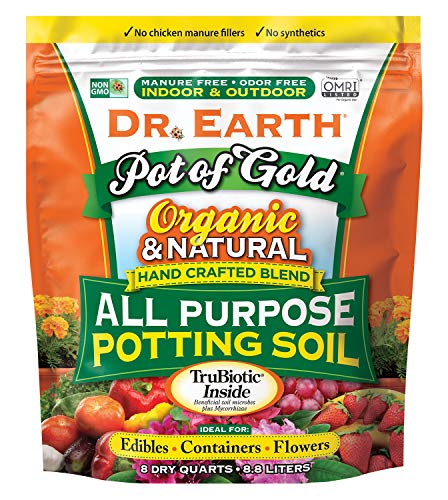
Dr. Earth Pot of Gold is the go-to choice when you want a premium organic potting soil in a smaller, more manageable quantity — the 8-quart bag is perfect for filling hanging baskets, small windowsill planters, or individual four- to six-inch herb pots without the waste that comes from opening a large bag and not being able to use it all before it dries out. The all-purpose formulation is genuinely versatile, performing reliably for everything from tender basil seedlings to established woody herbs like rosemary and sage.
Dr. Earth's approach to fertility relies on a blend of alfalfa meal, feather meal, kelp meal, and fish bone meal that releases nutrients in response to microbial activity rather than simply dissolving in water on first contact. This biological activation mechanism means your herbs receive consistent nutrition even during periods of slow growth, such as shorter winter days or cooler temperatures on an indoor windowsill. The inclusion of beneficial soil organisms and mycorrhizae in the mix further supports root development across both indoor and outdoor applications.
The container versatility is a genuine strength — you can use this mix in hanging baskets, window boxes, traditional terra cotta pots, and fabric grow bags with equal confidence. If you are currently exploring the best containers to pair with this mix, our breakdown of the 12 Best Pots for Basil covers the specific container requirements that culinary herb varieties like basil respond to best, including pot size, material, and drainage configuration.
Pros:
Cons:
Coast of Maine sources its ingredients from the Maine coastline, and that origin shapes everything about this product's performance profile. The lobster and crab shell meal component is a particularly interesting addition — shellfish meal is rich in chitin, a compound that not only provides slow-release calcium and nitrogen but also stimulates beneficial soil microorganisms and has been shown to suppress fungal root pathogens, which is a genuine concern in the humid microclimate of a densely planted herb container. This is the mix you want when root health and soil structure longevity matter as much as initial fertility.
The 16-quart bag is assembled around a foundation of sphagnum peat moss, compost, and perlite — a tried-and-true structural combination — but the kelp meal and shellfish amendments give it a mineral complexity that purely peat-and-perlite mixes lack. The perlite content promotes the aeration and drainage that oregano, thyme, lavender, and other Mediterranean herbs require, while the compost fraction brings the humic acids and water-holding capacity that prevent moisture stress during hot outdoor growing conditions. The result is a mix that revitalizes itself biologically with each watering rather than simply depleting over time.
Coast of Maine particularly excels in raised bed planters, window boxes, and large outdoor containers where soil structure must hold up through an extended growing season of six months or more. You will notice the difference most clearly in the second and third month of growth, when conventionally amended mixes begin to compact and exhaust their fertility but Bar Harbor Blend continues to support vigorous growth through its ongoing biological activity.
Pros:
Cons:
Miracle-Gro's Performance Organics line represents the brand's answer to gardeners who want certified organic ingredients without sacrificing the rapid results that made conventional Miracle-Gro famous. The 6-quart 2-pack format gives you 12 quarts total at a price that competes directly with specialty organic brands, and the three-month organic feeding window is a genuine performance advantage for herb growers who want low-maintenance nutrition during the peak growing season. If you want organic credentials alongside the convenience and performance consistency that Miracle-Gro has built its reputation on, this is the container mix to reach for in 2026.
The Performance Organics formula achieves its three-month feeding window through a combination of naturally derived plant foods embedded in the mix at potting time, which release gradually as the medium wets and dries with each irrigation cycle. This release mechanism works particularly well for herbs that are watered on a consistent schedule, because the steady moisture fluctuation keeps the organic nutrient complex biologically active throughout the delivery period. Herbs grown in this mix typically establish faster and produce more abundant leaf growth in the first 60 days compared to unfed alternatives.
The all-natural ingredients and organic certification make this suitable for use with edible culinary herbs where input transparency matters to you. The 2-pack format is convenient for stocking a growing season's supply, and Miracle-Gro's distribution network means you can replenish it from virtually any garden center or big-box retailer rather than ordering online and waiting for shipping.
Pros:
Cons:
Miracle-Gro's flagship Potting Mix remains the bestselling container medium in North America for a straightforward reason: it delivers reliable, consistent results at a price that makes container gardening accessible to anyone, regardless of budget. The six-month feeding window built into this mix is the longest of any product reviewed here, which gives you a substantial low-maintenance growing window before you need to think about supplemental feeding for your herbs. For new container gardeners who want a no-fuss approach that consistently outperforms generic store brands, this 8-quart 2-pack is the sensible starting point.
The mix is formulated with Miracle-Gro's proprietary slow-release fertilizer technology, which activates with each watering to deliver controlled amounts of NPK nutrition to your herb roots over the full six-month period. This approach works well for fast-growing annual herbs like basil, dill, cilantro, and parsley that need consistent nitrogen availability to support rapid foliar production. The lightweight, well-aerated texture prevents the compaction that plagues cheaper potting soils, keeping drainage fast and root oxygenation strong even in small four- to six-inch containers.
The non-organic formulation means it lacks the biological complexity of FoxFarm or Espoma products, but for many home herb growers who prioritize consistent results over certified organic status, that is an acceptable trade-off. The 8-quart 2-pack format fills a good range of container sizes without requiring you to store a large open bag, and the price per quart is among the lowest of any quality container mix available in 2026. If you are pairing this with the right containers, our selection of Best Pots for Indoor Plants covers the drainage and material considerations that complement this mix's performance profile indoors.
Pros:
Cons:
Selecting a potting soil for herbs involves evaluating several specific factors that matter more for container herb culture than for general container gardening. The factors below are the ones that separate a thriving herb container from a struggling one through the full 2026 growing season.
Drainage is the single most important characteristic of any potting soil you use for herbs. The majority of culinary herbs — rosemary, thyme, oregano, sage, lavender, and marjoram — evolved in Mediterranean climates with fast-draining, low-organic-matter soils and significant drying periods between rainfall events. In a container, slow-draining soil creates the anaerobic root zone conditions that kill these plants faster than drought, frost, or pest pressure combined.
For culinary herbs that you are growing to eat, the fertility source in your potting mix deserves more scrutiny than it gets with ornamental container plants. Organic fertility sources — bat guano, earthworm castings, kelp meal, alfalfa meal — feed your herbs through biological processes that also support the soil microbiome responsible for nutrient cycling. Synthetic fertilizers deliver nutrients directly but do not build the biological infrastructure that protects root health over a long growing season.
Most culinary herbs prefer a slightly acidic to neutral pH range of 6.0 to 7.0, with the majority performing optimally between 6.2 and 6.8. Outside this range, nutrient lockout occurs — even when your soil contains adequate fertility, the plants cannot absorb it efficiently because the pH makes key mineral compounds insoluble. Most quality potting soils are formulated and tested to fall within this range at the time of manufacture, but pH can drift over time with irrigation water quality and fertilizer additions.
The relationship between container volume and potting mix selection is often overlooked, but it directly affects how quickly your mix exhausts its fertility and how often you need to water. Larger containers buffer temperature and moisture fluctuations better than small ones, which means the premium biological activity in an organic mix remains more consistently active in a 10-inch pot than in a four-inch pot where temperature and moisture swing dramatically with each watering.
Potting soil is specifically engineered for the confined environment of a container, where drainage, aeration, and nutrient density operate under fundamentally different constraints than in-ground garden soil. Garden soil compacts densely in pots, restricts root oxygenation, and drains poorly — all of which are lethal conditions for most herb varieties. Quality potting mixes contain perlite, bark, or other structural amendments that maintain an open texture in confined containers throughout the entire growing season. Never use raw garden soil in herb containers; the results are consistently poor, regardless of how fertile your garden soil is outdoors.
You can reuse old potting soil, but it requires preparation before adding fresh herbs. After a full growing season, most potting mixes are depleted of their original fertility, compacted from repeated watering, and potentially harboring root pathogens from the previous plants. To refresh used potting soil effectively, break it up to restore aeration, remove all old root material, and amend with earthworm castings or compost at a ratio of one part amendment to four parts used mix. Sterilizing used mix in a 180°F oven for 30 minutes eliminates most pathogens. Premium organic mixes generally refresh more successfully than synthetic-fertilizer-amended mixes because the biological structure has more capacity to regenerate with the addition of fresh organic matter.
Mediterranean herbs — rosemary, thyme, oregano, lavender, sage, and marjoram — are the most demanding when it comes to drainage. These herbs evolved in rocky, fast-draining soils and will develop root rot within days in waterlogged conditions. For these varieties, use a mix with a high perlite content, or blend additional perlite into any of the products reviewed above at roughly 20 to 25 percent by volume. FoxFarm Ocean Forest and Coast of Maine Bar Harbor Blend are the two options in this review that already drain fast enough for Mediterranean herbs without amendment in most container configurations. Mint, basil, parsley, and chives tolerate — and often prefer — more moisture-retentive conditions, making Happy Frog or Espoma a better fit for those varieties without modification.
The answer depends entirely on the mix you choose. Pre-amended organic mixes like FoxFarm Ocean Forest and Happy Frog deliver sufficient fertility for the first 30 to 60 days without any supplemental feeding — starting fertilizer during that initial window risks over-fertilization and bitter-tasting herbs. After the initial amendment period is exhausted, a diluted liquid fertilizer every two weeks during the active growing season maintains strong growth without pushing excessive soft-tissue development. Synthetic-fertilizer-amended mixes like Miracle-Gro's products provide built-in feeding for three to six months, after which you transition to the same biweekly liquid feeding schedule. Always follow label rates; halving the recommended dosage for culinary herbs is a reasonable practice that produces better flavor concentration than full-strength feeding.
Conventional potting mixes with synthetic fertilizer amendments are safe for growing edible herbs — the synthetic nutrients they contain are water-soluble compounds that do not accumulate in leaf tissue at harmful concentrations under normal growing conditions. The preference for organic mixes among culinary herb growers is driven primarily by concerns about soil biology and long-term fertility management rather than acute safety. That said, if you are growing herbs for household culinary use and want complete transparency about inputs, certified organic mixes eliminate any ambiguity. The biological advantages of organic mixes — active soil microbiome, slow-release nutrition, mycorrhizal support — are genuine performance benefits beyond just certification, and they typically produce herbs with better essential oil concentration and flavor complexity than synthetically fertilized counterparts.
For a productive container herb garden, individual herb plants need a minimum of six inches of pot diameter, with 10 to 12 inches preferred for vigorous growers like basil and mint. A single 10-inch pot holds approximately two quarts of potting mix. For a mixed herb container with three to four different varieties, a 14- to 16-inch planter requires six to eight quarts of mix. A 1.5 cubic foot bag (like FoxFarm Ocean Forest) fills approximately 12 to 14 standard 10-inch containers, making it economical for gardeners running multiple pots simultaneously. Err on the side of larger containers rather than smaller ones — herb roots that are constrained by a too-small pot exhaust water and nutrients faster, require more frequent maintenance, and produce less abundant harvests than the same varieties given adequate root volume to develop.
The best potting soil for your herbs is the one that drains fast enough for the roots to breathe, feeds steadily enough for the leaves to thrive, and gives you a full season of productive harvests without constant intervention — everything else is secondary.
 |
 |
 |
 |

About Christina Lopez
Christina Lopez grew up in the scenic city of Mountain View, California. For eighteen ascetic years, she refrained from eating meat until she discovered the exquisite delicacy of chicken thighs. Christina is a city finalist competitive pingpong player, an ocean diver, and an ex-pat in England and Japan. Currently, she is a computer science doctoral student. Christina writes late at night; most of her daytime is spent enchanting her magical herb garden.


Get new FREE Gifts. Or latest free growing e-books from our latest works.
Disable Ad block to reveal all the links. Once done, hit a button below
|
|
|
|
 rinjal