reviewed by Christina Lopez
You're standing in the garden center — or scrolling Amazon at midnight — staring at a wall of weed killers and wondering which ones won't poison your dog, your kids, or your vegetable patch. It's a real dilemma. Chemical herbicides like glyphosate work fast, but the trade-offs are hard to ignore. Organic options have come a long way in 2026, and this guide cuts through the noise to show you exactly what's worth your money.
Organic weed killers typically rely on ingredients like citric acid, clove oil, vinegar (acetic acid), corn gluten meal, or iron-based compounds. They break down quickly in soil and don't leave the kind of residues that keep scientists busy writing alarming studies. If you pair a good organic killer with a solid organic lawn fertilizer program, you can genuinely have a clean, chemical-free yard. That's not marketing fluff — it just takes a bit more consistency than spraying glyphosate once a season.
We tested and researched seven of the most popular organic weed killers available right now. Below you'll find honest reviews, a buying guide, and answers to the questions we see most often. Whether your enemy is crabgrass, dandelions, clover, or a driveway full of mystery weeds, there's something on this list for you. Check out more lawn and garden picks over at our gardening reviews section.

Contents





DR Earth is one of the more trusted names in organic gardening, and the Final Stop herbicide lives up to that reputation. It's OMRI listed (certified for use in certified organic production), which means it's passed third-party scrutiny — not just a label claim. The active ingredients are plant-derived essential oils, primarily clove oil and citric acid, which work by disrupting the plant's cell membranes on contact. You'll see browning and wilt within hours on young, actively growing weeds.
Being a ready-to-use gallon, there's zero mixing involved. You just attach a sprayer head and go. That convenience factor is real — especially if you've ever dealt with concentrated formulas that require precise dilution math on a hot afternoon. The non-selective formula means it'll kill pretty much any green thing it touches, so be careful near lawn edges and garden beds. It's safe to use indoors as well, which makes it handy for greenhouse pathways or potted plant areas with unwanted hitchhiker weeds.
Performance is solid on young annual weeds. Established perennial weeds with deep taproots (think bindweed or thistle) may need multiple applications. That's not a knock — it's just the honest reality of any contact herbicide, organic or chemical. For routine lawn edge maintenance and patio cracks, this is a genuinely excellent, fuss-free option.
Pros:
Cons:
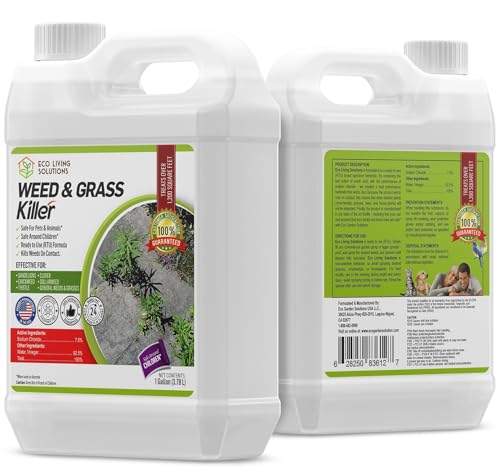
ECO Garden PRO leads with safety, and for good reason. If you have kids playing on the lawn or a dog who rolls in everything, the ingredient list here will give you peace of mind. The formula is built around natural white vinegar, organic rock salt, and biodegradable plant activators. No synthetic chemicals, no glyphosate, nothing that'll make you nervous when your toddler sits down in the grass an hour later.
The brand claims results within 24 hours, and that's not an exaggeration for actively growing annual weeds in warm, sunny conditions. The acetic acid (vinegar) in higher concentrations than household vinegar works by dehydrating plant tissue rapidly. Rock salt adds a persistent soil desiccation effect, which is worth knowing — avoid applying heavily near areas where you want to grow things later, since excessive salt can linger in soil. For driveways, sidewalks, pavement cracks, and gravel paths, this concern disappears entirely.
The ready-to-use gallon format is a convenience win. Coverage on a gallon is reasonable for most residential applications. The scent is strong — vinegar-based products almost always are — but it dissipates within a few hours. If you're treating large commercial areas like parking lots or farm pathways, you'd want to buy in bulk. For the average homeowner, one gallon goes a fair distance. This is also a strong pick for flower beds where you want to spot-treat between plants without worrying about harming beneficial insects or wildlife.
Pros:
Cons:
Natural Armor takes a slightly different approach by offering a concentrated formula rather than a ready-to-use spray. That one gallon goes much further because you're diluting it before application. The formula is built on a blend of natural acids and plant-derived ingredients — no glyphosate, and no petroleum-based solvents. The company describes the result as making weeds look like you took a torch to them, which is colorful but honestly pretty accurate based on user reports.
The "friendly for people and pets" claim holds up when the product is used as directed and allowed to dry. Application is described as spray-and-go, and because it's a contact killer, it works quickly — you'll see wilting and browning within hours on most target weeds. The broad list of use locations is genuinely useful: gravel areas, fence lines, foundations, rock walls, pavers, pool areas, water systems, and anywhere else you're trying to eliminate all vegetation. It's not a lawn-safe product, so keep that in mind.
The concentrated format does require a bit of measurement on your part, and you'll need your own pump sprayer. That's a small trade-off for the economy you get per treated square foot. If you're managing a larger property — long fence lines, a gravel driveway, outbuildings with overgrown edges — this concentrated gallon is where the value story really shines. Pair it with a quality lawn fertilizer routine for the grass areas you do want to keep, and you've got a clean management system going.
Pros:
Cons:
BioSafe Systems is the product for the serious organic gardener who needs certifications, not just label claims. This concentrate is EPA-registered, OMRI-listed, and carries USDA certification — a triple-header that most competitors can't match. It's a broad-spectrum, non-selective herbicide, meaning it kills a wide range of both broadleaf and grassy weeds without discriminating. The active mechanism is cell disruption — it starts destroying plant cells on contact, and you'll see visible results within two hours.
The "won't spread" characteristic is particularly valuable in a garden context. Unlike some herbicides that migrate through soil and harm nearby plants or affect future plantings, BioSafe's formula stays where you put it. That's a meaningful advantage when you're treating weeds right next to a raised bed or between rows in a vegetable garden. The four-day replanting window (after treatment, you can re-seed or plant within four days) is excellent and beats many competitors.
Being a concentrate, you control the dilution and therefore your cost per application. It works with standard pump sprayers. The speed — two hours to visible results — is impressive for an organic product and approaches the performance of synthetic contact herbicides. If you're maintaining organic container gardens or a certified organic growing operation, this is likely the one product on this list that fits your compliance requirements without compromise.
Pros:
Cons:
Natural Elements keeps things simple. The formula is vinegar-derived, free of synthetic herbicides, and safe around your family and pets. It's positioned as an accessible entry point into organic weed control — straightforward ingredients, straightforward pricing, and straightforward results. It targets most common broadleaf weeds and grasses effectively when applied in direct sunlight during peak growing hours.
One thing the brand is admirably honest about: this will kill grass. If you're spraying it near lawn edges to get dandelions, you need a steady hand, because it doesn't distinguish between weeds and your turf. That's not a flaw — it's just the nature of contact herbicides. Use it in flower beds, around landscaping trees, mulched areas, rock beds, and hardscaped zones where you want clean lines. Avoid drift onto lawn areas you want to keep.
The gallon size is ready to use, which removes any guesswork. For occasional spot-treating around a residential property, one gallon lasts a reasonable time. It's not the most powerful formula on this list — established perennial weeds may laugh at a single application — but for routine annual weed management in garden beds and pathways, it does the job without breaking the bank or introducing anything you'd be worried about. A good secondary option if you already have a primary lawn program going with something like a neem oil treatment for pest control.
Pros:
Cons:
Espoma plays a completely different game than every other product on this list. Rather than killing existing weeds, it prevents new weeds from germinating in the first place. The active ingredient is corn gluten meal (CGM), a natural byproduct of corn wet milling that inhibits root development in germinating seeds. This means crabgrass, dandelion seeds, and other annual weeds never get a foothold — their seeds sprout but can't establish roots and die off. According to the EPA's lawn and garden guidance, preventive approaches like pre-emergent treatments are among the most effective strategies for long-term weed management.
The timing matters enormously with this product. You apply it in early spring, before soil temperatures warm enough to trigger weed seed germination. That window typically falls around forsythia bloom time in most temperate regions. If you miss the window, it won't do much against weeds already established. This is a set-it-and-forget-it spring ritual, not an emergency treatment. The added benefit is the organic nitrogen content, which feeds your lawn as the corn gluten breaks down — so you're preventing weeds and feeding grass simultaneously.
The 25-pound bag covers a meaningful area, and you apply it with a standard drop or broadcast spreader (the same type used for lawn fertilizer). For an integrated organic lawn program — prevent new weeds in spring, spot-treat escaped ones with a contact killer during the season — this is the anchor product. It contains no sludges or toxic ingredients, just 100% corn gluten meal. If you're serious about organic lawn care, this belongs in your shed.
Pros:
Cons:
Bonide BurnOut earns its name. The formula is fast-acting and non-selective, targeting both broadleaf and grassy weeds with visible results within hours. What sets BurnOut apart is its cold-weather performance — it works in temperatures as low as 40°F (4°C), which is uncommon for organic contact herbicides. Most vinegar-based products need warm, sunny weather to perform well. If you're dealing with weeds in early spring or late fall, this is the organic product that'll actually work.
The formula becomes waterproof once it dries after application. That's a practical advantage — you don't need to watch weather forecasts and hope for three dry hours after spraying. This 32-ounce ready-to-use bottle is smaller than the gallon options elsewhere on this list, which makes it well-suited for targeted spot treatments rather than large-area blanket spraying. It's a grab-and-go format for a problem you notice while doing yard work.
The approved use areas are wide: borders, driveways, sidewalks, fence lines, barns, pastures, around buildings, and near mature tree bases. The non-selective nature means you follow the same caution as other products here — keep it away from lawn areas and plants you value. The smaller bottle size means a higher per-ounce cost compared to gallon concentrates, so think of it as a precision tool in your arsenal rather than a primary large-area treatment. For winter and shoulder-season weed control, or quick spot treatments in any weather, it's one of the most practical organic options available.
Pros:
Cons:
Not every organic weed killer works the same way, and picking the wrong type means buying it twice. Here's what to think through before you add one to your cart in 2026.
Contact herbicides (most of the products on this list) kill weeds that are already growing. They work on contact by destroying plant tissue. You spray, the plant wilts and dies. Pre-emergent herbicides like the Espoma corn gluten meal work differently — they prevent weed seeds from establishing roots in the first place. If you have a serious crabgrass or dandelion problem, the smartest long-term approach combines both: pre-emergent in early spring, contact killer for anything that gets through. Using only a contact killer without a preventive program means you're fighting the same battle every season.
Every organic contact killer on this list is non-selective — they'll kill whatever green plant they touch. That matters because your lawn is full of plants you want to keep. For spot-treating weeds in a garden bed or on a paver patio, non-selective is fine. For treating weeds within a lawn, you'd need a product designed to target broadleaf weeds while leaving grass unharmed. That type of selective organic herbicide is harder to find and less common in organic formulations, so most organic lawn programs rely on pre-emergent prevention plus physical removal for in-turf weeds. Pair your weed control routine with a strong organic lawn fertilizer to keep turf thick enough to crowd out weed competition naturally.
Ready-to-use products are convenient — you point and spray. Concentrated products require dilution but cover far more area per dollar. If you're treating a small garden bed or a cracked driveway, ready-to-use makes sense. If you're managing a large property, fence lines, or commercial areas, a concentrate is almost always better value. Calculate your approximate square footage before buying. A one-gallon concentrate at the right dilution ratio can cover ten or more times the area of a one-gallon ready-to-use product.
Most organic contact herbicides work best in warm, sunny conditions. Acetic acid (vinegar-based) products need heat and direct sunlight to perform well — applying them on a cloudy 55°F day will give you disappointing results. Bonide BurnOut is the outlier here, rated down to 40°F. For the best results with any contact killer: apply in the morning on a sunny day with no rain forecast for at least four to six hours. Young, actively growing weeds are always easier to kill than mature, established plants. Multiple applications two weeks apart will take down even stubborn perennials over time.
For most annual weeds in the right conditions, yes — organic contact killers are competitive with glyphosate in speed and effectiveness. The gap shows up with deep-rooted perennial weeds like bindweed or Canadian thistle, where systemic chemical herbicides (which travel into root systems) have an advantage. Organic killers are contact-only, so established perennials need multiple applications over several weeks. For routine lawn and garden maintenance in 2026, organic options perform well enough that many homeowners see no meaningful performance difference on common weeds like crabgrass, dandelions, and clover.
Most organic weed killers are considered pet-safe once they are fully dry. Drying time typically ranges from one to four hours depending on temperature and product. Vinegar-based and essential oil-based formulas break down quickly in the environment. Products like ECO Garden PRO are specifically marketed as safe for pets, children, bees, and fish. That said, you should still keep animals off treated areas until dry — fresh application is concentrated and could irritate paws or cause stomach upset if ingested. Always read the specific product label for the recommended re-entry interval.
Yes. Every contact organic herbicide on this list is non-selective, meaning it kills all green plant material it touches — including desirable lawn grass. Do not spray contact organic killers directly on turf you want to keep. Use them only on pathways, driveways, garden beds, and hardscaped areas. For in-lawn weed control, your best organic options are corn gluten meal (pre-emergent prevention) and physical removal. Dense, well-fertilized turf also naturally outcompetes weeds — a thick lawn leaves little room for weed establishment.
Annual weeds in active growth often die after one application in good weather conditions. Perennial weeds with established root systems usually require two to four applications spaced one to two weeks apart before they fully decline. The key is persistence — each application weakens the root system, and eventually the weed can no longer regenerate. Applying in bright sunlight and warm temperatures maximizes effectiveness per application. Don't expect a single spray to kill a two-year-old thistle instantly, but consistent treatment over a season will eliminate most persistent perennial weeds.
Yes, with care. Products like BioSafe Systems are specifically designed not to migrate through soil, making them safer near vegetable beds than many chemical alternatives. The four-day replanting window on BioSafe is particularly useful for garden management. Vinegar-based products can temporarily acidify soil, so avoid heavy, repeated application directly in active growing beds. Spot treatment at the edges of raised beds or along pathways between rows is generally fine. If you're concerned about soil pH, test before and after treatment — most organic contact killers have minimal lasting soil impact compared to salt-heavy formulas.
For driveways, sidewalks, patios, and other hardscaped surfaces, nearly any contact organic herbicide works well because you have no concern about surrounding plants or soil health. ECO Garden PRO and Natural Armor both have strong reputations for hardscape use. Bonide BurnOut is the best choice if you're dealing with weeds in cooler weather or inconsistent sun. The rock salt component in some vinegar-based products can be an advantage here since you don't mind a bit of lasting soil desiccation in a driveway crack — it just helps keep future weeds from establishing.
 |
 |
 |
 |

About Christina Lopez
Christina Lopez grew up in the scenic city of Mountain View, California. For eighteen ascetic years, she refrained from eating meat until she discovered the exquisite delicacy of chicken thighs. Christina is a city finalist competitive pingpong player, an ocean diver, and an ex-pat in England and Japan. Currently, she is a computer science doctoral student. Christina writes late at night; most of her daytime is spent enchanting her magical herb garden.


Get new FREE Gifts. Or latest free growing e-books from our latest works.
Disable Ad block to reveal all the links. Once done, hit a button below
|
|
|
|
 rinjal