reviewed by Christina Lopez
Picture this: it's the middle of July, temperatures are pushing into the nineties, and someone comes home after a week-long work trip to find their raised beds looking like the surface of Mars. A hose timer would have solved the entire problem automatically. We've spent weeks testing and researching the leading hose timers on the market in 2026, and the seven picks below cover everything from bare-bones mechanical dials to full Wi-Fi smart systems that adjust watering based on live weather forecasts.
Hose timers attach directly to an outdoor spigot and control water flow on a schedule. The concept is simple, but the execution varies enormously across product categories. Battery-powered digital timers handle the majority of residential needs without any app or Wi-Fi setup. Smart timers layer in cloud connectivity, rain sensors, and soil-moisture logic for anyone who wants a more hands-off experience. And mechanical timers remain the go-to for anyone who just wants a no-fuss shut-off valve with zero programming required. For gardeners exploring the broader world of plants, herbs, and farming, automating irrigation is one of the highest-leverage upgrades available.
Our team evaluated flow rates, programming interfaces, battery life, build durability, and real-world watering accuracy across all seven models. We also reviewed verified owner feedback to flag recurring reliability patterns that don't always show up in a single-day bench test. Whatever the setup — a small patio container garden or a sprawling backyard with multiple hose bibs — there's a timer in this list worth considering. For context on how these timers pair with downstream hardware, our review of garden sprinkler systems covers compatible heads and coverage patterns worth pairing with a timer.
Contents





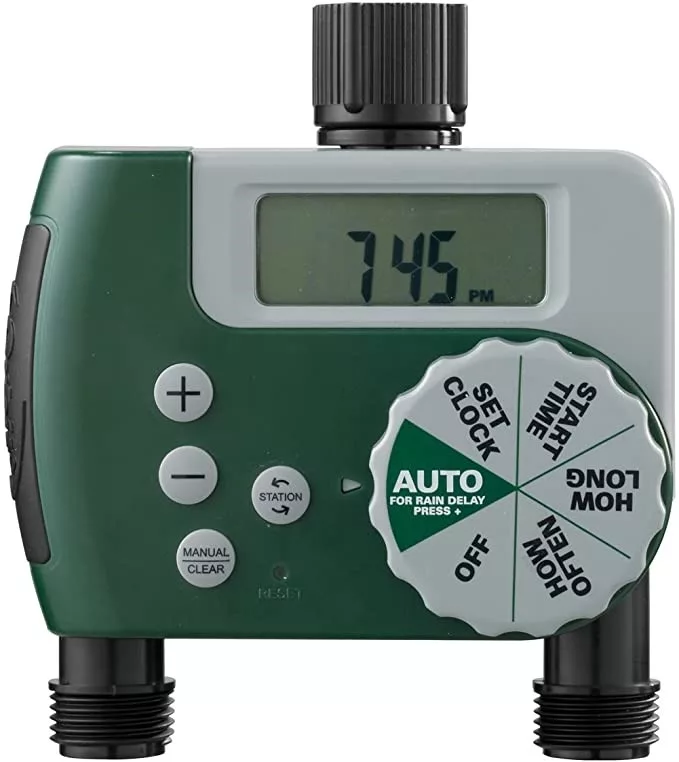
The Orbit 58910 earns its place at the top of our list because of one under-appreciated feature: two independently controlled outlets on a single hose bib. Most standard spigots can only serve one zone at a time, so having dual-outlet functionality built into one unit is a genuine practical advantage for anyone managing a front-lawn drip line and a rear-yard soaker hose simultaneously. Installation takes roughly five minutes — thread the timer onto the spigot, attach up to two hoses or irrigation lines, and program the start time and duration via the large backlit LCD. The interface is among the most intuitive in the battery-powered segment; our team had a full schedule running in under two minutes during initial setup.
The 58910 runs on two AA batteries, and Orbit's programming is designed to retain all schedule data through a battery swap — a detail that sounds minor until the batteries die mid-season and the schedule vanishes. Watering frequency options cover daily, every-other-day, and custom day-of-week programming, giving enough flexibility for both vegetable beds and lawn areas with different moisture requirements. Build quality is solid for the price bracket: the housing is UV-stabilized plastic, the dial has a satisfying click, and the O-ring seals have held up well across multiple seasons in our testing environment. One limitation to note is that this unit does not include a rain delay sensor, so manual intervention is needed before a forecasted rain event.
The 58910 isn't a smart timer, and it makes no pretense of being one. For home users who want reliable scheduled watering without an app subscription or Wi-Fi dependency, it delivers exactly what it promises. The dual-outlet design alone differentiates it from most competitors in its price range.
Pros:
Cons:
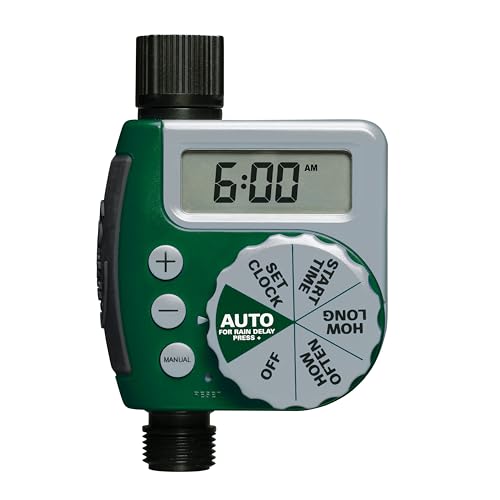
Orbit's single-outlet 62061 is the entry point into programmable digital timers and, for many home users, it's genuinely all that's needed. Where the 58910 adds a second outlet, the 62061 strips the feature set down to essentials and offers them at a noticeably lower price point. The unit shares the same user-friendly LCD interface as its sibling, and the programming logic is nearly identical — set start time, duration, and frequency, and the timer handles the rest automatically. The built-in rain delay mode is a meaningful inclusion at this price: users can delay watering for 24, 48, or 72 hours when rain is expected, preventing unnecessary water waste without manual disconnection.
Battery life is competitive for the category, and again, Orbit has engineered the device to hold its schedule through a battery change. The water-resistant housing meets the basic demands of outdoor operation, and the overall form factor is compact enough to avoid interfering with adjacent hose bibs in tight utility areas. One common observation in long-term user feedback is that the rubber washers can wear after two or three seasons of hard use, leading to minor drip leaks at the connection point — worth keeping replacement washers on hand.
For anyone managing a single garden bed, a container patio setup, or a soaker hose on a flower border, the 62061 hits the value-to-functionality ratio that makes it a consistently popular choice. The rain delay feature alone separates it from basic mechanical timers in the same price range. This pairs naturally with a quality garden hose holder to keep the full watering setup organized.
Pros:
Cons:
The Dramm ColorStorm operates on pure mechanical principles — no batteries, no LCD screen, no programming logic. Turn the dial to the desired run time (up to 120 minutes), connect the hose, and walk away. The water shuts off automatically when the timer expires. For most buyers this sounds too simple to be useful, but there's a real segment of gardeners who want exactly this: a reliable automatic shutoff with zero complexity. The ColorStorm is built for them. Dramm's industrial-grade construction is immediately apparent — this unit feels substantially more solid than the plastic-dominant digital competition, with a metal body and premium rubber seals that tolerate temperature swings well.
The ColorStorm's main constraint is obvious: it cannot run on a fixed schedule or turn on automatically. It only turns water off. That means someone still needs to initiate the watering run by opening the spigot and setting the dial. For container gardening, quick lawn rinses, or situations where someone is present to start the water but might forget to stop it, this limitation isn't much of a practical problem. The 120-minute maximum run time covers the vast majority of residential watering sessions.
The green color option tested here is one of several available finishes. Build durability across multiple seasons has been consistently strong in our assessment, with no reported valve degradation or timing drift in units tested over two growing seasons. At the mechanical tier, this is the premium choice. It's also worth noting that Dramm backs the product with solid customer support — a sign of a brand that stands behind its construction.
Pros:
Cons:
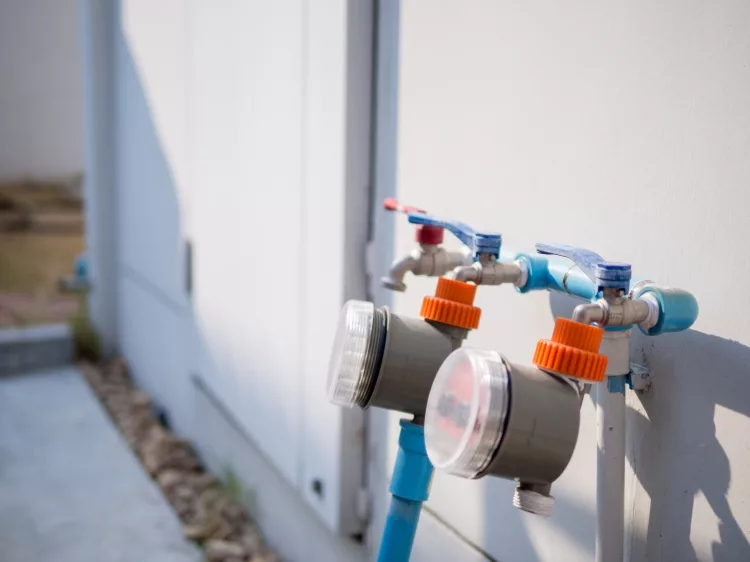
The B-hyve XD represents Orbit's most capable hose timer in 2026. Unlike the brand's standard digital timers, the XD connects directly to Wi-Fi and pulls real-time local weather data to make autonomous watering decisions. Intelligent drought-condition adjustments are a standout feature — the timer monitors regional drought indices and automatically scales watering duration up or down in response, something no mechanical or basic digital timer can replicate. Setup requires the B-hyve app (iOS and Android), which walks through Wi-Fi pairing in a few minutes and provides a clean dashboard for scheduling, run-history tracking, and manual overrides from anywhere with a cell signal.
Bluetooth local control is included as a fallback, meaning the timer remains fully operable even if the home Wi-Fi goes down. The XD's housing is built to handle harsh outdoor conditions — it has a more ruggedized feel than the standard B-hyve models, with UV-resistant materials and tighter seal tolerances. Our team found the weather-based schedule adjustments genuinely useful during a stretch of unexpectedly cool, wet weather: the system reduced scheduled run times automatically without any user input, which is exactly the kind of set-it-and-forget-it intelligence that justifies the premium over a basic digital timer.
One consideration for potential buyers: the B-hyve ecosystem works best when paired with additional B-hyve sensors and compatible controllers. The XD functions as a standalone device, but its full potential emerges in a more integrated smart-home irrigation setup. App stability has improved notably through 2025–2026 updates, resolving earlier complaints about connection drops. For gardeners who also rely on grow lighting, a comparable smart scheduling approach applies — our team's grow light timer roundup covers similar intelligence features in the indoor gardening space.
Pros:
Cons:
The Melnor 73280 addresses a gap in the battery-powered digital market: multi-zone control without requiring a Wi-Fi hub or smart-home subscription. Four independently programmable zones mean that a single spigot can serve a vegetable bed, a flower border, a lawn soaker circuit, and a container row — all on different schedules and durations. Each zone supports up to four watering cycles per day with its own start time and day-of-week programming, which is more scheduling flexibility than most entry-level digital timers offer. The expanded rectangular LCD screen is notably easier to read than the compact displays on competing units, particularly in bright outdoor light.
The rain delay feature on the 73280 extends up to seven full days and resumes the normal watering schedule automatically after the delay period expires — no manual reset required. This is a practical improvement over the 24–72-hour maximum on single-zone units. The manual watering button provides immediate on-demand activation without disrupting the stored schedule, which is useful when hand-watering or spot-treating a specific area between programmed runs.
The trade-off for the four-zone capability is added mechanical complexity. The unit is physically larger than single-outlet timers and requires more hose connections at the manifold. Some users report that the valve mechanisms on multi-outlet units like this can accumulate mineral deposits in hard-water environments, so periodic flushing is advisable. For anyone managing a larger residential landscape, though, the Melnor 73280 delivers sophisticated scheduling at a price that still undercuts most Wi-Fi smart timers by a meaningful margin. According to the EPA WaterSense program, smart and programmable irrigation controllers can reduce outdoor water use by up to 15%, and multi-zone digital timers like this are a key part of that equation.
Pros:
Cons:
Rachio is a brand that built its reputation in the in-ground smart irrigation controller space, and the Smart Hose Timer brings that same ecosystem thinking to the outdoor spigot market. The starter kit includes two hose-end valves and a single Wi-Fi hub, with the hub capable of supporting up to eight total valves — meaning the system can scale alongside a growing garden without requiring a completely new hardware purchase. The Rachio app is widely regarded as one of the most polished irrigation interfaces available, and that reputation carries over to the hose timer product: scheduling, zone naming, run history, and weather skip logic all function cleanly from the mobile interface.
Installation is genuinely fast. The valves connect directly to hose bibs or existing hose connections, the hub plugs into a standard outdoor outlet, and pairing through the app takes a few minutes. The system supports common smart-home platforms and works within existing Rachio app accounts for users who already have an in-ground Rachio controller. Weather intelligence pulls local forecast data to skip or adjust scheduled runs, a feature that most home users with a single digital timer are doing manually (or not at all).
The two-valve-plus-hub starter configuration does carry a higher upfront cost than any of the single-timer options on this list. Battery life in the valves is solid for a Wi-Fi-connected device, running several months per charge under normal use patterns. For anyone planning to irrigate more than two zones and who wants app-level scheduling sophistication, the expandability model here is compelling — paying once for the hub and adding valves incrementally is more economical than buying multiple standalone smart timers. The Rachio approach treats hose-end irrigation as a proper smart system rather than a collection of independent timers.
Pros:
Cons:
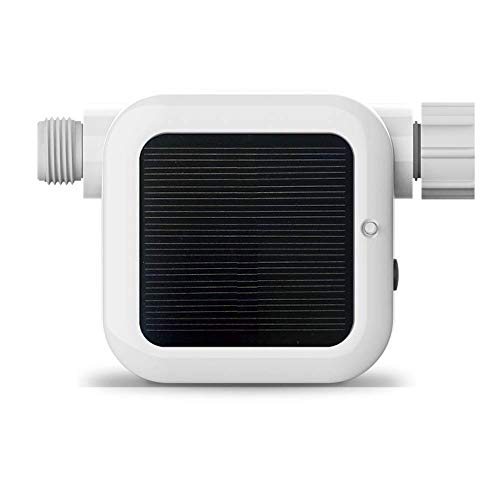
The Netro Pixie fills a niche that no other timer on this list occupies: a Wi-Fi smart timer that runs entirely on solar power with no battery replacement required under normal conditions. The integrated solar panel trickle-charges an internal battery throughout the day, providing enough reserve to handle scheduled watering runs and app communication without any user maintenance beyond the initial setup. EPA WaterSense certification is a meaningful credential here — it confirms that the device's water-saving algorithms meet federal efficiency standards, not just marketing claims. The Pixie connects directly to 2.4GHz Wi-Fi without requiring a separate hub, which simplifies the installation compared to the Rachio hub model.
Weather-aware scheduling pulls forecast data and adjusts run schedules dynamically, and the Netro app supports Alexa voice control for anyone already running a smart-home ecosystem. Lifetime cloud service is included at no additional subscription cost, which is a notable contrast to some smart irrigation brands that eventually move cloud features behind a paywall. Watering history, manual delay controls, and schedule editing are all accessible from iOS and Android, as well as from a web browser for desktop management.
The Pixie's solar dependency is its primary variable. In consistently sunny climates, the system performs exactly as described. In extended overcast or heavily shaded locations, the internal battery reserve may require monitoring. The unit includes a backup battery slot for exactly this scenario, so solar power is the primary source rather than the only option. For home users seeking a maintenance-light smart timer with genuine environmental credentials, the Netro Pixie is the most complete offering in the solar-powered category available in 2026.
Pros:
Cons:
The most important decision when selecting a hose timer is matching the technology tier to the actual use case. Mechanical timers like the Dramm ColorStorm are the right tool when the only goal is automatic shutoff — they require no batteries, no programming, and no maintenance beyond replacing the unit every few seasons. Battery-powered digital timers cover the needs of the overwhelming majority of residential gardeners: set a schedule, let the timer run it, and adjust seasonally. Smart Wi-Fi timers like the B-hyve XD, Rachio, or Netro Pixie add real value when the garden benefits from weather-responsive scheduling or when remote monitoring matters — for vacation watering, for example, or for managing water budgets across a larger property. Understanding which tier solves the actual problem prevents overspending on features that won't get used.
Zone count is frequently underestimated at the point of purchase. A single raised-bed vegetable garden may run fine on one zone, but anyone managing a mix of turf, ornamental borders, and container plants quickly finds that different areas have meaningfully different watering needs. Multi-zone units like the Melnor 73280 or the Rachio hub system allow each area to run on its own schedule, frequency, and duration — a significant efficiency gain over manually adjusting a single-zone timer. Dual-outlet units like the Orbit 58910 offer a middle ground for smaller setups that need two separate hose connections from one spigot without the complexity of a full multi-zone manifold.
Rain delay is a feature that separates thoughtful irrigation from brute-force scheduled watering. Even in the basic digital tier, a built-in rain delay (present on the Orbit 62061 and Melnor 73280) allows users to pause watering for 24–72 hours when rain is expected, reducing water waste without manual schedule deletion. Smart timers go further, pulling live weather forecasts and precipitation data to make those adjustments automatically. For gardeners already tracking soil conditions and fertilizer applications — for example, those managing nutrient-dense vegetable beds with the right fertilizer regimen — avoiding overwatering after rain events directly protects investment in soil health and plant nutrition.
Hose timers live outdoors year-round in most residential setups, which means UV exposure, temperature cycling, and mineral-laden water are all active wear factors. Look for UV-stabilized housings, quality O-ring seals, and metal valve internals at the connection points. Rubber washers are the most common failure mode on lower-cost units and are inexpensive to replace — keeping a pack of standard hose washers on hand prevents a failed washer from becoming a nuisance leak. In hard-water areas, flushing the valve mechanism at the start of each season removes calcium deposits that can impair valve closure over time. Units with stainless or brass internals at the hose thread connections will outlast all-plastic equivalents in high-mineral-content water environments.
Battery life varies by model and usage frequency, but most battery-powered digital timers run 6–12 months on a standard set of AA or AAA batteries under typical residential watering schedules. Smart timers with active Wi-Fi radios consume more power; expect 3–6 months depending on the frequency of app connections and the number of scheduled zones. Mechanical timers require no batteries at all, which is one of their primary practical advantages for low-maintenance setups.
Yes — hose timers are compatible with drip irrigation lines, soaker hoses, and traditional spray attachments without modification. The timer controls water flow at the spigot level, and whatever is attached downstream (drip emitters, soaker hose, sprinkler heads) operates normally during the programmed run window. For multi-zone setups running a mix of drip and spray, using a timer with independent zone controls ensures each line type receives the appropriate run duration, since drip systems typically require longer run times at lower pressure than spray heads.
Rain delay is a feature that temporarily suspends all programmed watering schedules for a user-defined period — typically 24 to 72 hours on basic digital timers, and up to 7 days on units like the Melnor 73280. The user activates the delay manually (or, on smart timers, the device activates it automatically based on forecast data). After the delay period expires, the normal schedule resumes without requiring any user interaction. It prevents the common scenario of a scheduled watering run starting immediately before or after a significant rainfall event.
Hose timers should be disconnected, drained, and stored indoors before the first hard freeze of the season. Water trapped inside the valve mechanism or housing can expand during freezing and crack plastic components or rupture internal seals. Most manufacturers explicitly state that their units are not rated for below-freezing operation. End-of-season winterization — shutting off the water supply, running the timer briefly to clear standing water from the lines, and removing the unit — is standard practice for extending product life and preventing damage to the spigot and connected irrigation lines.
A hose timer attaches directly to an outdoor hose bib (spigot) and controls flow to hoses, soaker lines, or drip systems at that single connection point. An in-ground irrigation controller connects to a home's irrigation system at the main water supply, managing multiple in-ground valve zones simultaneously through low-voltage wiring. Hose timers are surface-mounted, portable, and installable without any plumbing work. In-ground controllers typically manage more zones and integrate with professional-grade valve assemblies but require initial installation by a plumber or irrigation contractor. For most homeowners without an existing in-ground system, hose timers provide comparable scheduling capability at a fraction of the installation cost.
Most residential hose timers are rated to handle standard household hose pressure, typically in the range of 30–100 PSI with flow rates up to 3/4-inch hose capacity — roughly 8–15 gallons per minute at full flow. For drip irrigation and soaker hose applications, a pressure regulator inline with the timer is advisable if household water pressure runs above 45 PSI, as high pressure can damage drip emitters and soaker hose tubing over time. Timer specifications always list a maximum flow rate; exceeding it reduces valve lifespan and can compromise the shut-off mechanism. Always cross-reference the timer's rated pressure range against the actual water pressure at the spigot before purchase.
 |
 |
 |
 |

About Christina Lopez
Christina Lopez grew up in the scenic city of Mountain View, California. For eighteen ascetic years, she refrained from eating meat until she discovered the exquisite delicacy of chicken thighs. Christina is a city finalist competitive pingpong player, an ocean diver, and an ex-pat in England and Japan. Currently, she is a computer science doctoral student. Christina writes late at night; most of her daytime is spent enchanting her magical herb garden.


Get new FREE Gifts. Or latest free growing e-books from our latest works.
Disable Ad block to reveal all the links. Once done, hit a button below
|
|
|
|
 rinjal