If you need one reliable pick right now, the GE BR30 LED Grow Light Bulbs deliver balanced full-spectrum light at a price that won't break your budget — and they fit any standard light socket you already own. Succulents are tough plants, but low indoor light is the number-one reason they stretch, fade, and die. The right grow light changes everything.
In 2026, indoor succulent growing has exploded. Windowsills fill up fast, apartments block natural sun, and the Pacific Northwest exists. Whether you're maintaining a single pot on your desk or running a shelf full of echeverias and haworthias, you need a light that mimics the intensity of the outdoor sun without cooking your plants. Succulents want bright, indirect light for around 12–16 hours a day. Most standard indoor bulbs simply don't provide enough photosynthetically active radiation (PAR — the wavelengths plants actually use) to keep them compact and colorful.
We've tested and researched the best options available to you right now. From affordable screw-in bulbs to designer pendant lights that double as home decor, this list covers every budget and setup. If you're also thinking about fertilizing your indoor plants alongside better lighting, that combination makes a real difference in succulent health. Read on for the full breakdown.

Contents






The GE BR30 is the grow light you recommend to every first-time succulent grower without hesitation. It screws into any standard BR30 fixture — a floor lamp, a recessed ceiling socket, a clip-on utility fixture — and produces a natural white light that looks great in your living room instead of casting that ugly purple or red glow. You get two bulbs per pack, and each runs at just 9 watts while providing 16 PPF (micromoles per second) of plant-usable light across a balanced spectrum.
For succulents specifically, the balanced spectrum matters. Plants need blue wavelengths for compact, tight rosette growth and red wavelengths for flowering. GE includes both without tipping the spectrum so far toward red or blue that the light looks unnatural to human eyes. The low heat output is a genuine advantage here too — succulents are sensitive to heat stress, and a bulb that runs cool means you can position it closer to your plants for better coverage without worrying about scorching.
With a rated lifespan of 25,000 hours, you're looking at years of use before replacement. These aren't the highest-output bulbs on this list, but for a small collection of four to eight succulents on a shelf, they're genuinely all you need. Pair them with a grow light timer to automate your 12-hour light cycles.
Pros:
Cons:
The Aspect Soltech Gen 2 is genuinely different from every other grow light on this list. It's a pendant light — the kind that hangs from your ceiling on a cord — and it looks like a real piece of home lighting, not a piece of grow tent equipment. If you've ever hesitated to put a grow light in your living room because it would look ridiculous, the Soltech Gen 2 is your answer. It blends into your space while delivering serious plant performance.
The Gen 2 puts out 110% more plant-usable light than the original Aspect, with warm white LEDs that emit a comfortable 2700K color temperature. That warm tone is actually well-suited to succulents — it encourages compact growth and stress coloring (the beautiful pinks and purples you see on well-lit echeverias). The diffused output means no harsh hotspots and no glare on your eyes. This is a premium product with a premium price, but if your succulents are in a living room or bedroom and aesthetics matter, nothing else comes close.
Coverage is best for one to three plants positioned directly below the pendant. It's not a mass-production grow light. According to Wikipedia's overview of grow light technology, warm-spectrum LEDs in the 2700–3000K range promote flowering and compact vegetative growth — exactly what you want for succulents. This is the light for the design-conscious plant parent.
Pros:
Cons:
The SANSI 10W bulb punches well above its weight class. While the GE bulb runs at 9W, SANSI's optical lens design concentrates that extra watt into a measured PPFD (photosynthetic photon flux density — the actual light intensity hitting your plant's surface) of 97.91 µmol/s/m² at one foot. That's a meaningful jump, and the 4000K daylight color temperature puts it in a natural, neutral range that mimics midday sun. The full spectrum spans 400nm to 780nm, covering everything from UV-adjacent blue to far-red, with a color rendering index (CRI) near 100.
What makes SANSI technically distinctive is the patented COC (Chip on Ceramic) technology. Instead of mounting the LED chip on an aluminum substrate as every standard LED does, SANSI solders directly onto a ceramic heatsink. Ceramic conducts heat faster than aluminum in this application, which keeps junction temperatures low and extends the lifespan past 25,000 hours. Lower operating temperatures also mean more stable light output over time — your plants get consistent intensity month after month.
The secondary optical lens is another genuine differentiator. It redistributes light more evenly across your plant canopy rather than letting it scatter and waste at the edges. You get two bulbs per pack, and at 10W each they're rated as 150W equivalents in traditional incandescent terms. For a shelf of succulents where you want every photon to count, SANSI gives you more science per dollar than any standard screw-in option.
Pros:
Cons:
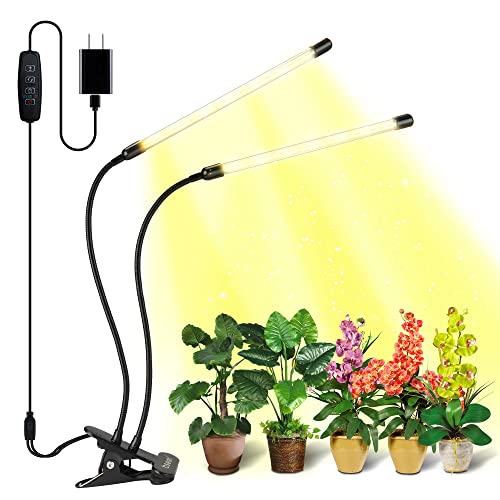
If you're looking for a clip-on grow light that does the job without costing much, the bseah is the one to buy. It clips onto a shelf, a pot rim, or a desk edge and positions its LED head directly over your succulents. The full spectrum combines yellow and white LEDs in a combination that promotes photosynthesis across the whole plant growth cycle — from compact vegetative growth through to flowering if your succulents bloom.
The built-in timer is genuinely useful. Set it once for 3, 9, or 12 hours, and it automatically cycles on and off at the same time every day without you touching anything. That cycle memory function matters because consistent light schedules are one of the most important factors in healthy succulent growth. You don't want to be plugging and unplugging every morning. The 10 dimmable brightness levels give you control over intensity too — dial it back for newly repotted or stressed plants, ramp it up for established specimens.
The 3 switch modes (white only, red only, and combined) give you a basic form of spectrum control. For succulents, run the combined or white-dominant mode during the day cycle. The red-only mode can be useful for plants you're trying to push into bloom. Build quality is basic — this is a budget light — but for what it costs, the feature set is hard to beat. Check our gardening reviews for more indoor plant tools that complement this kind of setup.
Pros:
Cons:
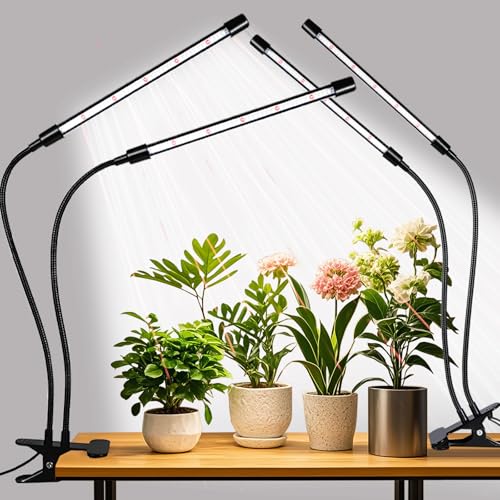
When you have more plants to cover and you want serious LED count without moving up to a full panel light, the 168 LEDs Clip Lights in a two-pack make a compelling case. Each unit has two arms, each arm carrying a strip of 5 red LEDs and 37 white LEDs — that's 84 LEDs per head and 168 per unit across a wide coverage arc. The gooseneck design lets you bend and position each arm independently so you can direct light exactly where you need it. This is the most flexible physical design of any clip light on this list.
The 6000K daylight-temperature white LEDs produce a crisp, bright light output that's strong enough to maintain compact growth in tighter succulent varieties. The red LEDs supplement the warm end of the spectrum, promoting flowering and fruiting in species that bloom. Three switch modes let you run white only, red only, or the combined full-spectrum mode — and for most succulents, full spectrum is what you want. The auto on/off timer with cycle memory handles 3, 9, or 12-hour schedules, and 10 dimmable brightness levels give you precision control.
Getting two complete units in one purchase makes this a great deal if you're setting up a multi-shelf succulent display or want to cover a wider table spread. The flicker-free output is worth noting too — some cheaper LED grow lights pulse at frequencies that stress plants over long cycles. This one doesn't. For a growing collection where a single clip light won't cut it anymore, the 168 LEDs two-pack is the upgrade that makes sense.
Pros:
Cons:
The Otryad 40W is a step up in raw power compared to the clip-style budget lights. At 40 watts, it delivers more intensity across a wider area — useful when you have a full shelf of succulents rather than two or three individual pots. The clip-on desk mounting keeps it versatile, and the USB power input (note: requires an adapter that handles under 3A — not always included) means you can power it from a USB port or standard USB wall adapter.
The spectrum options here lean into the traditional horticulture model: red, blue, and combined red/blue modes. Pure blue light (around 450nm) drives compact, vegetative growth — ideal for keeping succulents tight and preventing etiolation (the stretching that happens when plants don't get enough light). Pure red light (around 660nm) promotes flowering and fruit development. The combined red/blue mode gives your succulents what they need across the full growth cycle.
The timing function allows 3, 6, or 12-hour cycles, and the adjustable arm lets you move the light closer or further from your plants as needed — important as your collection grows taller or wider. The 9 dimmable brightness levels add flexibility. One note: the red/blue spectrum produces that classic purple-pink glow that looks out of place in a living room. If aesthetics matter to you, consider the GE or Soltech instead. If maximum plant performance per dollar is the goal, Otryad delivers.
Pros:
Cons:
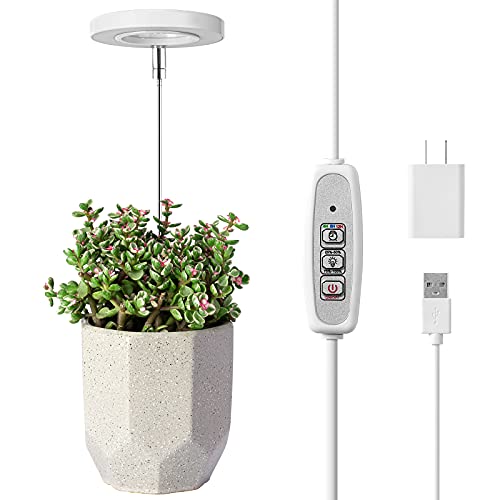
The LORDEM is the most distinctive-looking grow light on this list — it's designed as a ring (halo) that surrounds or sits above a single plant, creating a symmetrical crown of light that covers every angle of your succulent's canopy. The warm white LED output runs in the 380nm–800nm range, covering the full spectrum your plants need. It has the look of a stylish desk accessory rather than a grow light, which makes it perfect for a home office, a bedroom nightstand, or a living room side table.
The height-adjustable stand is a real convenience feature. As your succulent grows — especially for taller varieties like aloes or agaves — you can raise the ring to maintain the right distance without repositioning the entire setup. The auto timer cycles through 4, 8, or 12-hour schedules with cycle memory, and the 4 dimmable brightness levels handle most situations. The 50,000-hour rated lifespan is the longest of any light on this list by a significant margin — that's over five years of continuous runtime.
Coverage is focused on one central plant due to the ring form factor. This isn't the light for a wide shelf. But for showcasing a single specimen succulent — a prized echeveria, a sculptural euphorbia, or a dramatic aloe — the LORDEM creates a visual presentation that no clip lamp or pendant can match. The warm, soft output is easy on human eyes too, which matters when the light is on for 12 hours in a shared living space. If you're building out a serious indoor setup, also consider a grow box for seedlings alongside this for display plants.
Pros:
Cons:
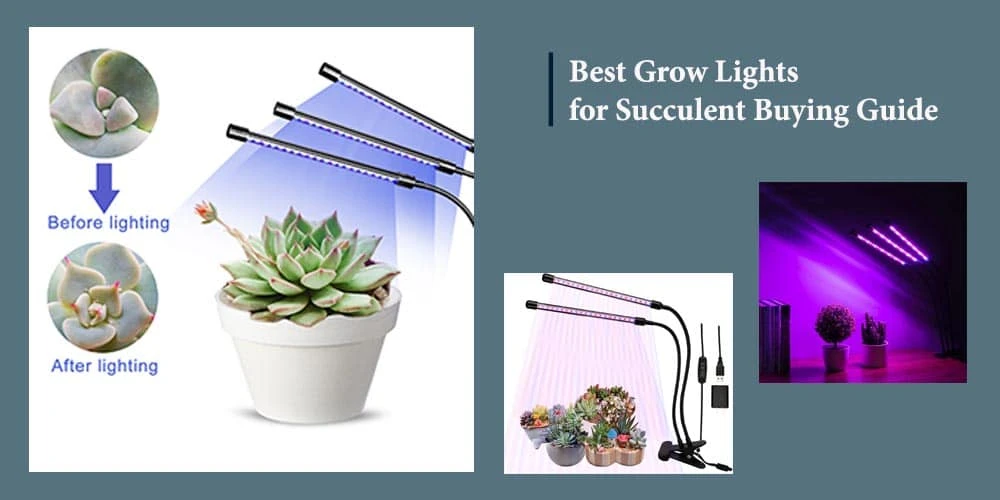
Before you buy, you need to match the light to your actual situation. Here's what actually matters when shopping for succulent grow lights in 2026.
Succulents evolved under intense, full-spectrum sunlight. They use the full range of visible light — blue for compact growth, red for flowering, and the spectrum in between for everything else. When you're shopping, look for these indicators:
For succulents you're maintaining primarily for appearance and health, a full-spectrum bulb in the 4000K–6500K range is the practical choice.
This is where most buyers get confused. Here's a quick breakdown of the key terms:
Position your grow light 6–12 inches above succulents for most clip and bulb-style options. Watch your plants for signs of too much light (bleaching, crispy tips) or too little (stretching toward the light source).
Succulents need 12–16 hours of light per day on a consistent schedule. Manual scheduling is unreliable. A built-in auto-cycle timer is not just convenient — it produces measurably better plant outcomes. Look for:
If your light doesn't have a built-in timer, you'll need to add an external one. Our guide to the 10 best grow light timers covers the best options to pair with timer-free lights like the GE BR30 and SANSI bulbs.
The right physical format depends entirely on your setup:
If the light will be in a shared living area, white or warm-white output is far more livable than the purple glow of red/blue spectrum lights. Plan for where the light will actually live before choosing your format.
Succulents need 12–16 hours of light per day under a grow light. Set your timer for 14 hours as a starting point. If you notice stretching (etiolation), increase the duration or move the light closer. If leaf tips are bleaching or turning crispy, reduce hours slightly or raise the light higher. Consistent daily schedules matter more than occasional extra-long sessions.
For most clip-style and bulb-format grow lights, position the light 6–12 inches above the top of your succulents. High-output pendant lights like the Aspect Soltech can hang 18–24 inches above. The right distance depends on the light's PPFD output — higher-output lights can be positioned further away. Watch your plants: stretched growth means the light is too far; bleaching or tip burn means it's too close.
No. Succulents need a dark period — typically 8–12 hours of darkness per day — to complete their metabolic processes. Continuous 24-hour light disrupts their natural circadian rhythm, leading to stress and weakened growth over time. Stick to 12–16 hours on and 8–12 hours off. The built-in cycle timers on most lights on this list handle this automatically once you set them.
Both. Blue light (around 450nm) promotes compact, dense growth and prevents the stretching that happens when succulents don't get enough light. Red light (around 660nm) promotes flowering and encourages the stress colors — pinks, purples, and reds — that make succulents visually striking. A full-spectrum light covers both automatically. Red/blue-only lights work well for plant performance but produce an unattractive purple glow in living spaces.
For a small collection of two to four succulents, a 9–10W LED bulb is sufficient. For a full shelf of six to twelve plants, look for 20–40W total output across your lighting setup. Watts alone don't tell the whole story — PPFD at your plant's height is the more meaningful number. A 10W bulb with an optical lens (like the SANSI) can outperform a 25W bulb with poor light distribution.
Yes, LED grow lights are safe around kids and pets when used correctly. They run at low temperatures — unlike older incandescent or HID grow lights — so burn risk from accidental contact is minimal. Make sure cords are secured and out of reach. Avoid looking directly into high-output LED arrays, and position lights so they don't shine into eye level for humans or pets resting nearby. The natural white output lights (GE, SANSI, Aspect Soltech) are particularly eye-friendly for shared spaces.
The right grow light will transform your succulents from pale, stretched survivors into compact, colorful specimens worth showing off. Start with the GE BR30 if you want simplicity and value, go with the Aspect Soltech Gen 2 if aesthetics are non-negotiable, or choose the SANSI 10W if you want the best technical performance per dollar in a screw-in bulb. Pick the one that fits your space, set the timer, and watch your collection thrive — your succulents will thank you for it in 2026 and beyond.
 |
 |
 |
 |

About Truman Perkins
Truman Perkins is a Detroit-based SEO consultant who's been in the business for over a decade. He got his start helping friends and clients get their websites off the ground, and he continues to do so today. In his free time, Truman enjoys learning and writing about gardening - something he believes is a natural stress reliever. He lives with his wife, Jenny, and their twins in Detroit.


Get new FREE Gifts. Or latest free growing e-books from our latest works.
Disable Ad block to reveal all the links. Once done, hit a button below
|
|
|
|
 rinjal