reviewed by Truman Perkins
Which garden sprinkler actually delivers the lush, evenly watered lawn you've been chasing all season — and which ones leave dry patches, leak at the collar, or give up after two summers? If you've spent any time browsing the options on Amazon, you know the choices are overwhelming. Impact sprinklers, oscillating sprinklers, traveling sprinklers, gear-drive rotors — each type has its loyalists, and each promises to be the last one you'll ever need to buy. Spoiler: a few of them might actually deliver on that promise.
In 2026, the best garden sprinklers have gotten smarter about coverage uniformity and water efficiency, but the fundamentals haven't changed much. Brass and cast iron still outlast zinc and plastic, and a well-designed nozzle still beats raw water pressure every time. Whether you're maintaining a modest flower bed or soaking a sprawling half-acre lawn, there's a sprinkler on this list built specifically for your situation. We've broken down seven of the top-rated options so you can skip the guesswork and get straight to the watering.
Before you dive into the reviews, it's worth knowing that sprinkler choice pairs directly with how you deliver water to your yard. If you're also looking at your full irrigation setup, check out our guide on the best garden hose holders to keep everything organized and kink-free. And if lawn health is your goal, don't overlook the fertilizer side of the equation — our Best Fertilizer for Grass guide covers exactly what your turf needs alongside consistent watering. You can also browse all our top picks in the gardening reviews section. According to the EPA's WaterSense program, the average American household uses about 30% of its water outdoors — and much of that is wasted through inefficient irrigation. The right sprinkler helps you water smarter, not just more.

Contents







If you grew up watching a sprinkler click-click-click across the backyard on a summer afternoon, this is the one. The Rain Bird 25PJDAC is the #1 best-selling brass impact sprinkler on Amazon for good reason — it's built from brass, bronze, and stainless steel at a time when most competitors have quietly switched to zinc or plastic. That material choice matters. Zinc corrodes faster in most water chemistries, and plastic cracks in freeze-thaw cycles. The 25PJDAC is designed to outlast both.
Coverage is adjustable from 20° to a full 360° pattern, and throw distance ranges from 20 to 41 feet depending on your water pressure. That gives you serious flexibility for oddly shaped lawns, garden beds that border hard surfaces, or spots where you need to keep water off a deck or driveway. Setup is dead simple — thread it onto a hose, pound a stake into the ground, and you're watering in under a minute. There's no learning curve here, no app to download, no batteries to replace.
Performance is consistent and dependable. The impact mechanism delivers large, wind-resistant droplets that penetrate turf instead of misting into the air, which is a real advantage on breezy days. It won't cover 4,500 square feet in a single pass, but for the area it's designed to handle, it does the job reliably season after season. This is the sprinkler you buy and forget about in the best possible way.
Pros:
Cons:
If your yard is a large, roughly rectangular space, an oscillating sprinkler is almost always the most efficient choice — and the Melnor XT Turbo is one of the best examples of the format available in 2026. It covers up to 4,500 square feet with its 20 precision nozzles, sweeping back and forth in a gentle arc that delivers even coverage without the flooding effect you sometimes get from high-pressure impact heads. The nozzles are designed to resist clogging, which is a practical detail that matters if your water supply carries any sediment.
What really separates this model from cheaper oscillating sprinklers is the TwinTouch width and range control system. Two independent adjusters let you narrow the width to water just a flower border, or open it fully to drench the whole lawn. The Watering Width Indicators are a nice usability touch — they let you visualize exactly what your settings will cover before you even turn on the water. The included Quick Connect bundle makes hose attachment and removal genuinely fast, which is useful if you're moving it around the yard throughout the week.
Durability is solid for an oscillating design. The turbo drive mechanism keeps the arm moving smoothly even at lower water pressures, where cheaper oscillators tend to stall mid-arc. For large, open lawn areas that need consistent coverage, this one punches well above its price point.
Pros:
Cons:
This one's in a category by itself. The Nelson Rain Train isn't just a sprinkler — it's a slow-moving irrigation machine that drives itself along your hose path, watering as it goes. We're talking up to 200 feet of travel distance and 13,500 square feet of total coverage per session. If you have a large yard, a sloped property, or simply don't want to move a sprinkler every 20 minutes, this changes the game entirely. You lay out your hose in whatever path makes sense, set the Rain Train on it, turn on the water, and walk away.
The cast iron construction is built to last decades — this isn't a flimsy plastic toy. The aluminum spray arms are adjustable, giving you a coverage diameter between 15 and 55 feet, and the three-speed setting (high, low, neutral) lets you control how much water gets applied per pass. Slower speed means more water per square foot — useful for dry, compacted soil that needs time to absorb before runoff begins. The auto shut-off feature is a welcome addition; it stops the unit automatically when it reaches the end of the hose, so you're not flooding a single spot if you forget about it.
Setup takes a few minutes more than a stake-style sprinkler, but once you've done it once, the routine becomes second nature. This is the right tool for anyone with serious acreage to cover, and it pairs beautifully with a good fertilizer program — if you're feeding a large lawn, our guide to the best Bermuda grass fertilizers is worth a read alongside this review.
Pros:
Cons:
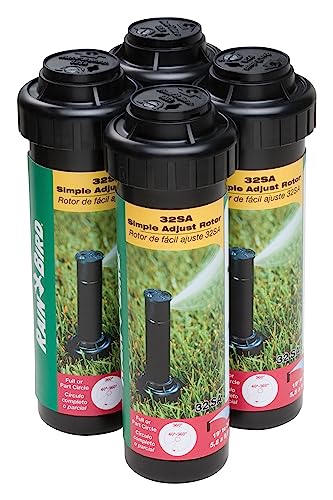
If you have an existing in-ground irrigation system or you're planning to install one, gear drive rotors are the professional standard — and the Rain Bird 32SA is an excellent entry point into that world. This 4-pack of water-lubricated rotors is designed for long-life operation with minimal maintenance. Water-lubricated means the internal gears are protected by the same water flowing through the head, eliminating the need for external greasing and reducing wear over years of operation.
The Rain Curtain nozzle technology is the standout feature here. It produces large, wind-resistant droplets distributed in a precise curtain pattern across the spray arc. That uniformity matters — patchy coverage leads to dry spots and over-watered zones, which stresses turf and wastes water. The pattern adjusts from 40° to a full 360°, and the spray distance ranges from 19 to 32 feet. Adjustment is done with a flat-blade screwdriver directly on top of the rotor, which is far simpler than systems requiring buried access or special tools.
These are an economical choice when you factor in the 4-pack pricing. Whether you're replacing aging heads in an existing system or laying out a new zone, you get consistent performance across all four units. For a deeper look at comprehensive water delivery approaches, our piece on drip irrigation methods and kits covers the complementary side of the irrigation picture.
Pros:
Cons:
There's a reason irrigation contractors reach for tripod-mounted sprinklers when they need to cover a large area quickly and efficiently. Elevation changes everything. By raising the sprinkler head above ground level — this model's tripod adjusts from 22 to 48 inches — you dramatically increase both throw distance and coverage uniformity. Water arcs over the tops of shrubs, tall grasses, and ground-level obstacles that would otherwise create dry shadows. The heavy-duty brass impact head and adjustable metal tripod bring that professional-grade approach to the residential market at an accessible price.
The 360-degree rotation pattern covers large areas evenly, and the high-pressure nozzle delivers water to the far edges of the coverage zone without the droplet breakdown you get from lesser impact heads. Setup is straightforward — extend the tripod legs, adjust height, connect to a hose, and fine-tune the pattern adjustment. The build quality is solidly above average: this isn't the kind of sprinkler that bends or tips over in wind, and the brass head will hold up through years of seasonal use without corroding out.
This one appeals to a wide audience — residential homeowners with large gardens, market gardeners watering long rows, or contractors who need portable irrigation on job sites. If you tend to move your sprinkler frequently, the tripod base makes repositioning easier than pounding stakes in and out of the ground repeatedly.
Pros:
Cons:
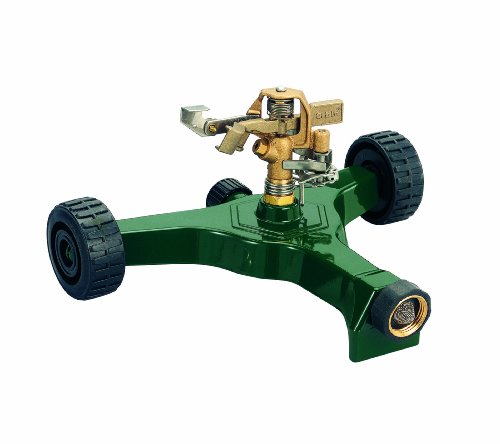
The wheel-base format solves a specific problem: you want the stability of a grounded sprinkler without the hassle of staking it down. The Orbit 56186N sits on a flat metal wheel base that keeps it planted on any surface — lawn, gravel, patio, concrete — without needing to punch into the soil. That makes it genuinely easy to drag from zone to zone as you work through your yard, especially on days when you're moving the sprinkler every 30 minutes to cover the whole property.
The brass impact head delivers full-circle coverage up to 50 feet in diameter, and the adjustable spray nozzle lets you dial in both the flow rate and the spread. The gentle, steady stream it produces is particularly kind to delicate plantings — you're not blasting flower petals off your roses or washing mulch out of your beds the way a high-pressure spray head might. Gardens with a mix of lawn, shrubs, and flower borders benefit from that controlled delivery.
Build quality is reliable — metal wheel base, brass head, and adjustable nozzle all feel built for the long haul. There's nothing fancy happening here electronically or mechanically, which is partly the point. Fewer parts means fewer things to break. If you want a capable, no-nonsense impact sprinkler that moves easily around your yard, this one delivers.
Pros:
Cons:
The MiniMax is Melnor's answer to a genuinely common problem: you want the coverage pattern of an oscillating sprinkler, but you're working with a modest-sized yard or an area where a full-sized oscillator would be overkill. This compact unit stakes directly into the ground via the step spike base — no tripod legs to fiddle with, no wheel base to drag around. It covers up to 4,000 square feet, which puts it in the same class as many full-sized oscillating sprinklers despite its smaller footprint.
The four-way adjustment system is the feature that earns it a place on this list. You can control width, range, left-end stop, and right-end stop independently, giving you precise directional control that most compact sprinklers can't match. That's genuinely useful when you're watering a narrow side yard or a strip of lawn between hardscape elements. The dirt-resistant performance design keeps the oscillating arm moving smoothly even if there's sediment in your water supply — a common issue in municipal systems during heavy rain periods or in well-water setups.
The Quick Connect bundle makes hose management easier, and the step spike base is solid enough to stay planted in firm soil without drifting. For small to medium lawns, raised garden beds, or newly seeded areas where you need gentle, consistent coverage, the MiniMax hits a sweet spot that's hard to find at this price range.
Pros:
Cons:
Before anything else, know your numbers. Measure the square footage of what you need to water, and note the shape. Rectangular lawns are served best by oscillating sprinklers, which deliver uniform coverage across a defined rectangular zone. Circular or irregularly shaped areas are better matched to impact sprinklers or gear-drive rotors, which rotate in adjustable arcs. Large properties — half an acre and up — are where traveling sprinklers like the Nelson Rain Train genuinely earn their keep.
This is where long-term value separates from short-term savings. The material hierarchy for sprinkler longevity looks like this:
If you're buying a sprinkler you plan to use every season for the next decade, brass and cast iron are worth the price premium every time.
The more precisely you can direct water, the less you waste — and the healthier your plants stay. Look for these control features:
Most residential outdoor spigots deliver between 40 and 80 PSI, but pressure varies considerably by neighborhood, time of day, and season. Check the operating pressure range listed for any sprinkler you consider. Oscillating sprinklers with turbo drives (like Melnor's XT line) are designed to work at lower pressures without stalling. Impact sprinklers generally handle a wider pressure range, including high-pressure well systems. Gear-drive rotors like the Rain Bird 32SA are specifically engineered for pressure-consistent in-ground systems. If your water pressure is on the low end, avoid sprinklers that require high pressure to reach their advertised throw distance — you'll just get a sad trickle instead of proper coverage.
An impact sprinkler (sometimes called an impulse sprinkler) uses a spring-loaded arm that hits the water stream repeatedly, causing the head to rotate in a circular arc. It produces large droplets, handles wind well, and is very durable. An oscillating sprinkler sweeps a horizontal arm back and forth in a fan pattern, covering a rectangular area. Oscillating sprinklers are better for flat, rectangular lawns; impact sprinklers work better for circular coverage and irregular shapes.
It depends heavily on the type and your water pressure. A standard brass impact sprinkler on a stake covers roughly 1,200–2,000 sq. ft. per position. A full-sized oscillating sprinkler like the Melnor XT Turbo covers up to 4,500 sq. ft. A traveling sprinkler like the Nelson Rain Train can water up to 13,500 sq. ft. in a single automated run. Always check the manufacturer's coverage specs and factor in your actual water pressure, which affects throw distance.
Most lawns need about 1 inch of water per week, including rainfall. A typical lawn sprinkler delivers roughly 0.5–1 inch per hour depending on type and pressure. Run your sprinkler for 30–60 minutes per zone to hit the 1-inch target in a single session, or split it into two shorter sessions if your soil tends to run off before absorbing properly. Early morning watering (before 10 a.m.) minimizes evaporation and reduces fungal risk compared to evening watering.
For brass and cast iron sprinklers, you can often leave them out through mild winters, but storing them is always the safer choice. Water left inside plastic components can freeze and crack. Metal threads can corrode if left with standing water through freeze-thaw cycles. Disconnect all hose connections before the first freeze, drain the sprinkler head, and store it in a shed or garage. This single habit will extend the life of even a budget sprinkler by several seasons.
Most residential garden sprinklers are designed to operate between 30 and 80 PSI. Standard municipal water pressure in the U.S. typically falls between 40 and 60 PSI, which works well with virtually every consumer sprinkler on this list. If you're on a well with variable pressure, or if you notice reduced throw distance compared to the specs, check your pressure with an inexpensive hose bib gauge before assuming your sprinkler is faulty. Most oscillating sprinklers need at least 30 PSI to oscillate consistently; impact sprinklers are more tolerant of pressure variation.
For permanent in-ground irrigation systems, gear-drive rotors like the Rain Bird 32SA are generally preferred over impact heads. They're quieter, produce more uniform precipitation rates, and are less prone to jamming with debris in buried environments. Impact sprinklers are better suited to surface applications where you're connecting directly to a hose. That said, impact heads are more tolerant of dirty or hard water and tend to last longer in high-mineral-content water supplies where gear mechanisms can scale up over time.
You've got seven solid options here covering everything from compact oscillating heads for a city garden to heavy-duty traveling sprinklers that handle half an acre on autopilot — the right choice simply comes down to your yard's size, shape, and how hands-on you want to be. Take stock of your coverage needs, check your water pressure, and match the build material to how long you want this investment to last. Pick the one that fits your situation, set it up this weekend, and give your lawn the consistent watering it needs to stay healthy through the 2026 growing season and beyond.
 |
 |
 |
 |

About Truman Perkins
Truman Perkins is a Detroit-based SEO consultant who's been in the business for over a decade. He got his start helping friends and clients get their websites off the ground, and he continues to do so today. In his free time, Truman enjoys learning and writing about gardening - something he believes is a natural stress reliever. He lives with his wife, Jenny, and their twins in Detroit.


Get new FREE Gifts. Or latest free growing e-books from our latest works.
Disable Ad block to reveal all the links. Once done, hit a button below
|
|
|
|
 rinjal