Ever stood in a garden store staring at a wall of grow tents, wondering which one is actually worth your money? You're not alone. Picking the right grow tent — especially a large-format one — can feel overwhelming when every brand promises "maximum reflectivity" and "military-grade durability." In 2026, the market has only gotten more crowded, which means more options but also more confusion. If you want a shortcut, the VIVOSUN S888 8x8 has consistently impressed growers who need serious square footage. But keep reading, because the right choice really does depend on your setup, your budget, and how you like to work.
An 8x8 grow tent gives you 64 square feet of growing space — enough to run a serious indoor garden, whether you're growing vegetables, herbs, or flowering plants under LED or HID lights. That kind of space demands a tent that can handle real weight on its hanging bars, reflect light efficiently so your plants get every photon your fixture produces, and seal tightly enough that odors and light stay where they belong. If you're stepping up from a 4x4 grow tent or even a 5x5 model, you already know what bad zipper quality feels like at 2 a.m. This guide is here to make sure you don't repeat that mistake at twice the scale.
Below you'll find hands-on breakdowns of five of the best grow tents available right now — ranging from a true 8x8 flagship down to well-built 4x8 and 4x4 options for growers who want the same quality in a smaller footprint. We'll cover materials, frame strength, light-sealing performance, and the small ergonomic details that separate a tent you'll love from one you'll fight with every week. Check out our full gardening reviews section for more guides on indoor growing gear. Let's get into it.

Contents
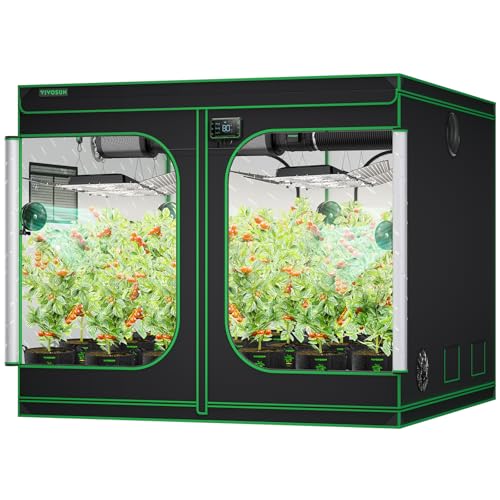




If you need a true 8x8 footprint and you're not looking to break the bank, the VIVOSUN S888 is the first tent most experienced growers will point you toward. The tent measures 96"x96"x80" — that 80-inch ceiling gives you real room to hang heavy LED fixtures, carbon filters, and inline fans without things getting cramped above your canopy. The frame is built from metal poles with tool-free corner connectors, so assembly doesn't require a PhD. The top hanging bars are rated at 250 lbs. each, which is generous enough to support even a dual-light setup with a large carbon filter alongside it.
The canvas is 340g high-density Oxford fabric with a reinforced PE layer backing and 100%-reflective mylar walls. In plain terms: light bounces back to your plants instead of getting absorbed by the walls, and the thick outer shell means your neighbors won't see a glow around your door frames. VIVOSUN upgraded the zipper design with a black inner lining to kill any light bleed at the seams — no tape, no flaps needed. The observation window uses transparent plastic and hook-and-loop fasteners so you can sneak a peek at your plants without unzipping the whole front door and blowing your climate control. There's also a removable floor tray that makes spill cleanup genuinely painless, which you'll appreciate the first time a reservoir gets bumped.
One thing to keep in mind: at 8x8, this is a large tent that needs dedicated space. Make sure you measure your room carefully before ordering — door clearance matters when you're moving equipment in and out. Some growers also report that the included hanging straps are workable but not exceptional. If you're planning to push the weight limits, upgrading to aftermarket heavy-duty ratchet hangers is a smart move. Overall though, for the price and size, the VIVOSUN S888 delivers a dependable, well-sealed growing environment that holds up over multiple grow cycles.
Pros:
Cons:
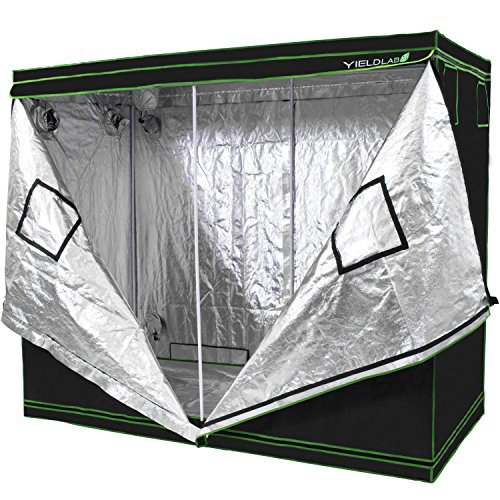
The Yield Lab 96x48x78 is a 4x8 tent (not a true 8x8), so it's included here as a strong companion option for growers who want proven Yield Lab quality in a rectangular layout. At 96"x48"x78", you get 32 square feet of canopy space in a footprint that fits easily in a standard bedroom or utility room. The 78-inch height is slightly shorter than some competitors, but it's still enough for most grow setups that don't involve extremely tall plants or dual stacked fixtures. Reflective mylar lining coats the interior to bounce light back evenly across your canopy, reducing hot spots and helping plants on the edges of your tent get as much light as those directly below the fixture.
Build quality on the Yield Lab is solid. Heavy-duty metal poles form the skeleton, and the tear-resistant fabric wraps it tightly. This is a brand that has been around long enough to iterate on design weaknesses, and it shows — the seams are reinforced and the zippers are smooth. For growers who are newer to indoor growing and want something that won't punish them with complicated assembly or mystery light leaks, the Yield Lab is a reassuringly no-fuss tent. You set it up, you dial in your environment, and it does its job quietly for grow cycle after grow cycle.
The trade-off compared to newer 2026 models is that the Yield Lab doesn't include some of the premium extras — no controller mount hook, no oversized observation window, and the fabric weight is lower than what you'd get from Spider Farmer or AC Infinity. If you're running a simpler setup with a single light and a compact inline fan, none of that will matter to you. But if you're pushing the tent with heavy equipment, you may wish you'd gone a step up. Still, as a value-oriented entry in the 4x8 category, it's hard to argue with the Yield Lab's track record.
Pros:
Cons:
AC Infinity has earned a reputation among serious growers for building gear that simply feels different the moment you touch it. The CLOUDLAB 844 is a 4x4 tent (48"x48"x80"), and while it doesn't match the footprint of an 8x8, it's included here because the build quality sets a benchmark that any tent in this guide should be judged against. The 1-inch steel poles are the thickest in its class, and the 2000D mylar canvas — that denier rating (a measure of fabric thickness and density) is roughly three times heavier than standard grow tent canvas — means you're getting a shelter that won't sag, tear, or let light through unexpected seams. AC Infinity had its mylar lab-tested, and the results show higher light reflectivity than competing options on the market.
The zipper system uses SBS brand zippers, the same type found on high-end luggage, and the observation windows are significantly taller than what you'll find on most tents. That taller window design matters more than you might think — you get a real view of your canopy without having to crouch or press your face against a tiny porthole. There's also a built-in controller mount plate, which is a small detail that makes a big difference if you're running an AC Infinity fan controller or similar device. Everything about the CLOUDLAB 844 feels engineered rather than assembled.
The obvious downside is price. You're paying a premium over budget-tier options, and if you're scaling up to a true 8x8 format, you'll need the larger CLOUDLAB model rather than the 844. But if a 4x4 is the right size for your space, or if you want to understand what the absolute best build quality looks like before buying a larger tent, the CLOUDLAB 844 is the standard. It's the kind of tent that experienced growers who've burned through cheaper options eventually end up buying. If you're also exploring ways to improve soil health in your indoor garden, adding worms to your indoor plant containers can be a surprisingly effective companion practice to good light management.
Pros:
Cons:
Spider Farmer is best known for its LED grow lights — the SF4000 and SE5000 are staples in the indoor growing community — and this 8x4 tent is built with that ecosystem in mind. At 96"x48"x80", it's a rectangular tent rather than a square one, which gives you a different growing geometry. That 80" ceiling matches the VIVOSUN S888, and it's tall enough to give headroom for your lights, fans, and filters without feeling cramped. The 1680D Oxford canvas is one of the thicker fabric weights in the 4x8 category, and the diamond-patterned reflective mylar on the inside is designed to scatter light more evenly than flat mylar — a detail worth noting if you're pushing for even canopy coverage across a long rectangular space.
The zipper system uses premium SBS zippers backed by a double-stitched zipper flap, which gives you a two-layer seal against light leaks at the most vulnerable point on any grow tent. There's a dedicated hook included for mounting a controller — again, clearly designed with Spider Farmer's own controller accessories in mind. The observation window is generously sized at 11.8"x15.7", and the waterproof floor tray is included along with a tool bag for keeping small accessories organized. These aren't just marketing bullet points; when you're working inside a tent regularly, having a tidy space makes the whole growing experience less frustrating.
If you're already invested in the Spider Farmer light ecosystem, this tent is a natural pairing. The dimensions are calibrated to match what their lights are optimized to cover, and the build quality is on par with AC Infinity while typically coming in at a slightly lower price. The main limitation is the 4x8 footprint — if you genuinely need 8x8 square footage, this tent won't do it. But for a well-built rectangular tent with pro-grade materials and thoughtful ergonomics, the Spider Farmer 8x4 is one of the strongest options available in 2026.
Pros:
Cons:
The Zazzy 4x8 is the most compact tent in this roundup at 96"x48"x72", and that 72-inch ceiling height is the most significant thing you need to know before clicking "Add to Cart." If you're running tall plants, long-bodied LED fixtures, or a carbon filter stacked on top of an inline fan, 72 inches will feel tight. But for growers who are working with lower-profile setups — compact LEDs, shorter-statured plants, or a dedicated clone and veg space — the Zazzy tent makes a compelling case as an entry-level option that doesn't feel cheap. The 600D mylar walls offer 95% light reflectivity, which is a solid number for the price, and the double-stitched construction keeps seams from becoming light-leak problems down the line.
Assembly is reported to be smooth. The steel frame is finished to eliminate sharp edges, which sounds minor until you're building a tent alone at night and you realize how much nicer it is to handle poles that won't cut your hands. The all-steel pole structure is rated to handle at least 110 lbs., which is lower than the VIVOSUN's 250-lb. bar rating but still adequate for a single LED fixture and a compact fan/filter combo. The observation window and easy-access door zipper design are both competent — nothing groundbreaking, but they work reliably.
Where the Zazzy earns its place in this list is the value proposition. If you're testing out indoor growing for the first time and you're not ready to commit to a premium tent purchase, the Zazzy gives you a functional, lightproof growing environment without asking you to spend like a veteran grower. You can always upgrade later once you know the hobby is for you. Think of it as a starter tent that doesn't embarrass itself — honest materials, honest construction, honest price. For the budget-conscious grower who also wants to experiment with plant nutrition, check out the benefits of electrolyte water for plants to squeeze more out of your setup without spending more on equipment.
Pros:
Cons:
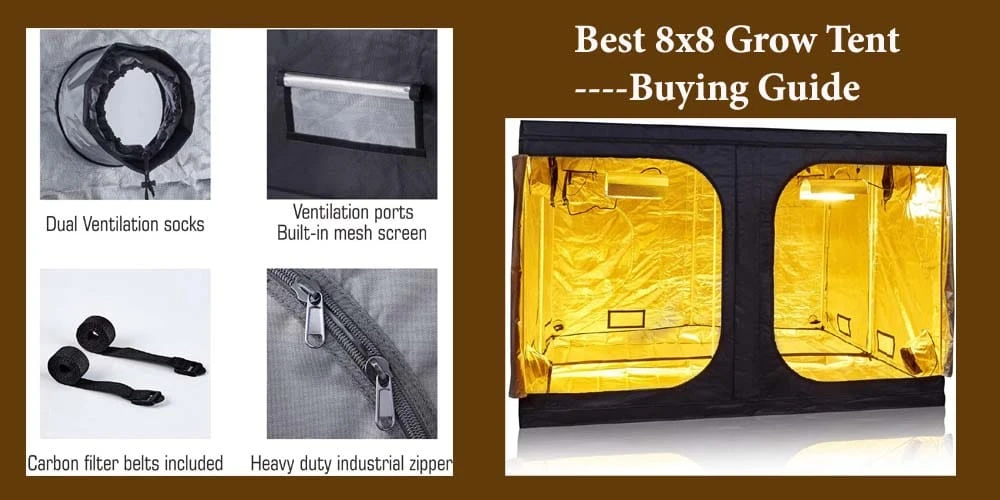
A grow tent is the foundation of your entire indoor growing system. Get it right and everything else — your lights, your fans, your growing medium — works better inside a stable, controlled environment. Get it wrong and you'll be fighting light leaks, collapsed frames, and unstable temperatures for the entire life of your grow. Here's what to focus on when you're comparing options in 2026.
The most important number isn't the tent's listed dimensions — it's the space in your room after the tent is up. A true 8x8 tent (like the VIVOSUN S888) will eat up 64 square feet of floor space plus a working perimeter on all sides so you can actually open the door and move equipment in and out. Measure twice. Also consider ceiling height: a tent that's 80 inches tall needs at least 84-86 inches of clear room height above it, ideally more, to allow you to zip and unzip the roof vents without fighting the ceiling. If your ceilings are lower or your room is narrower, a 4x8 rectangular tent often fits more easily than a square 8x8 while still giving you substantial canopy space.
Hydroponics (a method of growing plants in a water-based nutrient solution without soil — learn more on Wikipedia) is one of the most popular ways to fill a large grow tent efficiently. If you're going the hydroponic route, factor in floor tray size and the number of duct ports you'll need for reservoir lines and power cables. A tent with more sock-style duct ports gives you more flexibility to route cables and tubing cleanly.
Canvas is listed in denier — a unit measuring fiber thickness. Higher denier means a thicker, heavier, more light-resistant fabric. Entry-level tents use 600D canvas. Mid-range options step up to 1680D. The AC Infinity CLOUDLAB 844 tops out at 2000D. In practice, anything 1200D and above will block light effectively for most setups. The key metric beyond raw denier is whether the tent is truly lightproof — even tiny pin-hole leaks matter if you're growing plants that are sensitive to light cycles. Check user reviews specifically for light leak reports, not just the manufacturer's claims.
The interior mylar lining reflects light back to your plants. Look for reflectivity ratings of 90% or above. Diamond-pattern mylar (like the Spider Farmer tent uses) tends to scatter light more evenly than flat mylar, which is worth considering in a rectangular tent where plants on the short ends may receive less direct light than plants in the center.
The hanging bar rating is one of the most practically important specs in any grow tent. A large 8x8 setup might include two high-powered LED fixtures, a heavy carbon filter, an inline fan, and environmental sensors. Add that up and you're often pushing 150-200 lbs. before you've hung a single plant. The VIVOSUN S888's 250-lb.-per-bar rating gives you headroom. Budget tents rated at 110 lbs. can fail under a fully equipped system, and a dropped fixture or filter is a significant safety hazard.
Steel pole diameter also matters. Thicker poles — like the 1-inch poles on the AC Infinity CLOUDLAB — flex far less under load. Thinner poles on cheaper tents can bow inward over time, pulling the canvas taut in ways that stress the seams and zipper attachment points. If the frame moves, eventually the tent leaks.
Zippers are the number-one failure point on grow tents. Cheap zippers jam, split, or start letting light through after a few months of daily use. SBS-brand zippers — the same standard used in quality luggage — are the benchmark to look for. Both the AC Infinity CLOUDLAB and the Spider Farmer 8x4 use SBS zippers and add a secondary stitched flap over the zipper track for double protection. If a tent listing doesn't mention zipper brand or construction, that's usually a sign the zippers are generic and potentially short-lived.
Observation windows, floor trays, and controller hooks are quality-of-life additions rather than core requirements — but once you've grown in a tent that has them, you'll miss them in one that doesn't. The ability to quickly check your plants without opening the main door is especially useful during lights-off periods when disturbing the dark cycle can stress photoperiod-sensitive plants. If you're planning to grow multiple types of plants and want to understand more about indoor plant care beyond the tent itself, our guide on top air-purifying indoor plants has useful background on how different plants respond to controlled indoor environments.
An 8x8 grow tent provides 64 square feet of canopy space in a square layout, while a 4x8 tent offers 32 square feet in a rectangular layout. The 8x8 is better suited for large-scale growing with multiple lights, while a 4x8 fits more easily in smaller rooms and is easier to manage with a single LED fixture. Your choice should depend on your available floor space, your number of plants, and how many lights you plan to run simultaneously.
For a reliable, lightproof grow tent, aim for at least 1200D canvas. Entry-level tents use 600D, which can work but tends to be thinner and more prone to pin-hole light leaks over time. Premium options like the AC Infinity CLOUDLAB 844 use 2000D canvas, which is noticeably thicker and more durable. Spider Farmer's 1680D canvas sits solidly in the mid-to-premium range and is a good balance of durability and cost for most growers.
It varies significantly by tent. Budget tents may be rated at 100-110 lbs. per bar, while heavy-duty options like the VIVOSUN S888 are rated at 250 lbs. per bar. In practice, a fully equipped large grow — two LED lights, a carbon filter, and an inline fan — can easily exceed 150 lbs. of hanging weight. Always check the stated weight rating before purchasing, and leave yourself a safety margin of at least 20-30% below the rated maximum to avoid long-term stress on the frame and connectors.
An observation window isn't strictly necessary, but it's genuinely useful. Being able to visually check on your plants without opening the main door helps you maintain climate stability — every time you unzip the main door, temperature and humidity levels shift. Observation windows are especially valuable during the dark period for photoperiod plants (plants that flower based on light-to-dark ratios), when even brief light exposure can trigger stress responses or interrupt the flowering cycle. Most quality tents in 2026 include them as standard.
You can, but it's not the most efficient approach. An 8x8 tent is designed to be filled with mature plants under high-powered lighting. Running a single small light over a tray of seedlings in a large tent wastes electricity and leaves most of the reflective surface unused. Many growers use a small dedicated tent — like a 2x2 or 2x4 — for seedlings and clones, then transfer plants into the 8x8 once they're ready for the vegetative stage. This lets you manage each stage of growth with appropriate lighting and environmental settings.
Light leaks most commonly occur at zipper seams, duct port openings, and at the base of the tent where canvas meets the floor tray. Start with a tent that uses quality SBS zippers with a secondary flap stitched over the zipper track, like the AC Infinity or Spider Farmer models. For duct port openings, use the included fabric flaps (most quality tents include them) and ensure ducting is sized correctly to fill the port snugly. After setup, run your grow lights and check the exterior of the tent in a dark room to spot any leaks before your plants are inside.
 |
 |
 |
 |

About Truman Perkins
Truman Perkins is a Detroit-based SEO consultant who's been in the business for over a decade. He got his start helping friends and clients get their websites off the ground, and he continues to do so today. In his free time, Truman enjoys learning and writing about gardening - something he believes is a natural stress reliever. He lives with his wife, Jenny, and their twins in Detroit.


Get new FREE Gifts. Or latest free growing e-books from our latest works.
Disable Ad block to reveal all the links. Once done, hit a button below
|
|
|
|
 rinjal