Picture this: it's early spring, seeds are ready to go, and the question everyone on our team keeps asking is whether the ground is actually warm enough yet. Getting that answer wrong means replanting in a few weeks — or worse, losing an entire batch to cold rot. That's what pushed us to spend several months testing soil thermometers side by side, from compact 4-inch dial models to 36-inch compost probes.
Soil temperature is one of those variables that's easy to overlook when starting seeds or planning transplants, yet it drives germination success more reliably than air temperature. Most cool-season crops want soil around 50–65°F; warm-season vegetables need 60–75°F or higher. Without a dedicated thermometer, gardeners are essentially guessing — and experienced growers rarely guess. According to University of Minnesota Extension, monitoring soil temperature is one of the simplest ways to improve planting outcomes across climates.
In 2026 our team evaluated seven soil thermometers across garden beds, raised planters, and active compost piles. We looked at build quality, accuracy, readability, and how each model holds up after repeated insertions into clay-heavy soil. Whether the goal is precise seed timing, healthier transplants, or optimized composting, the picks below cover the full range of what's available. For a complete garden toolkit, it's also worth pairing a solid thermometer with a reliable soil pH tester — the two tools together give a much clearer picture of what's happening underground.

Contents
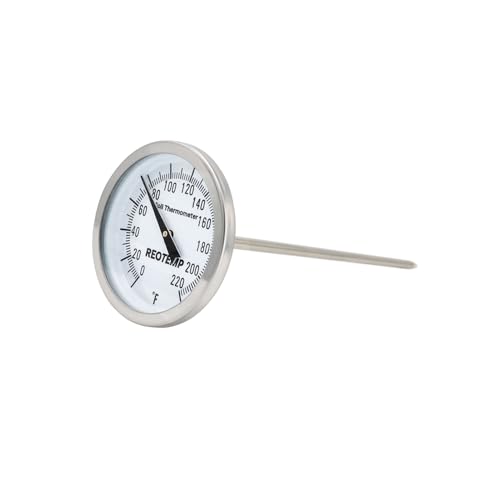




The REOTEMP K82-3 is the thermometer our team reaches for most often when checking raised bed temperatures before seeding. The 5-inch stainless steel stem hits the 2–4 inch depth range most commonly cited for germination checks, and the 2-inch dial is easy to read without stooping too far. REOTEMP builds this one from corrosion-resistant 304 stainless steel throughout — case, bezel, and probe — which means it doesn't corrode after a season of repeated insertions into moist soil.
The 0–220°F range covers everything from frozen winter soil to active compost, though the compact stem limits its usefulness in deep beds or large compost piles. Accuracy held within ±2°F in our side-by-side comparisons with a calibrated lab thermometer, which is more than sufficient for practical gardening decisions. The waterproof construction is genuine — we ran this one under a hose several times without issue.
For home gardeners managing vegetable beds or flower borders and wanting a simple, durable analog option that doesn't require batteries, this is one of the most straightforward picks in the lineup. It's compact enough to keep in a pocket and sturdy enough to handle daily use throughout the season. Anyone managing raised bed soil mixes will find the short stem ideal for monitoring surface-layer warmth before transplanting.
Pros:
Cons:
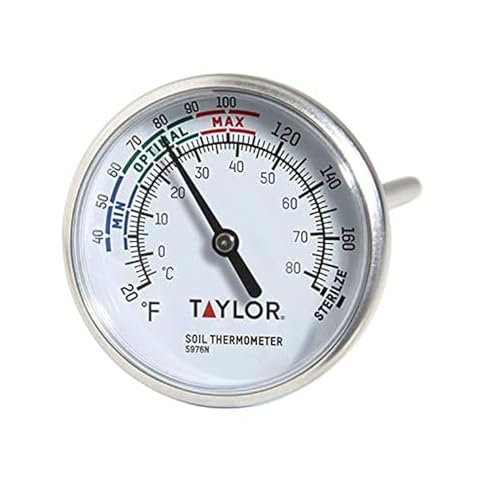
Taylor has been making precision measurement instruments for over a century, and the brand's soil thermometer reflects that institutional knowledge. What sets this model apart is the dual-scale dial (20–180°F and 0–80°C) with min, max, and optimal temperature bands printed directly on the face — so anyone new to soil temperature monitoring can instantly see whether their reading is too cold, ideal, or above range, without needing to memorize crop-specific numbers.
The 4-inch stem is designed to reach 2 inches below the surface when inserted at a slight angle, which targets the zone most relevant for seed germination. Build quality is solid for the price point — stainless steel probe and a conventional dial housing that's proven durable in our season-long testing. Accuracy is comparable to the REOTEMP at this depth, generally within ±2–3°F in controlled conditions.
The main limitation is stem length. Deeper raised beds, cold frames, or compost monitoring require a longer probe. But for anyone focused primarily on in-ground vegetable gardens or standard planting decisions, the Taylor's intuitive dial markings eliminate a lot of guesswork. It's the thermometer our team recommends when someone asks for a single-purchase starting point.
Pros:
Cons:
The Luster Leaf Rapitest 1625 is the one digital-readout thermometer in our test group, and it appeals to a specific kind of gardener: someone who wants an exact number rather than a needle pointing between two tick marks. The digital display eliminates parallax reading errors entirely, which makes a measurable difference in low-light conditions like early spring mornings when analog dials can be hard to read accurately.
The probe is appropriately sized for garden bed monitoring, and the response time is quick — we typically had a stable reading within 60–90 seconds of insertion, faster than most dial thermometers settle. The Luster Leaf brand is well-established in the home gardening testing instrument market; their Rapitest line is often cited by extension services as a practical consumer-grade option.
Battery dependency is the main operational consideration here. Running out mid-season is an inconvenience that analog instruments avoid entirely. That said, most buyers find the digital precision worth the minor maintenance requirement, especially when making fine-tuned decisions about early-season planting windows for heat-sensitive crops. Luster Leaf includes straightforward instructions about optimal soil temperature ranges, making it a good companion to their broader Rapitest testing ecosystem.
Pros:
Cons:
AcuRite's 00661 is a no-frills stainless steel thermometer that covers the fundamentals cleanly. It reads 0–220°F, handles both indoor potting applications and outdoor garden monitoring, and is built from stainless steel that resists the gradual corrosion that plagues cheaper probe materials. For anyone who needs a functional, reliable soil thermometer at an accessible price point, the AcuRite delivers without unnecessary complexity.
The dial is legible under normal outdoor lighting and the probe inserts smoothly into moderately compacted soil. In our testing, it performed comparably to the REOTEMP K82-3 at equivalent depths, showing readings within the same ±2–3°F tolerance range. The AcuRite brand is well-known in the home weather and measurement space, with distribution in most major hardware retailers, which means replacement or warranty resolution is straightforward.
Where it falls short is differentiation — it lacks the optional color-coded temperature bands of the Taylor model and doesn't have the premium construction credentials of the REOTEMP. But those additions cost more, and not every buyer needs them. For potted plants, window boxes, or anyone wanting a second thermometer to leave in the ground for ongoing monitoring, the AcuRite 00661 does the job without stretching a budget.
Pros:
Cons:
The General Tools T300-36 is the specialist in this lineup — a 36-inch probe designed for deep soil monitoring, compost piles, and ground conditions that shorter-stem thermometers simply can't reach. The 3-foot stem goes deep enough to assess subsoil temperatures relevant for root vegetable crops, deep compost cores, and agricultural ground-temperature surveys. The 3-inch wide-dial face with a clear glass lens makes reading from standing height practical, which matters when the probe is inserted 2 feet into a compost heap.
The 0–220°F (−18° to 104°C) dual scale is clearly engraved and the needle movement is smooth and consistent. General Tools is a long-standing American instrument manufacturer, and the T300-36 reflects solid mechanical construction without over-engineering. The extended reach also makes this an interesting option for farmers or serious market gardeners who need consistent soil data across a full growing season.
The obvious trade-off is portability. A 36-inch thermometer doesn't slip into a pocket or tool belt easily. It's a dedicated instrument that lives in the garden shed and comes out for specific measurement tasks rather than daily quick-checks. Most home gardeners with standard raised beds or containers won't need this much reach. But for anyone working with tall compost bins, deep garden beds, or large agricultural plots, the T300-36 fills a gap that no compact thermometer can.

Pros:
Cons:
VIVOSUN has built a strong reputation in the home composting and indoor growing market, and this 20-inch compost thermometer lives up to that standard. The 50cm stem hits the active thermal core of most backyard compost bins, where temperatures in a well-managed pile regularly exceed 130°F — the USDA threshold for pathogen elimination. The IP55 waterproof PC-coated lens stays fog-free even when inserted into a steaming pile, which our team found genuinely useful during winter composting sessions.
Specs are straightforward: 304 stainless steel stem at 5mm diameter, a 1.9-inch dial face, and ±2°F accuracy. The reinforced connection between the dial housing and stem is a design detail worth noting — that junction is a common failure point on cheaper compost thermometers, and VIVOSUN's solution held up through all of our pull-and-insert cycles without any wobble developing. Temperature range is 0–200°F, covering the full composting spectrum from cold pile to thermophilic decomposition.
Home composters managing a single bin or tumbler will find the 20-inch length ideal. It's long enough to probe the center of a 3-foot pile but compact enough to store in a garden shed without dedicating shelf space. VIVOSUN also includes clear temperature guidance for composting stages, which simplifies decision-making about when to turn the pile. Anyone pair-testing compost quality alongside soil amendments will find this a natural addition to the toolkit — check out our best soil amendment guide for complementary product picks.
Pros:
Cons:
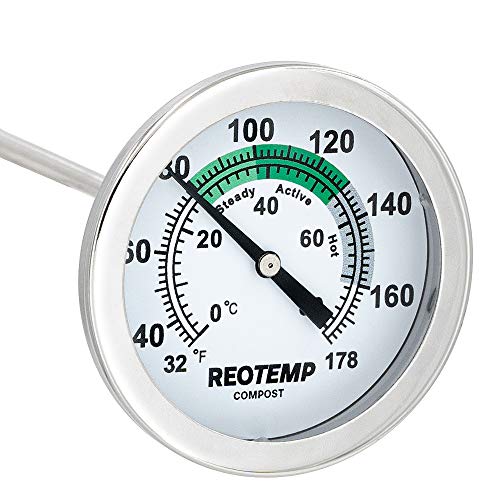
The Reotemp K83B1 occupies a smart middle ground in the REOTEMP lineup — longer than the K82-3 but more manageable than industrial-grade probes. At 12 inches, the stem reaches deeper compost layers and tall raised beds that the 5-inch model can't access, while the included free digital composting guide makes it genuinely beginner-friendly. The guide covers pile construction, carbon-to-nitrogen ratios, and temperature targets — information that transforms a thermometer reading from a number into an actionable decision.
Construction matches REOTEMP's standard: 304 stainless steel case and bezel, quality glass lens, waterproof and dustproof rating. The 32–178°F range in both Fahrenheit and Celsius covers the full composting arc, from a dormant cold pile to peak thermophilic activity. We found the needle movement smooth and the dial face easy to read even in the shaded corners of a bin enclosure.
The K83B1 is the thermometer our team would hand to someone starting their first backyard compost pile in 2026. The combination of reliable construction, appropriate stem length for smaller bins and garden beds, and the educational composting guide removes the typical barrier of not knowing what to do with the readings. It also handles standard soil temperature monitoring for seeding and transplanting, making it a genuinely versatile single purchase.
Pros:
Cons:
Soil thermometers are straightforward instruments, but the differences between models matter more than the price tags suggest. Our team found that matching the thermometer to the specific task — seeding, transplanting, or composting — produces better outcomes than defaulting to the most popular model. Here are the key considerations our team weighed across all seven picks.
This is the most important variable. Stem length determines which measurement depths are actually accessible, and the right length depends entirely on what's being measured.
Every model in our lineup except the Luster Leaf 1625 is analog — and that's not an accident. Analog thermometers offer several practical advantages: they work in any weather, never need batteries, and the mechanical construction is straightforward to maintain. For field conditions, analog reliability is hard to beat.
Digital thermometers like the Luster Leaf deliver exact numerical readouts that eliminate dial-reading ambiguity. This matters when making precise seeding decisions for crops with narrow germination windows, like lettuce (45–65°F optimal) or basil (above 60°F). The trade-off is battery dependency and slightly higher vulnerability to moisture damage in the long term. Most buyers don't need a digital model, but for precision-focused gardeners it's worth the added complexity.
Most soil thermometers in this category read 0–220°F, which covers everything from frozen winter ground to high-temperature composting. A few models top out at 178–200°F, which is sufficient for monitoring active compost piles but may occasionally fall short at the absolute peak of a well-managed thermophilic pile (which can hit 160–170°F before the pile needs turning). For soil monitoring specifically, any model in this lineup provides more than adequate range.
The presence of a Celsius scale alongside Fahrenheit is worth noting for anyone following international growing guides or working with extension recommendations from metric-system countries. The Taylor and Reotemp K83B1 both include dual scales clearly; the AcuRite and REOTEMP K82-3 are primarily Fahrenheit-focused.
304 stainless steel is the benchmark material for probe and housing construction — it resists the soil acidity, moisture, and mechanical stress that degrade cheaper alloys within a season or two. All seven models in our lineup use stainless steel for the probe, but the quality of the connection between probe and dial housing varies. That joint is the most common failure point, and models like the VIVOSUN and REOTEMP address it explicitly with reinforced connections. Waterproofing ratings (IP55 or equivalent) matter primarily for compost and wet-soil applications; for dry garden beds, standard stainless construction is sufficient.
For anyone building out a full soil health monitoring setup, it's also worth checking our gardening reviews section for companion tools covering pH, nutrient testing, and other soil quality indicators that complement temperature readings.
Most warm-season vegetables — tomatoes, peppers, cucumbers — need soil temperatures between 65–85°F for reliable germination. Cool-season crops like lettuce, spinach, and peas can germinate as low as 40–50°F. Checking soil temperature before planting is more reliable than relying on calendar dates or air temperature, which fluctuate more dramatically and don't reflect actual ground conditions at seed depth.
The standard recommendation is 2–4 inches below the surface, which is where most seeds are placed and where the relevant germination temperature exists. Surface soil warms and cools faster than deeper layers, so a reading at planting depth gives a more accurate picture of what seeds will experience after they're in the ground. Shorter 4–5 inch stem thermometers are well-suited for this depth range.
Yes, provided the thermometer is rated for the temperature range involved. Active compost piles can reach 130–160°F during thermophilic decomposition, and most of the models in this lineup cover that range. Accuracy within ±2–3°F is typical and sufficient for composting decisions, which generally use 10–15°F thresholds for turning or adjusting the pile. The key is using a stem long enough to reach the active thermal core, typically 12–20 inches into the pile's center.
The fundamental sensing mechanism is similar — both use bimetallic coil or liquid expansion principles — but soil thermometers are purpose-built for repeated probe insertions into abrasive material. The stainless steel probes are more corrosion-resistant, the dials are often calibrated for lower temperature ranges relevant to soil conditions, and the housings are designed to handle moisture and soil contact over extended periods. Using a kitchen thermometer in garden soil will shorten its lifespan and may compromise accuracy over time.
Analog bimetallic thermometers can drift slightly over time, especially after impacts or extreme temperature cycles. A simple ice water check — insert the probe into a slurry of ice and water, which should read 32°F — confirms whether the thermometer is accurate. Some models have a calibration nut at the base of the dial for minor adjustments. Digital models typically don't have field calibration options, but they tend to maintain factory calibration longer than analog instruments if handled carefully.
Our team consistently points beginners toward the Taylor Soil Testing Thermometer or the Reotemp K83B1 as starting points. The Taylor's color-coded temperature bands take the guesswork out of interpreting readings, while the Reotemp K83B1 includes a digital composting guide that adds educational context beyond the number on the dial. Both are analog, require no batteries, and are built to last multiple growing seasons with normal care.
The right soil thermometer is the one that actually gets used — match the stem length to the task, skip the overcomplicated features, and let the reading make the decision.
 |
 |
 |
 |

About Truman Perkins
Truman Perkins is a Detroit-based SEO consultant who's been in the business for over a decade. He got his start helping friends and clients get their websites off the ground, and he continues to do so today. In his free time, Truman enjoys learning and writing about gardening - something he believes is a natural stress reliever. He lives with his wife, Jenny, and their twins in Detroit.


Get new FREE Gifts. Or latest free growing e-books from our latest works.
Disable Ad block to reveal all the links. Once done, hit a button below
|
|
|
|
 rinjal