Which herb pot is actually worth your money in 2026? That's the question every home cook and balcony gardener wrestles with before dropping cash on yet another planter that ends up cracked, waterlogged, or shoved to the back of a shelf. The short answer: the Herb Planter Indoor 3 Iron Herb Pots set earns top pick for most windowsill herb growers — compact, attractive, and designed with drainage that actually works. But depending on your space, watering habits, and whether you're growing indoors or out, a different option on this list might suit you better.
Growing herbs at home is one of the most rewarding micro-investments you can make in your kitchen. Fresh basil, mint, cilantro, and thyme on demand — no more buying overpriced grocery-store bunches that wilt in three days. The pot you choose matters more than most people realize. Poor drainage kills herbs faster than neglect. A pot that's too large drowns roots. One that's too small stunts growth. And if you're growing indoors, aesthetics matter too — your planter is going to sit on your countertop or windowsill every single day.

This guide covers seven of the best herb pots available right now, ranging from simple terracotta classics to self-watering systems and vertical outdoor planters. Whether you're setting up your first windowsill herb garden or upgrading an outdoor setup, you'll find a clear recommendation here. We've also pulled together a full gardening reviews section if you want to explore more tools beyond planters. For those specifically growing basil, our deep-dive on the best pots for basil is worth bookmarking. And if lavender is on your list, check out our lavender pot guide too. For pairing your pots with the right growing medium, see our roundup of the best organic potting soils.
Contents





This is the herb planter that gets it right on almost every front. The three powder-coated iron pots sit on a varnished bamboo tray, and the whole setup looks sharp on a kitchen windowsill or counter without screaming "I bought this at a garden center." The square shape is clever — it maximizes the planting area relative to the footprint, and each pot has four drainage holes in the bottom, which is genuinely more than you'll find on most competitors. Four holes means water doesn't pool, roots don't rot, and your herbs actually thrive rather than just surviving.
The customizable chalkboard labels are a legitimately useful bonus. You get eight reusable oval labels, three stick labels, and a wipeable white marker pen. That's enough to label every pot multiple times over as you swap herbs throughout the seasons. The rust-resistant powder coating holds up well to regular watering — far better than cheaper painted metal options that start flaking within a few months. If you're setting up a first herb garden in 2026, this is the set to start with. The only real limit is size: these pots are designed for compact herbs like basil, chives, or thyme, not sprawling plants like mint that want to run.
The combination of four drainage holes per pot, attractive design, and reusable labeling system makes this the strongest all-around pick in the lineup. It's practical, it looks good, and it's built to last through regular indoor use.
Pros:
Cons:
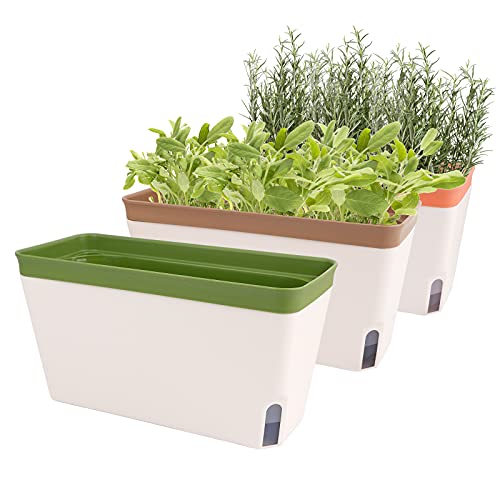
If you forget to water — and be honest with yourself here — the OurWarm self-watering planter set is going to save your herbs from your own schedule. These 10.5-inch rectangle planters use two absorbent cotton ropes per pot to wick water up from a bottom reservoir through osmosis, keeping the soil consistently moist without any effort from you. The visible water level window on the bottom is a practical touch: you can see at a glance whether you need to refill, which removes all the guesswork from herb care.
The double-layer split design is well thought out. Each planter has a dedicated water injection port on top, so you add water without disturbing your plants or pulling out the inner pot. That matters more than it sounds — with traditional planters, overwatering and underwatering happen exactly because the process is disruptive enough that people either flood it or avoid it entirely. The self-watering mechanism essentially removes human inconsistency from the equation. These planters handle basil, parsley, chives, and other medium-moisture herbs exceptionally well.
The plastic construction keeps them lightweight and the modern rectangular style fits clean, minimal kitchen aesthetics. The only caveat is that osmosis-based watering works best for plants that like consistent moisture — drought-tolerant herbs like rosemary or thyme might get too much water if the reservoir is kept full. For those herbs, you'd want to run the reservoir lower or stick to traditional drainage pots.
Pros:
Cons:
The Keter Urban Bloomer is a completely different category of planter compared to the others on this list. At 32.3 inches long, 14.7 inches wide, and 30.7 inches tall, this is a raised garden bed masquerading as a planter box. The 12.7-gallon capacity means you can grow a genuinely serious herb garden — multiple large plants, deep-rooted herbs like rosemary, or a dense mixed collection of basil, oregano, mint, and sage all coexisting in one raised bed.
The built-in water gauge is the standout feature. It tells you exactly when your plants need water, which takes the frustration out of outdoor herb care where evaporation and rainfall create wildly unpredictable moisture levels. The drainage plug gives you direct control: open it for full drainage during rainy periods, close it to retain moisture during dry spells. That level of control over moisture is what separates the Keter Urban Bloomer from basic outdoor planters. The dark grey color and clean lines suit patios, balconies, and decks without looking utilitarian. Assembly is straightforward and the material — Keter's resin construction — holds up through heat, frost, and UV exposure year after year. According to container gardening principles, raised beds like this dramatically improve drainage and root health compared to in-ground planting in compacted soil. If you have outdoor space and want to grow herbs at meaningful scale, this is your planter.
Pros:
Cons:
There's a reason terracotta has been the go-to material for herb pots for centuries. Clay is breathable. It pulls excess moisture away from roots. It creates the kind of slightly-dry-then-water cycle that Mediterranean herbs like rosemary, thyme, sage, and oregano genuinely thrive under. The vensovo 4-inch set gives you six pots baked at 1796°F, which is a high enough firing temperature to ensure durability and crack resistance. Each pot includes a matching saucer, which matters if you're placing them on windowsills or furniture.
The 4-inch size is perfect for individual herb plants at the seedling or established small-plant stage. Each pot has a drainage hole in the bottom — standard for terracotta, but executed cleanly here without jagged edges. Six pots in a set at this price point is exceptional value for anyone starting a multi-herb kitchen garden in 2026. The pots passed a 3-foot drop test during packaging quality control, which speaks to the firing quality rather than being a gimmick. Terracotta isn't indestructible, but this set is meaningfully sturdier than discount alternatives.
The main limitation is moisture: terracotta dries out faster than plastic or glazed ceramic, so herbs like basil or mint that need consistent moisture will require more frequent watering. That's not a flaw — it's the material's nature. Match terracotta to drought-tolerant herbs and you'll get excellent results. For moisture-loving herbs, stick with the self-watering options on this list.
Pros:
Cons:
The T4U self-watering pots offer a compelling deal: six 6-inch white plastic pots with a cotton rope wicking system that keeps your herbs hydrated for 7–10 days between refills. That's a full week without watering. If your herb garden has been a casualty of a busy week or a short trip out of town, these pots solve that problem completely. The dual-layer construction stores water at the base, completely separated from the soil layer above, so roots get moisture on demand without ever sitting in standing water.
At 6 inches, these are appropriately sized for established herb plants — bigger than the 4-inch terracotta options, which means more root space and more growing volume for plants like basil or parsley that benefit from a bit more room. The white finish is clean and modern. It reads as intentional rather than cheap, which matters if these are sitting in a visible spot in your kitchen or home office. Six pots at this price makes the T4U set one of the best value options for anyone setting up a full indoor herb collection.
One honest note: the cotton rope wicking system works best when the rope makes consistent contact with both the water reservoir and the root zone. If you repot or disturb the soil heavily, repositioning the rope correctly matters. It's not complicated, but it requires one moment of attention during setup. Beyond that, these are reliable, practical pots that deliver exactly what they promise.
Pros:
Cons:
Space is the limiting factor for most herb gardeners in apartments and smaller homes. The vertical 3-tier planter solves that directly. Three tiers of planting space, stacked vertically on a stable triangular-base metal frame, lets you grow significantly more herbs per square foot of floor space than any horizontal planter arrangement. The tiered design also makes light distribution more even for each plant — each tier gets reasonable exposure without being completely shaded by the tier above.
The high-quality metal construction is built for outdoor use. The triangular support base handles wind without tipping, which is a genuine concern if you're placing a tall planter on a balcony or patio. Each tier includes drainage holes and a removable tray underneath, so you control water runoff without staining your deck or patio surface. For anyone gardening on a balcony or small patio in 2026, this vertical design is the most space-efficient herb growing solution on this list.
The grey finish is neutral and works across most outdoor aesthetics. Setup is simple. You can dedicate each tier to a different herb family — a tier for Mediterranean herbs that like drier conditions, one for leafy herbs that need more moisture, one for slower-growing perennials. That separation makes watering and care more targeted. The downside is that this planter is entirely outdoor-oriented. It's too large and utilitarian for kitchen use, and the metal frame isn't designed for indoor floor placement.
Pros:
Cons:
The Cole & Mason Herb Keeper is a fundamentally different product from the growing pots above — and it's worth including because it solves a problem every herb gardener eventually faces. You've cut more herbs than you need right now. What happens next? Without a proper keeper, fresh herbs wilt and yellow within two to three days in the fridge. The Cole & Mason extends that to up to 10 days by maintaining an optimal refrigerator environment through its Flip & Slide Lid with air vents and a built-in hydro pad that keeps humidity at the right level.
The removable dividers let you store multiple herb varieties in a single container without them mixing or cross-contaminating flavors. That's genuinely useful when you're managing fresh basil, cilantro, and chives simultaneously — three herbs with very different flavor profiles that shouldn't mingle. The pour spout is a practical design detail for decanting water without removing the whole lid. For cooks who grow herbs actively and cut them regularly, this keeper is an essential companion to any growing pot setup.
This isn't a growing pot, to be absolutely clear. You're not rooting plants in here. It's purely a post-harvest storage tool. But for anyone who treats their herb garden as part of their cooking workflow — which is the point of growing herbs in the first place — this extends the usable life of your harvest significantly. Pair it with any growing pot from this list and you have a complete herb management system from garden to kitchen.
Pros:
Cons:
Herbs die from overwatering more often than any other cause. Every herb pot you buy needs at least one drainage hole — no exceptions. Without drainage, water accumulates at the root zone and creates anaerobic conditions that rot roots quickly, even with careful watering. More holes are better: the iron herb pots on this list have four per pot, which is excellent. Terracotta clay is naturally porous and provides passive drainage through the pot walls in addition to the bottom hole, making it particularly forgiving. Plastic pots rely entirely on the drainage holes at the base, so quantity and size matter more. If you find a pot you love but it has no drainage hole, you can drill one — but don't skip this step.
Self-watering pots with reservoirs operate differently: they use a wicking mechanism that pulls water upward into the soil on demand. The soil itself never sits in standing water. That's not the same as no drainage — the design is specifically engineered to prevent root rot. These systems work well for moderate-moisture herbs but require a bit more attention to which herb varieties you're planting in them.
Match pot size to the plant's eventual size, not just its current size. Basil, for example, can get tall and develops a substantial root system — a 4-inch pot is fine for a seedling but a 6-inch or larger pot is better for a mature plant. Mint is aggressively invasive by nature and actually benefits from being contained in a smaller pot; it redirects energy into leaf production rather than root spreading. Rosemary and thyme grow slowly but develop deep root systems over years — give them depth as well as diameter.
A pot that's too large is almost as problematic as one that's too small. Excess soil retains moisture beyond what the roots can absorb, creating the same waterlogged conditions as poor drainage. A general rule: choose a pot roughly 1-2 inches larger in diameter than the plant's current root ball.
The material affects moisture retention, temperature regulation, and aesthetics simultaneously. Here's how the main materials compare:
Your placement context determines almost everything else. Indoor herb pots need to look good on countertops and windowsills — aesthetics matter. They also need saucers or trays to protect surfaces. Drainage is still important but you have more control over watering indoors. Outdoor planters face UV exposure, temperature extremes, wind, and rain. Material durability becomes the priority. Vertical planters like the 3-tier option on this list make sense only outdoors where you have vertical space and don't need to worry about indoors aesthetics or stability on furniture surfaces.
Light is the other factor. Most herbs need 6–8 hours of direct light daily. Indoor windowsills rarely provide this fully, especially in northern climates during winter. If you're growing indoors year-round, a south-facing window is essential, or you'll need a grow light. No pot selection compensates for insufficient light.

For most common kitchen herbs, a 4–6 inch pot is the right starting point. Basil, chives, cilantro, and parsley do well in 4–6 inch pots. Mint needs at least 6 inches because it spreads aggressively. Rosemary grows slowly but needs depth — an 8-inch pot is appropriate for a mature plant. Don't oversize: large pots with excess soil hold too much moisture and can cause root rot, which is one of the most common herb-growing mistakes. Start at the right size and repot up as plants mature rather than giving them too much room at the start.
Yes, without exception — unless you're using a properly designed self-watering system with a wicking mechanism. Regular herb pots without drainage holes accumulate water at the root zone, creating anaerobic conditions that rapidly rot roots. Even careful watering doesn't prevent this without drainage, because you can never precisely calibrate how much water the soil retains versus releases. The pots on this list all include drainage by design. If you have a decorative pot you love that lacks holes, use it as an outer cachepot with a properly drained inner pot sitting inside it.
Self-watering pots work well for moisture-loving herbs: basil, parsley, cilantro, mint, chives, and Vietnamese coriander all thrive in them. They're a poor match for drought-tolerant Mediterranean herbs like rosemary, thyme, oregano, and sage, which need periods of soil drying between waterings. Consistently moist soil from a self-watering reservoir is exactly the wrong environment for those herbs. For a mixed herb garden, it's better to use traditional pots with drainage for Mediterranean herbs and self-watering pots for moisture-loving varieties, rather than trying to use one system for everything.
Terracotta is the best material for drought-tolerant Mediterranean herbs because it's breathable and helps soil dry evenly between waterings. Plastic and glazed ceramic retain moisture longer, making them better for herbs that like consistent moisture like basil or mint. Metal pots are attractive and durable but can heat up in direct outdoor sun, which stresses roots in summer — keep metal herb pots in partially shaded outdoor spots or use them strictly indoors. For outdoor raised beds and large planters, weather-resistant resin like Keter's construction is the most practical choice — it handles frost, UV, and heat without degrading over years of use.
A standard 6-inch individual pot supports one herb plant comfortably. Crowding multiple herbs into a single pot creates competition for water, nutrients, and light, and usually results in all of them underperforming. Larger planters — a 10-inch or 12-inch pot, or a raised bed like the Keter Urban Bloomer — can support three to five herb plants if they have compatible water needs. Don't mix drought-tolerant and moisture-loving herbs in the same planter, since you can't water them on different schedules when they're sharing soil. For a diverse kitchen herb collection, a set of individual pots (like the 6-pack terracotta or self-watering sets) gives you independent control over each plant.
There's no single correct frequency — it depends entirely on the herb, pot material, pot size, ambient temperature, and light level. The most reliable method is the finger test: push your finger 1 inch into the soil. If it feels dry, water. If it still feels moist, wait. Most herbs need watering every 2–3 days in warm conditions. Mediterranean herbs like rosemary and thyme want to dry out between waterings — once every 5–7 days in moderate conditions. Basil and mint dry out quickly and may need water daily in summer. Self-watering pots remove most of this calculation entirely by maintaining consistent moisture automatically, which is why they're worth considering if you find a fixed watering schedule difficult to maintain.
The pot that drains well, fits the herb's size, and suits your watering habits is always the right pot — everything else is just preference.
 |
 |
 |
 |

About Truman Perkins
Truman Perkins is a Detroit-based SEO consultant who's been in the business for over a decade. He got his start helping friends and clients get their websites off the ground, and he continues to do so today. In his free time, Truman enjoys learning and writing about gardening - something he believes is a natural stress reliever. He lives with his wife, Jenny, and their twins in Detroit.


Get new FREE Gifts. Or latest free growing e-books from our latest works.
Disable Ad block to reveal all the links. Once done, hit a button below
|
|
|
|
 rinjal