reviewed by Christina Lopez
Which fertilizer will actually make your fruit trees produce more — and which ones are overpriced hype? If you've spent time standing in a garden center comparing bags or scrolling through endless Amazon listings, you already know how overwhelming this decision gets. The right fertilizer can mean the difference between a tree that barely survives and one that gives you a full, flavorful harvest. After researching the top-selling products in 2026, one pick stands above the rest: Espoma Organic Citrus-Tone 5-2-6. But the best choice for you depends on your specific trees, soil, and gardening style — so keep reading.
Fruit trees are hungrier than most people realize. Unlike ornamental plants that just need to look decent, fruit-bearing trees are continuously channeling energy into root development, canopy growth, flowering, and fruit production — all at the same time. That's a massive nutrient demand, and feeding your trees the wrong NPK ratio or at the wrong time can suppress flowering and reduce yields dramatically. Whether you're growing citrus in containers, managing a backyard apple orchard, or nurturing an avocado in a warm-climate garden, the fertilizer you choose is one of the highest-leverage decisions you'll make all season.

This guide covers seven of the best fertilizers for fruit trees available in 2026, with detailed reviews, a clear buying guide, and answers to the most common questions gardeners ask. If you're also tending to a full lawn alongside your trees, check out our guide to the best fertilizer for Bermuda grass for a comprehensive feeding strategy. For background on how plant nutrients actually work at a biological level, the Wikipedia overview of plant nutrition is a solid starting point. Now, let's get into the reviews.
Contents





If you want a single bag that handles citrus, avocado, nut trees, and Meyer lemons without any complicated mixing, Espoma Citrus-Tone is your answer. The 5-2-6 NPK ratio with 5% calcium is specifically calibrated for fruit trees that demand more potassium than nitrogen — a balance that drives fruit development rather than just leaf growth. The Bio-tone formula incorporates beneficial microbes that actually improve soil biology over time, unlike synthetic fertilizers that feed the plant but leave your soil depleted season after season.
The application schedule is straightforward: late winter before bloom, spring after bloom, and fall. You broadcast it around the drip line and water it in — no measuring, no mixing. Gardeners who've used Citrus-Tone for multiple seasons consistently report heavier fruit sets and more vibrant foliage. The fact that it's OMRI-safe and contains no sludges or toxic ingredients also means you can use it around edible landscaping without concern. For a bag of 4 lbs, it covers a solid amount of ground if you apply according to label directions.
The one limitation is that slow-release organic formulas take 2–4 weeks to show visible results. If your tree is severely deficient and you need fast correction, you'll want to supplement with a quick-acting liquid for the first application. But for ongoing seasonal feeding, Espoma Citrus-Tone is the most reliable and user-friendly choice in this category for 2026.
Pros:
Cons:
Fertilizer spikes are a divisive topic among gardeners — but Jobe's Organics makes a compelling case for them. Each spike delivers nutrients directly into the root zone with zero runoff and zero mess. The 3-5-5 NPK formula puts phosphorus and potassium front and center, which supports root strength and fruit development rather than pushing excess leafy growth that doesn't translate to harvest. For container-grown citrus trees on a patio or indoors near a sunny window, these spikes are hard to beat for convenience.
The package includes 6 spikes, and application couldn't be simpler: you push them into the soil at the drip line of your tree at the recommended spacing and let them work. Because they're positioned below the surface, rain and watering don't carry nutrients away before roots can absorb them — a genuine advantage over granular formulas in containers where potting mix drains rapidly. The OMRI listing confirms organic status, and the absence of synthetic chemicals makes them appropriate for trees producing fruit you plan to eat.
The knock on spikes in general is uneven nutrient distribution across the root zone. In a large in-ground tree, the hotspot around each spike may not reach all feeder roots. That's why these work best in containers or young trees with compact root zones. For established backyard trees with wide spreading roots, a broadcast granular like Espoma or Down To Earth will deliver more uniform coverage. But for your potted Meyer lemon or dwarf mandarin, Jobe's spikes are the most hassle-free option in this roundup.
Pros:
Cons:
Down To Earth's Citrus Mix takes organic fertilizing seriously. Beyond the standard NPK numbers, this formula includes calcium, sulfur, zinc, and iron — secondary and micronutrients that most basic fertilizers completely ignore. Zinc deficiency is one of the most common causes of small, deformed fruit in citrus trees, and iron deficiency causes the yellowing leaves (chlorosis) that signals a tree in distress. Addressing these with a single product instead of buying separate amendments is a real advantage for home gardeners.
The 6-3-3 analysis leans nitrogen-forward, which makes it especially effective during the active growing season when trees are pushing new shoots and leafing out. The 5 lb box covers a meaningful area and represents good value for the nutrient density you're getting. Like all OMRI-listed organic fertilizers, it works through microbial breakdown in the soil, which feeds the tree naturally over time rather than delivering a synthetic jolt.
Down To Earth is a brand trusted by serious organic growers, and the Citrus Mix shows why. If you're in an area with known mineral deficiencies in the soil — common in sandy soils or regions with heavy rainfall that leaches micronutrients — this formula gives your trees a more complete nutritional foundation than any plain NPK product. If you're interested in building healthy soil from the ground up, pairing this with one of the best bagged composts creates a powerful feeding system for your entire edible garden.
Pros:
Cons:
Dr. Earth's Natural Wonder takes a different angle from the citrus-specific formulas: this is a truly universal fruit tree fertilizer designed to work across apples, pears, peaches, berries, grapes, nut trees, and avocados as well as citrus. The balanced 5-5-2 NPK provides equal nitrogen and phosphorus, which promotes both strong root development and healthy canopy growth without over-emphasizing any single nutrient. If you have a mixed orchard with multiple tree types, this eliminates the need to buy separate products for each species.
Dr. Earth is known for its hand-crafted small-batch approach to organic blending, and Natural Wonder is a good example of that philosophy. The formula explicitly excludes synthetic ingredients and GMO-infested chicken manure — a meaningful distinction from cheaper organic products that use low-quality inputs. The result is a clean, soil-building fertilizer that improves your growing medium over multiple seasons rather than just feeding the plant today.
The 5-5-2 ratio is slightly higher in nitrogen and phosphorus relative to potassium compared to citrus-specific formulas. For trees that are primarily in a vegetative growth phase — young trees establishing themselves, or trees recovering from transplant stress — this balance works well. For mature, established trees that you're pushing toward maximum fruit production, you may want to complement this with a higher-potassium product at bloom time. Still, as a base seasonal feed for a diverse fruit tree collection, Dr. Earth Natural Wonder earns its place on this list.
Pros:
Cons:
Jack's Classic is the fast-response tool in your fertilizing toolkit. The 20-10-20 water-soluble formula delivers nutrients immediately upon watering — there's no waiting weeks for microbial breakdown as with organic granulars. This makes it the go-to choice when you need to intervene quickly: a tree showing yellowing leaves mid-season, a container plant that's been depleted by heavy watering, or tropical fruiting trees like citrus grown indoors that need consistent feeding through the winter months.
The high nitrogen percentage (20%) drives strong green growth and is particularly effective for tropical fruiting plants that produce fruit on new wood. The 1.5 lb bag of powdered concentrate goes much further than liquid formulas — a single bag mixes into multiple gallons of liquid fertilizer, making it economical for large trees or frequent applications. You can apply it as a root drench or as a foliar spray, which is especially useful when you see localized deficiency symptoms on specific branches that need immediate attention.
The trade-off with high-analysis water-soluble fertilizers is precision: you need to mix correctly, avoid overfeeding, and never apply to dry soil. Over-application can burn roots and cause nutrient lockout. It's also not certified organic, which matters if you're running a certified garden or orchard. Use Jack's Classic as a corrective or supplemental feed alongside a slower organic base program, rather than as your only fertilizer. For gardeners who want full control over nutrient timing and dosage, it's an excellent complement to the organic options on this list.
Pros:
Cons:
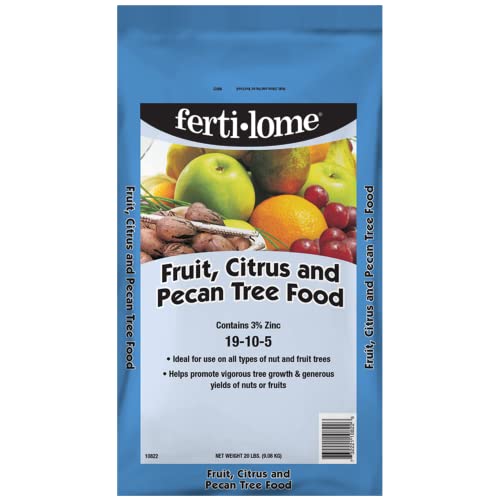
If you're maintaining a larger property with multiple fruit trees, nut trees, or pecan trees, buying small bags becomes inefficient fast. Fertilome's 20 lb bag solves the quantity problem directly. The 19-10-5 NPK analysis is heavily nitrogen-forward, designed to push maximum vegetative growth and canopy development, with enough phosphorus to support root establishment and flowering. The inclusion of zinc specifically targets Rosette disease in pecan trees — a real concern for pecan growers that most general fruit tree fertilizers ignore entirely.
This product covers a wide range of tree types: fruit, citrus, and nut trees all respond well to the formula. The granular format applies easily with a broadcast spreader — speaking of which, if you're covering a large area regularly, pairing this with a quality broadcast spreader makes the whole process significantly faster. For large-scale applications, using a spreader also ensures uniform coverage that hand-broadcasting simply can't match.
The nitrogen-heavy ratio means you need to be disciplined about application timing. Applying too late in the season — particularly heading into fall — can stimulate tender new growth that gets damaged by early frosts. For warm-climate gardeners or year-round applications in frost-free zones, this is less of a concern. As a budget-conscious large-quantity option that covers nut trees as well as standard fruit trees, Fertilome delivers solid results where other products fall short on volume or specificity.
Pros:
Cons:
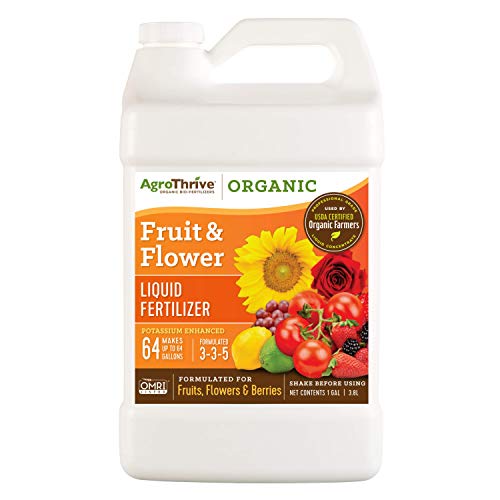
AgroThrive bridges the gap between organic credentials and liquid delivery speed. Most organic fertilizers are granular and slow-release; AgroThrive is a liquid concentrate derived from organic fish and grain that applies immediately and absorbs quickly. The 3-3-5 NPK with higher potassium is specifically designed to support fruiting and flowering — potassium is the nutrient that governs fruit size, sugar content, and overall yield quality. If your trees are flowering but dropping fruit prematurely or producing small, flavorless fruit, a potassium-rich liquid like this one is often the solution.
The Progressive Digestion Process AgroThrive uses breaks organic inputs down to a molecular level, which the brand claims improves absorption speed and bioavailability compared to standard fish emulsions. Whether you believe the marketing or not, the practical reality is that liquid organics are faster-acting than granular ones, and the 3-3-5 ratio at bloom time is exactly what flowering fruit trees need. The 1-gallon container concentrates go a long way when diluted according to label directions.
The fish-and-grain origin means this fertilizer has an odor when first applied — you'll notice it. It fades quickly once watered in, but if your trees are near a patio or outdoor seating area, plan your application timing accordingly. For gardeners who want organic certification-compatible products but also want the flexibility of a liquid that can be applied through a hose-end sprayer or irrigation system, AgroThrive is one of the few options that genuinely delivers on both fronts. It pairs naturally with the soil-building work of granular organic programs and fits neatly into a gardening routine that also draws on guides like our best boxwood fertilizer reviews for ornamental plants sharing the same beds.
Pros:
Cons:
Choosing a fertilizer isn't just about picking the highest NPK numbers on the bag. The right formula for your trees depends on species, soil condition, growth stage, and your broader gardening philosophy. Here's what actually matters when you're making this decision in 2026.
Nitrogen (N) drives leaf and shoot growth. Phosphorus (P) supports root development and flower formation. Potassium (K) governs fruit size, disease resistance, and overall tree health. For mature fruit trees focused on production, you generally want less nitrogen and more potassium — which is why citrus-specific formulas like Espoma Citrus-Tone (5-2-6) and AgroThrive (3-3-5) lean higher in K than N.
Young trees in their first 1–3 years need a more balanced ratio — equal N and P helps them build root systems and canopy before they start fruiting. For young trees, Dr. Earth Natural Wonder's 5-5-2 makes more sense than a high-potassium formula. Once your trees reach fruiting age, shift toward higher potassium to maximize yields. The timing of application matters as much as the formula: pre-bloom, post-bloom, and fall are the three critical windows for most fruit trees, and skipping even one of those moments affects the following season's harvest.
Organic fertilizers feed soil biology, which feeds your tree. Synthetic fertilizers feed the tree directly. Both approaches produce fruit, but the long-term soil health outcomes are different. Organic fertilizers build microbial populations, improve water retention, and reduce the risk of nutrient runoff and soil acidification — benefits that compound over years of use. Synthetics deliver faster results and more precise nutrient control but do nothing for soil biology and can degrade soil structure over time with repeated use.
If you're running an edible garden where soil health is a priority — and fruit trees are long-term investments that live in that soil for decades — the organic options on this list are the smarter choice. If you need rapid intervention or are managing a production-scale operation with tight seasonal windows, Jack's Classic or Fertilome give you the fast-acting control that organics simply can't match. Many experienced growers use both: an organic base feed for the season and a water-soluble synthetic for targeted corrections. You can also browse the full gardening reviews section for additional tools and products that complement your fruit tree care routine.
Granular fertilizers broadcast over the drip line offer the most uniform root zone coverage for in-ground trees. They're generally the best default choice for established backyard trees. Spikes are convenient and mess-free but create nutrient hotspots — ideal for containers and small trees, problematic for mature in-ground trees with extensive root systems. Liquid fertilizers apply quickly and absorb fast, making them the best corrective tool and the best choice for container trees that need frequent, consistent feeding.
The application method also affects how often you need to feed. Slow-release granulars typically require 2–3 applications per year. Liquid concentrates may need monthly or even biweekly applications during peak growing season. Match your application frequency to your schedule and the specific demands of your tree species to avoid both underfeeding and the equally damaging problem of overfeeding.
Calcium, magnesium, sulfur, zinc, and iron are not in most basic fertilizers — but fruit trees need them. Calcium prevents fruit splitting and blossom end rot. Zinc deficiency causes small, misshapen fruit in citrus. Iron deficiency causes chlorosis (yellowing between leaf veins). If your trees show any of these symptoms, a plain NPK fertilizer won't solve the problem. Down To Earth Citrus Mix specifically addresses this gap with its inclusion of calcium, sulfur, zinc, and iron in the base formula. For soils with known mineral deficiencies, this makes it the most complete single-product solution in this category.
The three most important windows are late winter before bloom begins, spring after petal fall, and early fall before the tree begins to go dormant. These timing points align with the tree's peak nutrient demands: pre-bloom feeding fuels flower formation, post-bloom feeding supports fruit development, and fall feeding replenishes reserves for winter and the following spring flush. Avoid fertilizing in late fall in frost-prone climates, as it can stimulate tender growth that freezes easily.
The general guideline is 1 lb of actual nitrogen per year of tree age, up to a maximum of about 1 lb per year for mature trees. For granular fertilizers, follow the label's pounds-per-tree or pounds-per-inch-of-trunk-diameter recommendations. Container trees need more frequent feeding at lower doses because nutrients leach out with every watering. Always water thoroughly after applying granular fertilizers to prevent root burn and activate the nutrients.
You can use a general fruit tree fertilizer like Dr. Earth Natural Wonder across apple, pear, peach, and plum trees. However, citrus and avocado trees have specific calcium and micronutrient needs that a citrus-specific formula like Espoma Citrus-Tone or Down To Earth Citrus Mix addresses better. Pecan trees benefit from zinc supplementation, which Fertilome specifically includes. If you have a mixed orchard, a multi-purpose formula works as a base, with targeted supplementation for specialized species.
For long-term orchard health, organic fertilizers are superior because they build soil biology, improve water retention, and reduce leaching. Fruit trees live in the same soil for decades, so soil quality compounds over time. Organic fertilizers also eliminate concerns about residue on edible fruit. The trade-off is speed — organics take weeks to show results, while synthetics work within days. Many growers use both: an organic granular for base seasonal feeding and a water-soluble synthetic for targeted deficiency corrections mid-season.
Yellow leaves on citrus are most commonly caused by iron, magnesium, or nitrogen deficiency. If the yellowing appears between the veins of young leaves while the veins remain green, that's iron chlorosis — usually triggered by high soil pH that locks iron out even when it's present. If older leaves yellow uniformly, nitrogen deficiency is more likely. Adjusting soil pH toward the 6.0–7.0 range often resolves iron uptake issues. A fertilizer that includes chelated iron, like Down To Earth Citrus Mix, helps address both the nutrient delivery and the soil chemistry simultaneously.
Apply granular fertilizers to the drip line of the tree — the area under the outermost branch tips where feeder roots are most active — rather than broadcasting broadly across the entire bed. This targets the application to where it's most needed and minimizes nutrient exposure to shallow-rooted ground covers or companion plants. With liquid fertilizers, apply to the root zone only and avoid foliage contact with sensitive neighboring plants. Organic formulas at recommended rates pose virtually no risk to surrounding plants and are the safest choice in mixed planting areas.
The right fertilizer for your fruit trees is out there — and after reading through these reviews, you now have the knowledge to make a confident choice rather than a guesswork purchase. Start with Espoma Citrus-Tone for citrus and avocado, reach for Down To Earth if your soil is micronutrient-deficient, and keep a water-soluble option like Jack's Classic on hand for fast corrections when your trees need immediate support. Pick the product that matches your trees, your soil, and your gardening approach, and your harvest in 2026 will show the difference.
 |
 |
 |
 |

About Christina Lopez
Christina Lopez grew up in the scenic city of Mountain View, California. For eighteen ascetic years, she refrained from eating meat until she discovered the exquisite delicacy of chicken thighs. Christina is a city finalist competitive pingpong player, an ocean diver, and an ex-pat in England and Japan. Currently, she is a computer science doctoral student. Christina writes late at night; most of her daytime is spent enchanting her magical herb garden.


Get new FREE Gifts. Or latest free growing e-books from our latest works.
Disable Ad block to reveal all the links. Once done, hit a button below
|
|
|
|
 rinjal