reviewed by Truman Perkins
You've been staring at a stubborn root ball for twenty minutes, your regular garden spade bent at an angle it was never meant to bend. Sound familiar? Choosing the right shovel for digging up roots makes the difference between a backbreaking afternoon and a job done in under an hour. In 2026, the market has more options than ever — serrated blades, V-tip cutters, compact nomad tools — and it can be genuinely hard to know where to start.
This guide cuts through the noise. We tested and researched seven top-rated root-cutting shovels across different price points, handle styles, and blade designs. Whether you're clearing out an old shrub, prepping a raised bed, or working in tight garden spaces, there's a tool here built for your specific job. If you're also planning to start fresh after clearing those roots, check out our 15 Best Seed Starter Kits to get your new planting season off to a strong start.
Root removal is one of the toughest tasks in any garden. Plant roots can extend deep into compacted soil, wrap around buried rocks, and resist even heavy-duty tools if the blade geometry isn't right. The shovels on this list were selected specifically for their ability to cut, slice, and pry roots out cleanly — not just move dirt. Browse all our gardening reviews if you're outfitting your full tool kit.

Contents
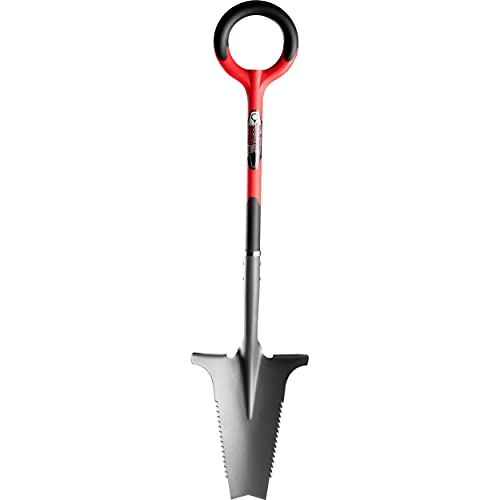




The Root Slayer 22011 earns the top spot because it was designed from the ground up for one job: cutting roots. The signature feature is that inverted V-shaped cutting tip — it's not just a pointy blade, it's an aggressive wedge that splits roots apart rather than pressing through them. Pair that with the ripsaw-style serrated edges running up both sides of the blade, and you have a tool that attacks roots from three angles at once. You'll feel the difference on your very first dig.
The carbon steel blade has a powder-coated finish that holds up to wet soil and repeated use without showing rust. The ergonomic handle is engineered to reduce strain on your hands and wrists, which matters a lot when you're spending an hour or more clearing a root-heavy garden bed. The tool is full-sized — not a compact version — so you get real leverage when you need to pry up a stubborn clump. For the home gardener dealing with everything from ornamental shrub roots to overgrown tree feeder roots, this is the one tool that does it all.
It's heavier than a standard spade, which some users find tiring during very long sessions. But if your goal is efficient root removal rather than casual soil turning, the extra mass works in your favor — it drives the blade deep with less effort per stroke. This is our pick for the best all-around root shovel in 2026.
Pros:
Cons:
If you want a professional-grade root-cutting tool, the Lesche Sampson Pro-Series is built for the job. At 31 inches overall with a 7.5-inch blade that's 4 inches wide, this shovel hits the sweet spot between maneuverability and cutting power. The pre-sharpened serrated blade edge arrives ready to work right out of the box — no sharpening required before your first session.
The T-handle design is what sets this apart from standard D-grip shovels. A T-handle gives you more twisting leverage — critical when you're trying to pry apart a dense root system rather than just cutting in straight lines. You can push down with one hand and rotate with the other for a slicing motion that standard handles simply can't replicate. Lesche has been making heavy-duty digging tools for serious users for decades, and the build quality here reflects that experience.
The blade dimensions make it ideal for working in tighter spots compared to a full-size shovel, without going as small as a compact tool. You get a purposeful middle ground: enough blade surface to cut wide root systems, short enough to use with precision. If you're regularly dealing with established shrubs, perennial root masses, or aggressive spreaders, this is your go-to tool.
Pros:
Cons:
The Root Slayer Nomad is approximately 70% the size of the original Root Slayer, and that size reduction solves a real problem: full-size shovels simply don't fit in raised beds, narrow planting rows, or tight corners. The Nomad brings the same ripsaw-style serrated teeth and V-shaped cutting tip to compact spaces where your standard tool can't maneuver. For raised bed gardeners, this compact form factor is a game-changer.
Despite being smaller, this is not a lightweight tool. The powder-coated carbon steel blade maintains the same corrosion resistance and cutting integrity as the full-size model. You're not sacrificing durability for portability here — you're getting a purpose-built compact tool that punches above its weight. It's also popular with campers and trail workers who need to dig around roots and stumps in remote locations where carrying a full-size shovel isn't practical.
Because it's shorter, you'll be working closer to the ground, which means more bending. That's the honest trade-off of any compact tool. But if your root problems are in contained spaces — raised beds, planter boxes, tight garden borders — the Nomad is the right call. It does the Root Slayer's job in the places the original can't reach.
Pros:
Cons:
Fiskars is a trusted name in garden tools, and this 46-inch spade earns its place on this list because it handles roots well while also being a genuinely excellent all-purpose digging tool. The all-steel welded construction means there's no weak joint between the blade and the shaft — a common failure point on cheaper shovels when you're prying against resistance. The teardrop-shaped shaft and oversized D-handle are ergonomically designed to reduce fatigue during extended sessions.
The flat spade blade with a sharp edge cuts cleanly through turf, grass, and small-to-medium roots. It's not a dedicated root-slayer like the serrated options above, but for general landscaping that involves occasional root encounters, it's the better choice because of its versatility. You can edge a lawn, cut a clean planting hole, divide perennials, and slice through roots all with the same tool. If you only want one shovel that does everything reasonably well, this is it.
At 46 inches, this is a full-length tool. Taller users will especially appreciate the handle length — no hunching forward. The steel head stays sharp through heavy use, and Fiskars backs their tools with a strong warranty. For gardeners who deal with roots as part of broader yard work rather than as their primary task, the Fiskars spade is the smart, practical choice in 2026.
Pros:
Cons:
The Toolite drain spade solves a specific problem that most shovels can't address: digging a clean, narrow trench through root-filled soil. The 14-inch long, narrow blade profile is designed to penetrate deep without disturbing the surrounding soil profile. Mud and muck releasing blade geometry means soil doesn't stick and build up on the blade face — a practical feature that saves real time and energy when you're working in wet, clay-heavy ground.
The 14-gauge tempered steel head with 3/8-inch reinforcing cores means this tool is built for serious work. The polymer-jacketed fiberglass core adds strength without unnecessary weight. With the 29-inch wood handle and poly D-grip, you get a comfortable working tool that fits in confined trenching situations where a longer handle would be a liability. This is the right tool if you're running irrigation lines through a root-filled lawn, or digging drainage channels along a foundation.
It's a specialized tool — we want to be clear about that. If you need to remove a large root ball or clear a wide area, this isn't the right choice. But for precision trenching work where roots cross your path and the blade needs to cut through them cleanly in a narrow channel, nothing else on this list does the job as well. Pair it with one of the serrated options for a complete root-management kit.
Pros:
Cons:
Not everyone needs a specialty serrated root cutter. If your soil is loose to moderately packed and you encounter roots only occasionally, the TABOR TOOLS J201A gives you solid performance at a price that doesn't sting. The round-pointed blade design — with that characteristic curved tip — slides through loosely packed soil and small root systems with ease. The curved blade also means you can scoop soil efficiently, something flat spades struggle with.
The heat-treated steel head with rust-resistant powder-coated paint handles everyday garden work without issue. A steel collar reinforces the critical head-to-handle joint, which is often where budget tools fail first. The forward-turned step (a small ledge at the top of the blade for your foot) adds pushing power and protects your shoes. The fiberglass handle is strong, lightweight, and weather-resistant — a clear upgrade over wood handles at this price point. If you're also investing in other gardening tools like a quality rose pruner, this shovel completes your basic toolkit without breaking your budget.
For heavy root infestations — especially tap roots (deep, thick central roots) or established shrub root masses — you'll want something with serrated edges. But for light-to-moderate root encounters during everyday planting, transplanting, and garden maintenance, the TABOR TOOLS J201A gets the job done reliably. It's the right starting point for casual gardeners who don't want to over-invest before they know what their yard actually demands.
Pros:
Cons:
Some tools you buy for a season. The DeWit Dutch Digging Spade you buy for a lifetime. Made in Holland from hardened boron steel (an alloy known for exceptional hardness and strength) that's been heat-treated for added toughness, this spade is in a completely different material class from everything else on this list. It's designed to last decades, not years. The blade slices far into compacted soil with precision, and the balance between the steel head and the ash wood handle is noticeably better than mass-market tools.
The ash handle is harvested from FSC-certified (Forest Stewardship Council — environmentally responsible) forests, which matters if sustainability is part of how you garden. The handle geometry is shaped to reduce back strain during deep digging, and the spade's narrow profile makes it ideal for precision work — cutting a clean edge around a root zone, slicing through hard soil in a specific line, or working in areas where you need control over exactly where the blade goes. If you're also growing herbs after clearing a bed, our guide to the 13 best potting soils for herbs pairs well with this level of investment.
The DeWit is the most expensive option on this list, and it doesn't have the serrated root-slicing features of the Root Slayer. What it offers instead is precision, craftsmanship, and longevity that mass-produced tools simply can't match. If you garden seriously, maintain a mature property with established plantings, and want a tool you'll pass down rather than replace, this is the one. It's not for casual gardeners — it's for people who take their tools as seriously as their plants.
Pros:
Cons:
Before you spend money, spend five minutes thinking about what you're actually dealing with. The wrong shovel makes a hard job harder. The right one turns a two-hour battle into a thirty-minute project. Here's what to evaluate before you buy in 2026.
This is the single most important decision you'll make. Serrated blades with V-tips — like the Root Slayer line — are purpose-built for root cutting. The teeth grip and slice through fibrous root tissue rather than pressing against it. Flat spade blades (like the Fiskars) cut cleanly through soil and smaller roots but struggle against thick, established root masses. Round-pointed blades (like the TABOR TOOLS) are best for loose soil where roots are thin and scattered.
If roots are your primary challenge, go serrated. If roots are occasional obstacles in otherwise normal gardening work, a quality flat or round-pointed blade handles both jobs adequately. Don't pay for specialization you don't need — but don't under-buy either.
Handle length determines how much leverage you get and how much you bend over. Full-length handles (46 inches, like the Fiskars) give the most power for driving the blade deep. Mid-length handles (around 29–31 inches) work well for controlled, close-quarters digging. Compact tools sacrifice reach for maneuverability in tight spaces.
Grip style matters too. D-grips (the loop at the top of the handle) give you two-handed control and are standard for spades. T-handles (like the Lesche Sampson) offer twisting leverage that's especially effective when prying roots apart. Straight handles are common on shovels meant for lifting and moving soil rather than cutting. Think about your primary motion — cutting, prying, or scooping — and choose accordingly.
Carbon steel blades are standard across most of these tools. The quality difference shows up in the gauge (thickness) and heat treatment. Heavier gauge steel (like the Toolite's 14-gauge head) resists bending when you're prying against resistance. Heat treatment (like the DeWit's boron steel process) adds hardness and holds a sharp edge longer.
Powder-coated finishes resist rust in wet soil conditions — look for this on any tool you expect to leave out in variable weather. The blade-to-handle connection is often where cheaper tools fail first. A welded or collared connection (like the Fiskars or TABOR TOOLS) handles the stress of prying far better than riveted or glued joints. Always check how the head attaches before you buy.
Not all root problems are the same. A network of fine surface roots from a grass lawn requires a different approach than a deep tap root from a removed shrub. Here's a quick reference:
If you're doing any kind of post-clearance treatment on cleared root zones, having the right application tools matters just as much as the digging tools. Plan your full workflow before you start.
A serrated blade with a V-shaped or inverted-tip cutting point is the most effective design for thick roots. The serrated teeth grip and slice fibrous root tissue in a saw-like motion, while the V-tip splits roots from the center outward. Tools like the Root Slayer 22011 combine both features for maximum root-cutting efficiency. Standard flat or round-pointed blades work on small roots but compress and deflect against thick ones rather than cutting through them cleanly.
Yes, for small or shallow roots a standard garden spade works. But for established shrub roots, deep tap roots, or dense root mats, a regular spade makes the job significantly harder and risks bending the blade or snapping the handle when you pry. A purpose-built root shovel with a serrated blade and reinforced construction handles those situations without damaging the tool or straining your body. For heavy root work in 2026, the right specialized tool is worth the investment.
A spade has a flat or nearly flat blade designed for cutting, edging, and slicing — it's the right profile for cutting through soil and roots. A shovel has a curved, scooping blade designed for moving loose material. For root digging, you almost always want a spade profile. Some tools marketed as "shovels" — like the Root Slayer — actually have spade-style blade geometry optimized for cutting rather than scooping, despite the name on the packaging.
Use a mill bastard file (a medium-coarse flat file) or a bench grinder on a low setting. Work at a consistent 25–30 degree angle along the beveled edge, moving in one direction only. For serrated blades, sharpening the serrations themselves is difficult at home — focus on keeping the V-tip sharp and the flat face of the blade clean. Wipe the blade with a lightly oiled cloth after sharpening to prevent rust. A sharp blade makes root cutting dramatically easier and reduces the force you need to apply on each stroke.
For most users, yes. Fiberglass handles absorb vibration slightly better, don't swell or crack with moisture exposure, and resist the weathering that shortens the life of wooden handles. They're also lighter than comparable wood handles. The trade-off is that fiberglass can't be easily replaced if it breaks — you typically replace the whole tool. Premium wooden handles, like the FSC ash on the DeWit spade, are an exception: properly maintained ash handles are exceptionally durable and can be replaced if needed, which is part of what makes heirloom-quality tools worth the price.
Clean the blade after every use — knock off soil and rinse with water if the soil is muddy. Dry it completely before storing, especially in humid climates. A light coat of oil (any mineral or machine oil works) on the blade face before storage creates a moisture barrier that prevents rust between uses. Store shovels indoors or in a covered tool shed rather than leaving them exposed. Powder-coated blades are more resistant than bare steel, but no coating is permanent — regular maintenance extends the life of any tool significantly.
Buy for the roots you actually have — not the ones you imagine — and a single well-chosen shovel will outlast a garage full of wrong ones.
 |
 |
 |
 |

About Truman Perkins
Truman Perkins is a Detroit-based SEO consultant who's been in the business for over a decade. He got his start helping friends and clients get their websites off the ground, and he continues to do so today. In his free time, Truman enjoys learning and writing about gardening - something he believes is a natural stress reliever. He lives with his wife, Jenny, and their twins in Detroit.


Get new FREE Gifts. Or latest free growing e-books from our latest works.
Disable Ad block to reveal all the links. Once done, hit a button below
|
|
|
|
 rinjal