Roughly 80% of American lawns develop a damaging thatch layer thicker than half an inch within just three to four growing seasons — and most homeowners never notice until bare patches and puddling water make the problem impossible to ignore. Thatch is that spongy mat of dead stems, roots, and debris that builds up between the soil surface and your living grass blades. Once it crosses the half-inch threshold, it blocks water, fertilizer, and oxygen from reaching the roots below. The result is a lawn that looks thin, yellow, and perpetually stressed no matter how much you water or feed it.
The good news is that a quality lawn dethatcher tears through that mat in a single afternoon and lets your turf breathe again. In 2026, the market ranges from lightweight corded electrics perfect for small suburban yards to heavy-duty tow-behind units that knock out an acre in minutes. Choosing the wrong one — say, an underpowered 12-amp machine on a half-acre Bermuda lawn — means multiple passes, frustration, and a job that still looks half done. We've dug into the specs, motor data, and cutting widths on seven of the top-rated models to save you that headache.
Whether your lawn is a modest 1,500-square-foot front yard or a sprawling property that takes a riding mower to cover, this guide points you to the right tool. We've also included a buying guide and FAQ section to help you understand exactly what to look for. For complementary lawn care, check out our picks for the best fertilizer for grass — because dethatching and feeding your lawn go hand in hand for the fastest green-up. You can also browse the full gardening reviews section for more outdoor maintenance tools and tips.
Contents



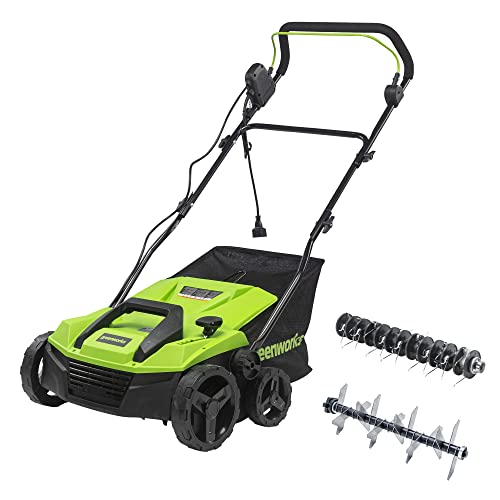




The Sun Joe AJ801E punches above its price point with a 12-amp motor and a 12.6-inch cutting width that handle most small-to-medium yard jobs without complaint. If you have a lawn under 5,000 square feet and a standard 120V outdoor outlet nearby, this machine covers that ground in a single session. The steel tines engage the thatch mat aggressively — you'll notice the clumps piling up almost immediately — and the included 8-gallon collection bag keeps cleanup contained. It isn't the widest deck on this list, but the lower price makes it a logical starting point for homeowners tackling dethatching for the first time.
The five-position height adjustment gives you genuine flexibility. Set it shallow for a light spring clean-up or deep for scarifying compacted soil before overseeding. The scarifier function cuts slightly into the root zone to open channels for water and nutrients, and on a lawn that hasn't been dethatched in a few years, that depth control is critical. One practical note: the 12.6-inch deck means more passes on anything wider than a standard townhouse strip, so plan your time accordingly. The cord itself is the other consideration — keep a 100-foot heavy-duty extension handy and map your path so you're not doubling back over the cord.
Build quality is honest for the price. The housing is lightweight plastic, and the collection bag bracket works reliably. This isn't a commercial-grade tool, but for a homeowner who dethatches once or twice a year, the AJ801E earns its keep without demanding a big upfront investment.
Pros:
Cons:
Greenworks built the DT13B00 around a 13-amp motor spinning at 3,200 RPM — a noticeable step up from entry-level corded units — and paired it with a 14-inch cutting deck that trims time off every run. The push-button start is genuinely convenient; there's no choking, priming, or yanking a pull cord. You press a button and the machine is working within seconds. For homeowners who use a tool a handful of times per year and want zero startup hassle, that matters more than it might sound.
The real selling point here is the quick-swap attachment system. Greenworks ships both a dethatcher tine reel and a scarifier blade reel in the box, and switching between them takes about a minute without tools. That flexibility means you can dethatch in early spring, scarify before overseeding in fall, and handle both jobs with one purchase. The lightweight frame makes maneuvering around flower beds and tree rings straightforward — this isn't a heavy machine, and you won't feel fatigued pushing it across a mid-size yard.
The tradeoff is that the collection bag, while functional, is on the smaller side compared to some competitors. On a heavily thatched lawn, you'll stop to empty it several times per session. That's a minor inconvenience, not a dealbreaker, but worth noting if you're working with dense St. Augustine or Zoysia that sheds material in big clumps. Overall, the Greenworks DT13B00 delivers professional-level RPM in a consumer-friendly package, making it one of the best values in the corded category for 2026.
Pros:
Cons:
Cordless convenience meets serious performance with the Worx WG855. Running on a 40V brushless motor platform with two 4.0Ah batteries included, this machine delivers sustained power without the drag of an extension cord trailing behind you. The brushless motor is the key spec here — it generates more torque per watt, runs cooler, and lasts significantly longer than a brushed motor under the same load. On thick, neglected lawns, that efficiency difference is tangible: the WG855 works through dense turf without the hesitation or bogging you sometimes get from corded competitors at similar price points.
The 14-inch dethatching reel carries 24 metal tines, and the scarifier attachment deploys 16 angled blades for deeper soil penetration. Two batteries in the box means you can swap on the fly and maintain runtime on larger properties — each battery handles roughly 2,000 to 2,500 square feet depending on thatch density, so a 5,000-square-foot lawn is fully manageable in one session. The Power Share compatibility is a genuine long-term value add: those same batteries work across 140+ Worx tools in the 20V, 40V, and 80V lineup, so this isn't a dead-end investment.
Maneuverability is a strong point. Without a cord to manage, you can reverse direction, work around garden beds, and tackle sloped areas without calculating your path in advance. The tradeoff versus corded is that you're always monitoring battery level, and if you underestimate the job size, you'll need to wait for a charge. But for most suburban lawns under 8,000 square feet, the two included batteries eliminate that problem entirely. This is the top pick if cord-free operation is your priority in 2026.
Pros:
Cons:
If you're managing a property that requires a riding mower or a zero-turn, the Brinly 48-inch tow-behind is the tool that matches your scale. A 48-inch working width eliminates the bottleneck of walking-speed dethatching — attach it to your mower hitch, lower the tines, and cover ground at riding speed. The unit deploys two rows of 12 independently flexing spring steel tines that comb the lawn surface, lifting thatch up and out where your mower deck can mulch it or your bagging system can collect it. On a half-acre or larger, the time savings over a walk-behind unit are dramatic.
The construction is all-steel with no rubber-tread wheels — Brinly made a deliberate choice here because rubber wheels flatten and degrade, while steel holds up through seasons of outdoor storage. The spring steel tines flex over bumps and uneven terrain, which matters on country properties with imperfect ground. A safety rod catches any broken tine before it contacts the mower blades — a thoughtful feature that shows Brinly engineered this for real-world use, not just catalog photos.
The limitation is obvious: you need a compatible riding mower or tractor with a hitch receiver. This isn't an option for push-mower households. But if you have the equipment, the Brinly 48-inch is the most efficient way to dethatch a large lawn in 2026. Pair the process with a quality watering schedule — our best hose timer reviews cover the tools that make post-dethatching irrigation easy to automate — and your lawn will respond quickly.
Pros:
Cons:
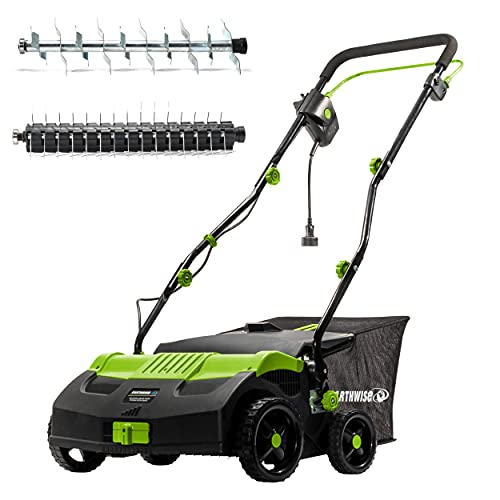
The Earthwise DT71613AA offers the widest cutting path in the corded walk-behind segment at 16 inches, paired with a 13-amp motor that keeps up with that wider deck. More cutting width means fewer passes on the same square footage — on a 5,000-square-foot lawn, the difference between a 12-inch and a 16-inch deck translates to roughly 25% less time pushing. If you're on the larger end of the walk-behind market but don't have a riding mower to pull a tow-behind, the Earthwise is the efficiency play.
The machine ships with a removable scarifier blade in addition to the standard dethatcher tine reel, and the 10.5-gallon collection bag is one of the largest in this category. On a heavily thatched lawn, that extra bag capacity keeps your stop-and-dump interruptions to a minimum. The bail wire switch provides a safe, predictable start every time — release it and the blades stop, which is the right behavior when you need to reposition or clear a jam. Earthwise tools have earned a solid mid-market reputation, and the DT71613AA fits that pattern: honest performance without overengineering or overpricing.
The cord-dependent operation is the expected limitation, but with a 16-inch deck you're covering ground faster, so your actual session time is competitive with some cordless options. Plan your outlet-to-lawn path before you start, use a heavy 12-gauge extension cord rated for outdoor use, and the Earthwise DT71613AA handles medium to large suburban yards without breaking a sweat.
Pros:
Cons:
Sun Joe's AJ805E occupies the sweet spot between the entry-level AJ801E and the wide-deck competitors — a 15-inch cutting width with a 13-amp motor at a price that makes it accessible for most homeowners. The power bump over the AJ801E is real: 13 amps handle thicker, wetter thatch mats without the motor laboring or the tines skipping over material. If you've dealt with a lawn that hasn't been dethatched in two or three seasons, you'll feel the difference immediately compared to a 12-amp unit.
The five-position depth control carries over from Sun Joe's other dethatcher models, giving you precise adjustment for both light maintenance passes and deep scarifying sessions. The collection bag is generously sized and attaches cleanly to the rear of the machine without any awkward fitment issues. Sun Joe's overall design philosophy on the AJ805E is simplicity: there aren't a lot of moving parts, the controls are intuitive, and the machine starts without drama every time you plug it in.
For homeowners with lawns in the 3,000- to 8,000-square-foot range who want a reliable annual tool without spending cordless-tier money, the AJ805E is a straightforward recommendation. It's a better fit than the AJ801E if you want the extra amp headroom, and it's more affordable than the wide-deck Earthwise if you're not working on an oversized suburban lot. After dethatching, pair it with a good fertilizer program — our guide to the best fertilizer for Bermuda grass covers the feeding schedules that complement a freshly dethatched warm-season lawn.
Pros:
Cons:
Greenworks brings its proven 40V platform to a 15-inch dethatcher that ships with a 5.0Ah battery and rapid charger included — a meaningful spec advantage over systems that bundle smaller 2.0Ah or 4.0Ah packs. A 5.0Ah battery on a 40V platform delivers roughly 200Wh of energy, which translates to extended runtime on dense lawns without the anxiety of watching the charge indicator drop mid-yard. The rapid charger brings the pack back to full in about an hour, so back-to-back sessions on the same day are practical.
The quick-swap tine reel system is the same concept Greenworks uses on the corded DT13B00: switch between the dethatcher and scarifier attachments in under a minute without tools. That versatility is genuinely useful across the growing season. Use the dethatcher in early spring to pull up winter thatch on cool-season grasses, then swap to the scarifier in late summer before overseeding to open the soil surface for better seed-to-soil contact. The timing guidance Greenworks provides is accurate: dethatch cool-season grasses (fescue, bluegrass, ryegrass) in early spring or early fall; warm-season varieties (Bermuda, Zoysia, St. Augustine) after the second mowing of late spring.
At 15 inches wide on a cordless platform, the Greenworks 40V covers medium to large suburban yards without the constraints of a power cord. The main competition is the Worx WG855 — both are 40V cordless 2-in-1 machines in the same price range. The Greenworks edges ahead on single-battery runtime thanks to its 5.0Ah pack, while the Worx includes two batteries for total session flexibility. Either is an excellent choice; your decision comes down to whether you prefer one large battery or two standard ones. For most single-session users, the Greenworks 40V is the cleaner, simpler setup.
Pros:
Cons:
Not every dethatcher is the right tool for every lawn. Before you spend money on a machine, nail down four things: your lawn size, your power preference, the thatch density you're dealing with, and whether you need scarifying capability. The answers point you directly to the right category — and from there, the specs do the rest of the work.
The power source decision shapes every other aspect of the ownership experience. Corded electric models — like the Sun Joe AJ805E and Greenworks DT13B00 — deliver consistent, unlimited runtime at the lowest price point. The tradeoff is the cord itself: you're tethered to an outlet, limited by extension cord quality, and required to manage the cord throughout your session. For yards under 5,000 square feet with an accessible outdoor outlet, corded is the most cost-efficient choice.
Cordless battery-powered models (Worx WG855, Greenworks 40V) eliminate the cord entirely and perform on par with corded units in terms of cutting power, thanks to modern brushless motors. The higher upfront cost buys you full freedom of movement and compatibility with a broader tool battery ecosystem. If you already own tools on the same platform — Worx Power Share or Greenworks 40V — the battery investment amortizes quickly. Tow-behind dethatchers like the Brinly 48-inch are in a separate category entirely: they're only relevant if you have a riding mower or tractor, but for large properties they reduce session time dramatically.
According to the U.S. Environmental Protection Agency, battery-powered outdoor equipment produces zero direct emissions during use, making cordless dethatchers a sound choice for homeowners who prioritize air quality alongside lawn health.
These two specs work together. A wide cutting deck requires more motor power to maintain consistent tine speed across the full width — a 16-inch deck needs at least 13 amps to perform reliably, while a 12.6-inch deck can get by on 12 amps. As a rule: match deck width to your lawn size and motor rating to your thatch density. For small yards under 3,000 square feet, a 12–13 amp motor with a 12–14 inch deck is sufficient. For yards between 3,000 and 8,000 square feet, upgrade to a 13-amp minimum with a 14–16 inch deck. Beyond that, a tow-behind unit is worth serious consideration.
On the RPM side, higher is generally better for dense thatch. The Greenworks DT13B00's 3,200 RPM rating is notably strong for a corded unit in its price range. Brushless cordless motors don't always publish RPM figures, but their torque curves are more consistent under load — that's the brushless advantage in practice.
These two functions get confused regularly, and the distinction matters for choosing the right machine. Dethatching uses spring tines to comb the lawn surface, pulling up the loose mat of dead material sitting above the soil. It's a surface-level operation that's appropriate for annual maintenance. Scarifying uses blades or harder tines that actually cut into the top layer of soil and root zone, breaking up compaction and creating channels for water and nutrients. It's more aggressive and should only be done when your lawn needs it — typically before overseeding or when the soil is severely compacted.
Most of the models on this list include both functions via interchangeable reels or adjustable depth settings. If you plan to overseed this fall, get a machine with genuine scarifying capability. If you're doing straightforward annual maintenance, a dedicated dethatcher tine reel is all you need. Don't scarify more than once a year on the same lawn — it stresses the root system and takes two to four weeks to recover fully.
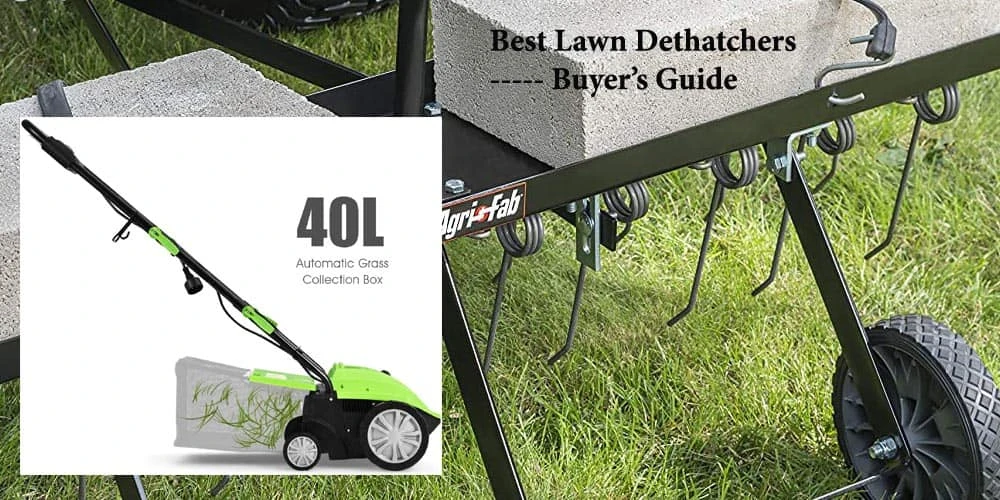
Some homeowners skip the collection bag entirely and mow up the pulled thatch immediately after dethatching — this works fine if your mower has a good bagging system. But if you're working with a heavily thatched lawn, the volume of debris pulled up can overwhelm a standard mower bag in a single pass. A built-in collection bag on the dethatcher lets you manage that debris in real time without stopping to rake.
Bag capacity varies significantly: the Sun Joe AJ801E offers 8 gallons, the Earthwise DT71613AA bumps that to 10.5 gallons, and the Greenworks DT13B00 falls slightly below the competition. Bigger bags mean fewer stops on dense lawns — a practical consideration that's easy to overlook when comparing spec sheets. If your lawn produces heavy thatch output, prioritize bag capacity alongside motor power. After clearing the thatch, maintaining soil health with quality feeding — our guide to the best garden sprinklers covers the irrigation tools that help water and nutrients reach newly opened root zones — keeps the progress you made with dethatching working in your favor all season.
For most lawns, once a year is the standard recommendation. Cool-season grasses like fescue and Kentucky bluegrass do best when dethatched in early fall — the stress recovery period aligns with cooler temperatures and natural growth. Warm-season grasses like Bermuda and Zoysia handle dethatching best in late spring after the second mowing of the season, once the lawn is actively growing and can recover quickly. If your thatch layer measures less than a quarter inch, skip the year entirely. If it's over three-quarters of an inch, plan for two sessions spaced several weeks apart to avoid overstressing the root system.
A dethatcher removes the surface layer of dead organic material sitting between your soil and grass blades. An aerator punctures or removes small plugs of soil to relieve compaction and improve drainage deeper in the root zone. They address different problems — thatch buildup versus soil compaction — and many lawn care professionals recommend doing both in the same season on problem lawns. Start with dethatching to clear surface debris, then follow with aeration to open the soil, then overseed and fertilize. Doing all three in sequence produces the most dramatic improvement in turf density and color.
You can, but you shouldn't. Dethatching a wet or waterlogged lawn pulls up living grass along with the thatch because roots lose their grip on saturated soil. The result is more turf damage than necessary and a slower recovery. Wait until the lawn is dry enough that you can walk on it without leaving deep footprints. A good rule of thumb: dethatch two to three days after rainfall, when the soil is moist but firm. If you're working in early spring, wait until the ground has fully thawed and the grass is actively growing — dethatching dormant turf delays the season's green-up.
For yards under 5,000 square feet with easy outlet access, corded models offer consistent power at a lower price and zero battery management concern. For larger yards, properties with limited outlet access, or homeowners who value clean, cord-free operation, cordless battery-powered models are the clear upgrade. The brushless motors in 2026's cordless dethatchers — like the Worx WG855 and Greenworks 40V — deliver power that matches their corded competitors in real-world performance, so you're not sacrificing capability for convenience. The premium is real, but so is the quality-of-life improvement.
For standard dethatching, set the tine depth so the tines just brush the soil surface — they should lift and pull the thatch mat without digging into the living root zone. Most machines offer five depth positions; start at the middle setting and adjust after your first pass. If you're scarifying before overseeding, go one or two positions deeper to cut slightly into the soil for seed-to-soil contact. If you see chunks of living turf coming up with the thatch, you're set too deep. Err on the shallow side for the first session on a lawn you haven't dethatched before.
After dethatching, rake up or bag all loose debris before it settles back into the turf. Then water deeply — at least an inch — to help the root system recover from the mechanical stress. If you were planning to overseed, this is the ideal window: the open soil surface maximizes seed-to-soil contact. Apply a starter fertilizer within 48 hours to support new root development and accelerate the green-up. Avoid heavy foot traffic for two weeks while the lawn recovers. Most lawns look rough immediately after dethatching — thin and raked over — but bounce back visibly within ten to fourteen days given proper water and feed.
The right lawn dethatcher makes a difference you can see within two weeks — thicker growth, faster water absorption, and grass that actually responds to the fertilizer you're putting down. Start with your lawn size and power preference to narrow the field, then match the motor rating and deck width to your thatch density. Whether you go with the budget-friendly Sun Joe AJ801E, the cordless freedom of the Worx WG855, or the large-property efficiency of the Brinly tow-behind, the tools on this list have the specs to back up the investment — pick the one that fits your yard and get dethatching before the 2026 growing season peaks.
 |
 |
 |
 |

About Truman Perkins
Truman Perkins is a Detroit-based SEO consultant who's been in the business for over a decade. He got his start helping friends and clients get their websites off the ground, and he continues to do so today. In his free time, Truman enjoys learning and writing about gardening - something he believes is a natural stress reliever. He lives with his wife, Jenny, and their twins in Detroit.


Get new FREE Gifts. Or latest free growing e-books from our latest works.
Disable Ad block to reveal all the links. Once done, hit a button below
|
|
|
|
 rinjal