reviewed by Christina Lopez
Nearly 90% of plant nutrient deficiencies trace back to one root cause: soil pH that's off by even half a point. When your pH is wrong, plants lock out the nutrients already sitting in the soil — no matter how much fertilizer you add. A $20 soil pH tester can save you hundreds in wasted amendments and dead plants. In 2026, the market is packed with options, from battery-free analog probes to digital multi-testers that measure four parameters at once.
Choosing the right tester depends on your situation. Are you growing vegetables in raised beds, managing a lawn, or caring for acid-loving plants like blueberries? Do you want a quick analog reading or precise digital data? We tested seven of the top-rated models so you can pick the right tool without guessing. You'll find everything from no-battery plug-in meters to capsule-based lab kits that also check nitrogen, phosphorus, and potassium. For more on optimizing your growing medium alongside pH, check out our guide to the best soil amendments and conditioners.
Soil pH is measured on a scale from 0 to 14 — with 7.0 being neutral. Most vegetables thrive between 6.0 and 7.0, while acid-lovers like azaleas prefer 4.5 to 5.5. According to the USDA Natural Resources Conservation Service, soil pH directly affects the availability of 13 of the 17 essential plant nutrients. That's why having a reliable tester in your garden toolkit is non-negotiable. Browse our full gardening reviews for more tools that make a difference.

Contents





The SONKIR MS02 is one of the best-selling soil testers on Amazon for a reason. You get three measurements in one compact unit: soil moisture, pH, and sunlight intensity. There's no battery required — the probe draws power directly from the soil's electrical properties. Just push it into the ground, wait a few minutes, and the needle gives you a clear analog reading on the color-coded dial. It's dead simple, and that simplicity is its biggest strength.
The dial splits each measurement range into easy-to-read color zones. For pH, you see green for neutral, red for acidic, and blue for alkaline. For moisture, it goes from dry to wet. Sunlight reads from shade to sunny. The build is lightweight plastic, which is fine for a garden tool you'll use a few times a week. The probe is dual-pointed — both tips need to be fully inserted for accurate readings. One important note: this meter cannot test liquid pH, only soil. Don't try it on hydroponics solutions or water samples — you'll get unreliable numbers and may damage the probe tips.
For the price, the SONKIR MS02 is hard to beat as an entry-level option. It won't give you laboratory precision, but it gives you actionable information fast. If your soil is bone dry, moisten it slightly before testing — the indicator won't move in completely dry conditions. Gardeners growing vegetables or flowers in raised beds will get real value from this. If you're pairing this tester with quality soil, take a look at our roundup of the best soils for vegetables in pots for recommendations that work across a wide pH range.
Pros:
Cons:
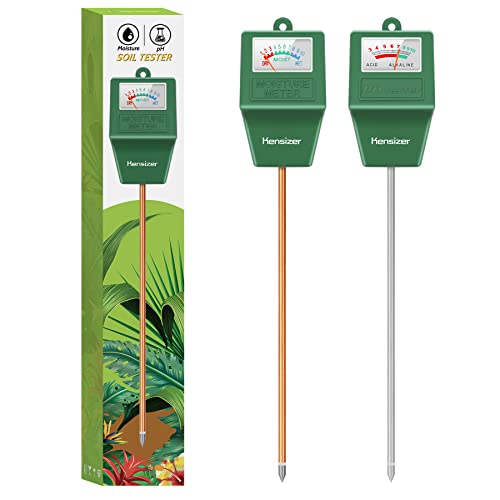
The Kensizer stands out for one specific reason: it uses a single probe instead of dual-tip designs. That matters because single probes cause less root disturbance when you insert them into soil around established plants. The unit measures both moisture and pH, switching between the two modes with a simple dial on top. No batteries required — the design is fully passive, just like the SONKIR. The dashboard features a wide-scale dial with a large arrow pointer and clearly spaced numbers, so readings are easy to read at a glance.
In testing, the single probe did feel more natural to insert into compacted garden soil. You push it in about 2 to 4 inches, wait for the needle to stabilize, then read the value. The moisture side of the dial runs from 1 to 10 (dry to wet), and the pH side covers a standard 3.5 to 8.0 range. The most important warning here is to never leave the probe in the soil for extended periods — the metal tip will corrode and your readings will become permanently inaccurate. Use it, then pull it out and wipe it clean.
The Kensizer is a solid daily-use meter for home gardeners. It's compact, well-built for the price point, and the single-probe format genuinely reduces probe wear compared to twin-tip models. If your soil is extremely dry, you'll need to water it first. Otherwise the probe simply won't move — not a flaw, just physics. For gardeners who regularly amend their soil based on pH readings, this tester pairs well with the information in our guide to the best soil mixes for raised beds.
Pros:
Cons:
The YAMRON steps up the game with a true digital readout and a backlit LCD screen — a major upgrade over analog needle meters. It measures four parameters: soil moisture, pH, temperature, and sunlight intensity. That fourth metric, temperature, is something most testers in this price range skip entirely. Knowing your soil temperature is genuinely useful — it tells you if it's warm enough to germinate seeds or transplant seedlings, especially in spring when air temperature and soil temperature can differ by 10 degrees or more.
The backlit LCD means you can read it in low-light conditions, like inside a greenhouse at dusk or in a shaded garden corner. The display is large and shows the numeric value clearly. The unit runs on four AAA batteries (not included), and it will alert you with a low-battery warning when power drops. The 2024 probe detection technology embedded in the YAMRON delivers faster readings than older generation testers — you'll typically see the value stabilize in under a minute. The light sensor sits on the body of the instrument itself, not on a separate probe, which gives you ambient light readings right at the plant canopy level.
This is the tester to choose if you want precision digital readings and the extra context that soil temperature provides. Farmers and serious home gardeners who track planting windows based on soil warmth will particularly appreciate this feature. The backlight makes it versatile across all lighting conditions. The trade-off is that you need batteries, so budget for a set of AAAs and keep a spare set in your garden shed.
Pros:
Cons:
The VIVOSUN combo is the most versatile kit on this list. You're getting three separate tools in one package: a digital liquid pH meter with ±0.1 accuracy, a 3-in-1 TDS/EC/temperature meter for water quality, and a soil probe that tests moisture, light, and pH. That covers both hydroponic setups and traditional soil gardens. The liquid pH meter measures the full 0.00 to 14.00 range — the other soil probes here can't do that. For hydroponic growers, nutrient solution pH is critical and needs to stay within a tight window, typically 5.5 to 6.5.
The digital pH meter includes one-touch automatic calibration and comes with buffer powder packs, so you can get it calibrated out of the box in minutes. Buffer solutions (pH calibration liquids) are the standard way to verify and reset probe accuracy — having the packets included removes a common first-use headache. The TDS/EC meter covers 0 to 9999 ppm TDS and 0 to 9999 µS/cm EC, which handles everything from tap water to nutrient solutions. Temperature reads in both Celsius and Fahrenheit. This kit solves three measurement problems at once — you won't need to buy separate instruments for water and soil testing.
If you're running a hydroponic garden, a soil garden, or both, the VIVOSUN combo is the most cost-effective comprehensive solution in 2026. The soil probe covers a pH range of 3.5 to 8.0, which is typical for garden testers in this category. The liquid pH meter is the star of the set — high accuracy, easy calibration, and it reads any aqueous solution. If your grow setup involves multiple media types, this is your best pick.
Pros:
Cons:
Luster Leaf is a well-established brand in the soil testing space, and the Rapitest 1605 is their digital battery-powered probe model. Unlike the passive analog testers, this one uses battery power to actively drive measurement — which generally results in faster needle response and more stable readings across a wider moisture range. You don't have to worry as much about soil being slightly too dry to register, which is a real practical advantage in summer when top-soil dries out fast.
The digital format means you get a clear numeric readout rather than a needle on a scale. Luster Leaf has been making Rapitest products for decades, and their build quality is consistent. The probe design is robust enough for regular use in garden beds, containers, and lawns. The battery-powered design also means you get consistent performance across temperature extremes — passive testers can be less reliable in very cold soil. The Rapitest 1605 is the go-to choice for gardeners who test soil frequently and want fast, repeatable readings without the inconsistency of passive probes.
This is a reliable workhorse meter. It won't give you the multi-parameter coverage of the YAMRON or the liquid-testing capability of the VIVOSUN, but it delivers straightforward soil readings quickly and dependably. For everyday garden use — checking raised beds before planting, monitoring container plants, or testing different spots in a lawn — the 1605 gets the job done efficiently. Keep a spare battery set handy and this tester will serve you for multiple growing seasons.
Pros:
Cons:
If you want to know not just your pH but also your nitrogen, phosphorus, and potassium (N-P-K) levels, this Rapitest kit is the right tool. It uses a capsule-based chemical test system — you mix a small soil sample with water, add the capsule for the nutrient you're testing, then compare the resulting color against a patented color comparator chart. The process takes about 10 minutes per test, which is longer than sticking a probe in the ground, but the information you get is far more complete.
The kit contains components for 40 total tests: 10 each for pH, nitrogen, phosphorus, and potash (potassium). That's enough to test four spots across your garden for all four parameters, or to monitor one bed through a full growing season. This is a lab-in-a-box approach — you're doing actual chemical analysis, not just measuring electrical conductivity in soil. The results are highly reliable when you follow the instructions carefully. The USA-designed capsule system and color comparators are patented, and Luster Leaf has refined this formula over many years.
The trade-off is convenience. You need to take a soil sample, mix it with water, and go through the test process for each parameter. It's more work than a probe tester, but for gardeners who want to understand why their plants are struggling — not just that the pH is off, but whether they also have a nitrogen deficiency — this kit provides answers that no probe meter can. Pair this with a good soil amendment strategy and you'll have genuinely data-driven results in your garden.
Pros:
Cons:
The Luster Leaf 1662 is the professional-grade version of the Rapitest chemical kit. It comes packaged in a sturdy plastic case that keeps all components organized and protected — a significant upgrade over the standard kit's simpler packaging. The case is the kind of thing you'd expect from a professional-grade tool, not a consumer garden product. All the components have dedicated slots, and the whole kit is ready to deploy the moment you open it. Instructions are simple and detailed, which matters for first-time users working through chemical test protocols.
Like the standard Rapitest kit, the 1662 Professional provides 40 total tests: 10 each for soil pH, nitrogen, phosphorus, and potassium. The chemical test formulas are the same, so the accuracy level is identical. What you're paying for is the professional packaging, organization, and durability — this is the version that makes sense for landscape contractors, serious hobby farmers, master gardeners, or anyone who will be conducting regular testing across multiple sites and needs the kit to survive repeated field use.
The sturdy case protects the capsules and comparator panels from moisture, light, and physical damage — all things that can degrade results if the kit isn't stored properly. If you're testing soil across multiple garden beds, a farm, or client properties throughout 2026, the 1662 is the reliable choice. The same chemical accuracy as the standard Rapitest kit, but built to last and stay organized through seasons of use. If you're pairing your soil knowledge with premium growing media, our guide to the best soil mixes for raised beds covers the top options worth testing against.
Pros:
Cons:
Not every gardener needs the same tester. Here's what to focus on before you buy so you get the right tool the first time.
These are the two fundamentally different approaches on this list. Probe meters — like the SONKIR, Kensizer, YAMRON, and VIVOSUN — give you instant readings by measuring electrical properties in the soil. You push the probe in, read the value, and move on. They're fast, reusable, and require no consumables. Chemical test kits — like the two Rapitest options — require you to mix a soil sample with water and a reagent capsule, then compare the color to a chart. They're slower but provide broader nutritional data including nitrogen, phosphorus, and potassium levels.
The rule of thumb: use a probe meter for regular monitoring and a chemical kit for diagnosing specific plant problems or before the start of each growing season. If your plants are yellowing and you're not sure why, the chemical kit can tell you whether it's pH, a nitrogen deficiency, or a phosphorus shortfall — information a probe simply can't provide.
Battery-free analog testers (SONKIR, Kensizer) are always ready to go and cost nothing to operate. The downside is that they can struggle in very dry soil and the needle response can be slow. Battery-powered digital testers (YAMRON, Luster Leaf 1605, VIVOSUN) give faster and more consistent readings across varied soil conditions. If you live in a dry climate or regularly test container soil that dries out quickly, a battery-powered model is worth the extra cost and maintenance.
You can spend more and get more metrics — but only buy what you'll actually use. A 3-in-1 meter covering moisture, pH, and sunlight covers most home gardeners' needs. If you're tracking planting windows by soil temperature, upgrade to the YAMRON's 4-in-1. If you're running a hydroponic system alongside a soil garden, the VIVOSUN combo's liquid pH meter with ±0.1 accuracy is the right call. Buying more features than you need wastes money and adds complexity you won't appreciate after the first week.
The probe is the most vulnerable part of any soil tester. Cheap probes corrode quickly, especially if left in the soil between uses. Single-probe designs (Kensizer) cause less wear than dual-probe designs. Regardless of which model you choose, always wipe the probe clean and dry immediately after each use. Never store a wet probe. For chemical kits, store capsules away from light and moisture to preserve their reactivity — degraded capsules give false low-color readings that can send you in the wrong amendment direction. A well-maintained probe meter will give you accurate readings for multiple growing seasons.
Most vegetables grow best between pH 6.0 and 7.0, with 6.5 being the sweet spot for the widest range of crops. At this level, nutrients like nitrogen, phosphorus, and potassium are all highly available to plant roots. Some crops like potatoes and blueberries prefer more acidic conditions around 4.5 to 5.5, while asparagus and brassicas tolerate slightly alkaline soil up to 7.5. Always check the specific pH requirements for the crops you're growing before amending.
Test your soil at the start of each growing season — spring and fall are ideal. If you've added lime, sulfur, or significant amounts of compost, test again 4 to 6 weeks after amending to see how the pH has shifted. For container plants, test every 4 to 6 weeks because the limited soil volume and frequent watering cause pH to drift faster than in-ground beds. Lawns benefit from annual testing, ideally in fall before any lime applications.
Standard soil probe testers are designed for solid growing media and cannot reliably test liquid nutrient solutions. If you're growing hydroponically, you need a liquid pH meter like the digital pen included in the VIVOSUN combo. These meters measure pH in solution with ±0.1 accuracy and require regular calibration with buffer solutions. Never use a soil probe in your reservoir — it will give inaccurate readings and may damage the probe.
To raise pH (make soil less acidic), apply agricultural lime (calcium carbonate). Ground limestone is the most common option — it works slowly over several months but is safe and effective. To lower pH (make soil more acidic), apply elemental sulfur or acidifying fertilizers. Sulfur works over weeks to months as soil bacteria convert it to sulfuric acid. Aluminum sulfate acts faster but can harm plants if over-applied. Always re-test 4 to 6 weeks after amending before adding more material.
The most common cause is soil that is too dry. Passive probe meters rely on soil moisture to conduct the tiny electrical current needed for a reading. If the needle doesn't move, water the soil lightly and wait 30 minutes before testing again. Also check that both probe tips are fully inserted to the correct depth — partial contact gives unstable readings. If the probe still won't respond after watering, check for probe corrosion or physical damage to the tip.
For pH specifically, well-calibrated digital probe meters and chemical test kits produce comparable accuracy. The key difference is what each can measure. Chemical kits like the Rapitest measure actual nutrient ion concentrations (nitrogen, phosphorus, potassium) through a chemical reaction — something no probe can do. Probes are faster and better for monitoring pH over time, while chemical kits are better for diagnosing specific nutritional deficiencies. For the most complete picture of your soil health, use both.
 |
 |
 |
 |

About Christina Lopez
Christina Lopez grew up in the scenic city of Mountain View, California. For eighteen ascetic years, she refrained from eating meat until she discovered the exquisite delicacy of chicken thighs. Christina is a city finalist competitive pingpong player, an ocean diver, and an ex-pat in England and Japan. Currently, she is a computer science doctoral student. Christina writes late at night; most of her daytime is spent enchanting her magical herb garden.


Get new FREE Gifts. Or latest free growing e-books from our latest works.
Disable Ad block to reveal all the links. Once done, hit a button below
|
|
|
|
 rinjal