What separates a snake terrarium that keeps your reptile thriving for years from one that causes stress, escapes, and chronic health problems? The answer is precision engineering — and in 2026, the market has never offered more options or more confusion. Whether you're housing a ball python, a corn snake, or a larger constrictor, the enclosure you choose sets the foundation for every aspect of your animal's life: thermoregulation, humidity retention, ventilation, and behavioral enrichment.
After hands-on testing and research across dozens of enclosures, the REPTI ZOO 67-Gallon Sliding Door Terrarium earns the top spot for most snake keepers. It delivers a proven combination of front-access convenience, robust ventilation, and a waterproof base at a price that won't require refinancing your living room. But it isn't the right pick for everyone — and that's exactly why we've put together this complete breakdown. If you want a broader look at reptile housing options, our guide to the top 5 reptile terrariums covers additional species considerations worth reading before you buy.
From compact starter kits for juvenile snakes to full-sized PVC enclosures built for large boas, the six enclosures reviewed here cover every major keeper segment. According to Wikipedia's overview of terrarium design, the fundamental requirements for a healthy reptile enclosure — adequate space, thermal gradients, humidity management, and security — haven't changed, but the materials and mechanisms available today make meeting those requirements easier than ever. Let's get into it.
Contents
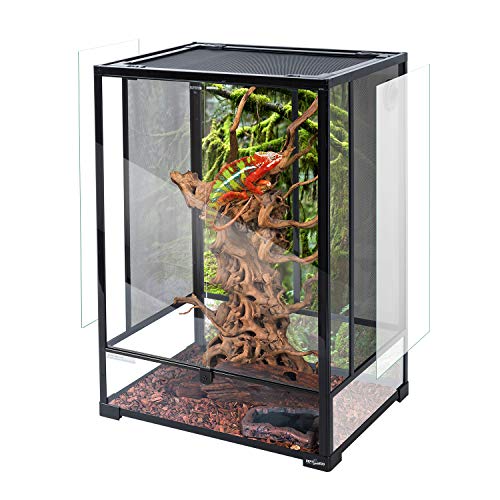





The REPTI ZOO 24"x18"x36" is purpose-built for vertical space — and if you're keeping a green tree python, rough-scaled sand boa, or any species that naturally seeks elevation, that distinction matters enormously. At 67 gallons with a footprint oriented toward height, this enclosure gives arboreal and semi-arboreal snakes the climbing room they need to express natural behavior. The standout engineering feature is the switchable side panel system, which lets you swap mesh panels for glass depending on whether your setup demands higher humidity or maximum airflow. That's not a gimmick — it's genuinely useful when dialing in seasonal humidity swings.
The front-opening double doors operate on a hinge system with a built-in escape-prevention lock. You get independent door operation, meaning you can open one side for targeted feeding or maintenance without exposing the entire enclosure at once. The mesh top is fully removable, providing unobstructed access for decorating deep naturalistic setups with cork rounds and hanging branches. The raised bottom frame accommodates an under-tank heater — a must-have for species requiring belly heat — and the waterproof base has been tested for leaks at the factory, which REPTI ZOO has made a consistent selling point across their lineup.
Assembly runs about 20 to 30 minutes with the included hardware. The tempered glass panels are thick and feel solid, and there's no rattling or flex once the unit is assembled. The only real limitation here is the footprint: at 24"x18", this isn't the right choice for larger terrestrial species that need horizontal roaming space. But for the keeper managing a vertical-oriented snake build, this enclosure delivers a feature set you'd normally pay considerably more for.
Pros:
Cons:
If you're housing a ball python, hognose, or any medium-to-large terrestrial snake that deserves a permanent, high-quality home, the Reptile Habitats V3 is the enclosure the experienced keeper community keeps coming back to. At 4'x2'x2' and 120 gallons, it gives you a proper adult-sized footprint without the weight penalty of all-glass construction. PVC panels are the material of choice for serious keepers for good reason: they don't crack under humidity cycles, they hold heat more efficiently than glass, and they clean up without the risk of scratching that comes with acrylic alternatives.
The V3 designation matters. Reptile Habitats has refined this enclosure through multiple iterations, and the version 3 brings upgraded hardware, tighter door tolerances on the glass sliding panels, and a heavy-duty aluminum frame that remains rigid even when fully loaded with naturalistic substrate depth. Assembly takes under 30 minutes for most buyers, and the lightweight PVC construction means you can actually move this enclosure once it's built — a consideration that matters when you're doing deep cleans or rearranging your reptile room. The heavy-duty screen panels deliver excellent cross-ventilation without creating excessive evaporative cooling that tanks your humidity targets.
This is the enclosure you buy once. It's not the cheapest option on this list, but the build quality justifies the premium. If you're comparing enclosure types and thinking about long-term habitat stability, it's worth reading our breakdown of best small greenhouse enclosures — the humidity management principles that apply to greenhouse setups translate directly to PVC reptile enclosures. The V3 handles high-humidity setups for species like Brazilian rainbow boas without delaminating, warping, or fogging — problems that plague glass enclosures in genuinely humid builds.
Pros:
Cons:
Carolina Custom Cages has built a reputation for no-nonsense, durable all-glass terrariums, and the 48Lx24Wx24H is their workhorse model for adult-sized snakes. The dimensions give you a 4-foot length — sufficient for most adult ball pythons, corn snakes, and king snakes — combined with a full 24-inch depth that allows for proper thermal gradient construction. The 6.3-inch deep waterproof base tray is one of the most practical features in this price tier: it contains substrate spills, water bowl overflow, and any animal mess without contaminating the door tracks, which is a chronic failure point on cheaper enclosures.
The sliding door system operates on full steel screen mesh top-equipped hardware, giving you smooth, key-lock secured access from the front. Substrate, food debris, and water don't migrate into the track channels — something you'll appreciate deeply after cleaning a track-clogged enclosure at midnight. The all-steel mesh top delivers reliable ventilation and full UVB penetration for species that benefit from lighting, and it's sturdy enough to support the weight of dome fixtures and clip-on basking lights without bowing.
Assembly is genuinely straightforward: Carolina Custom Cages designs their enclosures with a time-proven construction approach that doesn't require exotic tools or technical skill. The glass is thick, the seams are clean, and the overall build quality reads as a unit designed to last a decade, not a season. If you're deciding between this and a PVC option at a similar size, the tradeoff is weight versus humidity retention — all-glass breathes more and requires more active humidity management, but gives you full visibility from every angle.
Pros:
Cons:
The REPTI ZOO 67-Gallon Sliding Door Terrarium is the enclosure that consistently earns recommendation from experienced keepers in 2026, and for straightforward reasons: it nails the core requirements at a competitive price point. The 48"x18"x18" footprint gives you a proper horizontal layout for terrestrial snakes, the front sliding doors allow independent access without fully exposing the animal, and the raised bottom frame fits every standard under-tank heater on the market. This is the upgrade enclosure — the one you move to when you realize your previous setup was undersized or under-engineered.
The upgrade version uses premium thick tempered glass throughout — noticeably heavier and more rigid than budget competitors — with a screen top that handles both UVB and infrared penetration without compromising structural integrity under heavy lighting. The waterproof bottom is rated for both desert and rainforest builds, meaning whether you're running a dry corn snake setup or a humid hognose habitat, this tank handles both without issue. Front sliding doors lock independently: one side open for feeding with minimal disturbance, both sides open for deep cleaning or rearranging your hardscape.
The knock-down packaging makes shipping economical and assembly straightforward. In practice, you have this unit assembled and operational in 20 minutes. The screen top sections lift out completely for unobstructed top-down access, and the overall build quality — glass thickness, frame alignment, door travel — is consistent across units. This is the enclosure that balances value and performance better than anything else on this list, which is why it holds the top overall recommendation. If you're researching the full landscape of gardening and habitat products, our gardening reviews section covers related habitat and growing environment products worth exploring.
Pros:
Cons:
The Reptile Habitats V2 occupies a smart position in the market: it delivers the core PVC enclosure advantages — humidity resistance, heat retention, lightweight mobility — at a lower price point than the V3, with the primary compromise being the previous-generation aluminum frame. For the keeper who wants to step up from all-glass construction without spending at the premium tier, the V2 is a clear recommendation. At 4x2x2 and 120 gallons, it gives you adult-appropriate space for the majority of commonly kept snake species.
The durable PVC panels perform identically to the V3 in terms of humidity resistance and thermal performance. High-humidity species that would fog up and deteriorate an all-glass enclosure live comfortably in this build without causing material degradation. The glass sliding doors provide clean sightlines and easy access, and the heavy-duty screen ventilation strips along the frame ensure adequate airflow while maintaining thermal stability. The V2 aluminum frame is functional and secure — the V3 upgrade improves tolerances and rigidity, but the V2 holds together reliably for normal snake-keeping use cases.
Portability is a genuine feature here, not marketing language. When you need to perform a full substrate swap — which for bioactive setups might mean moving 60+ pounds of living substrate — being able to disassemble and reassemble the enclosure without tools saves serious time and prevents injury. The lightweight construction also makes this a practical option for keepers who rent or move periodically. For species like blood pythons, Kenyan sand boas, or other humidity-loving terrestrials, the PVC material choice alone makes this enclosure a fundamentally better option than any all-glass alternative at a comparable price point. You can also cross-reference how moisture management works in controlled growing environments by checking our plant moisture meter guide — the underlying humidity measurement principles apply to snake enclosure management as well.
Pros:
Cons:
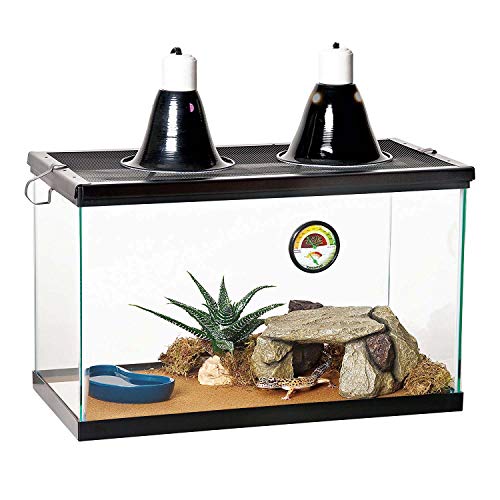
The Zilla 10 Gallon Starter Kit is the honest entry point into snake keeping — not because it's the best enclosure on this list, but because it's the right tool for a specific situation. If you're housing a juvenile corn snake, a young ball python under 18 inches, or a hatchling king snake, starting in a smaller enclosure isn't a compromise: it's best practice. Juvenile snakes are more easily stressed in oversized spaces, struggle to locate food effectively, and are more difficult to monitor and maintain in large setups. This kit gives you everything you need to house a small desert-dwelling snake from day one.
The kit ships with light and heat components already included — a significant cost and decision simplification for the first-time keeper. The terrarium liner is treated with a biodegradable enzyme that actively neutralizes odors, which matters more than it sounds when you're new to reptile keeping and managing cleaning schedules around a living animal. The glass tank itself is manufactured in the USA, which translates to consistent quality control and seal integrity. For small desert-dwelling species, the 10-gallon footprint is appropriate, properly sized, and easy to manage thermally.
The realistic ceiling for this enclosure is about 24 to 30 inches of snake length. Plan your upgrade path before you buy: a juvenile ball python in this kit will need a larger enclosure within 12 to 18 months. The starter kit won't damage your animal — it's a well-built, appropriately sized enclosure for the species it's designed for — but treating it as a permanent housing solution for any snake expected to reach adult size is a mistake. Use it as the launching pad it's designed to be, then transition to one of the larger enclosures on this list when your animal approaches the size threshold.
Pros:
Cons:
The single most important decision you'll make is matching enclosure size to the adult dimensions of your snake — not its current size. Ball pythons reach 3 to 5 feet and need a minimum 4x2x2 as adults. Corn snakes hit 4 to 5 feet and need comparable floor space. The rule of thumb most experienced keepers use: the enclosure's longest dimension should equal at least the snake's total length. Undersizing creates chronic stress, feeding problems, and immune suppression. Oversizing creates disorientation in juveniles and makes temperature gradient management harder.
Arboreal species — green tree pythons, emerald tree boas, rough-scaled sand boas — require vertical height over horizontal floor space. A tall enclosure like the REPTI ZOO 24"x18"x36" addresses this need specifically. Terrestrial species like ball pythons and corn snakes need floor space. Burrowing species like hognose snakes need enclosure depth to accommodate 6+ inches of substrate. Know your species before you buy the enclosure, not after.
Glass enclosures are visually open, easy to find locally, and give you full visibility from every angle. The tradeoff is thermal performance and humidity retention: glass loses heat readily and requires active humidity management to maintain elevated target ranges. For desert-dwelling species like corn snakes and king snakes operating at 50–60% humidity, glass is a practical, cost-effective choice. For humidity-demanding species like blood pythons and Brazilian rainbow boas that need 80%+ sustained humidity, PVC is the correct material. PVC panels retain heat more efficiently and resist the mold and delamination issues that plague glass enclosures running at sustained high humidity.
PVC enclosures also weigh significantly less than glass equivalents at the same size — an 80-pound glass enclosure becomes a 25-pound PVC enclosure. If you ever need to move, rearrange your reptile room, or perform a full deep clean, that weight difference is genuinely meaningful. The visual tradeoff is real: PVC panels aren't transparent, so you sacrifice the full-perimeter viewing of an all-glass setup. For keepers who prioritize animal welfare over display, this is a non-issue.
Every snake needs a thermal gradient — a warm side and a cool side — to thermoregulate. This isn't optional; it's fundamental to digestive function, immune response, and behavioral health. The enclosure you choose must allow you to create and maintain a temperature differential of 10 to 15 degrees Fahrenheit between warm and cool zones. Screen tops facilitate top-down heat lamp application; full-glass or PVC tops require under-tank heaters and heat tape setups for belly heat. Know your heating methodology before selecting an enclosure — the wrong combination creates uneven heating or thermal dead zones.
Ventilation also affects humidity directly. Heavy screen coverage accelerates moisture evaporation, which is ideal for desert species and problematic for tropical species. The REPTI ZOO switchable side panel system addresses this by letting you close off side mesh when you need to retain humidity. For a fixed setup, many experienced keepers cover 50–75% of the screen top with aluminum foil or custom acrylic panels to regulate humidity — a cheap, effective modification that works on any enclosure.
Snakes are escape artists. A secure lock isn't a convenience feature — it's a containment requirement. Front-opening doors with independent panel access are the gold standard for daily feeding and maintenance: you can introduce prey items to one side of the enclosure without fully exposing the animal or losing visual control. Sliding doors with key locks or clip mechanisms consistently outperform top-only-access enclosures for routine husbandry.
Consider your cleaning workflow before finalizing your choice. Deep substrate setups require full access to the bottom of the enclosure, which means removable screen tops, wide-opening front doors, or both. Enclosures with debris-catching tracks, poorly designed door rails, or insufficient opening angles make cleaning significantly harder over a lifetime of ownership. The Carolina Custom Cages 6.3-inch deep base tray exists specifically because substrate and water contaminating door tracks is a constant maintenance problem with cheaper enclosures. Invest in an enclosure that makes weekly spot cleaning and monthly deep cleans straightforward — your long-term commitment to the animal depends on it.
An adult ball python needs a minimum enclosure of 4 feet long by 2 feet wide by 2 feet tall — a 4x2x2 footprint. This provides adequate floor space for thermoregulation, a proper thermal gradient, and enough room for enrichment elements like hides, climbing branches, and water bowls. Males typically reach 3 to 4 feet at maturity; females can reach 4 to 5 feet. Size up to a 5x2x2 for large adult females. The Reptile Habitats 4x2x2 options on this list meet the minimum adult requirement precisely.
PVC is the better material for high-humidity species and large enclosures. It retains heat more efficiently, resists humidity-related delamination and mold, and weighs significantly less than glass at comparable sizes. Glass is appropriate for desert species operating at lower humidity ranges, is easier to source locally, and provides full-perimeter visibility. For most serious keepers housing tropical or semi-tropical species, PVC is the correct long-term investment. For desert snakes like corn snakes and king snakes, glass performs adequately at a lower cost.
Spot cleaning — removing waste, soiled substrate, and uneaten prey — should happen as soon as you notice it, typically every 2 to 7 days depending on feeding schedule. Full substrate replacement and enclosure sanitization should occur every 1 to 3 months depending on your substrate type, enclosure size, and snake species. Bioactive setups with clean-up crew insects extend the interval between full cleans significantly. A well-designed enclosure with a deep waterproof base tray and debris-catching door seals makes spot cleaning faster and reduces the frequency of full deep cleans.
Technically yes, but it's a significant compromise. Aquariums are designed for top-only access, which stresses snakes that interpret overhead approach as predator behavior. They typically lack front-opening doors, proper lock mechanisms, and the raised bottom frames needed for substrate heaters. Aquarium lids are usually lightweight mesh that snakes can push open. For a permanent setup, a purpose-built reptile terrarium with front-access doors, secure locks, and a waterproof reptile-grade base is the correct housing choice. Repurposed fish tanks work acceptably for short-term juvenile housing when a proper enclosure is on order.
Temperature requirements vary by species, but the general framework for most commonly kept snakes is a warm side ambient temperature of 85 to 88°F with a basking spot reaching 90°F, and a cool side ambient of 75 to 80°F. Ball pythons specifically need a warm side of 88 to 92°F and a cool side of 76 to 80°F. Nighttime temperatures can drop to 72 to 75°F for most species. Always maintain a gradient — a single uniform temperature is biologically inappropriate and prevents normal thermoregulation behavior.
Snakes need sufficient ventilation to prevent stagnant air, excess condensation, and bacterial buildup — but not so much airflow that it tanks your humidity targets or creates drafts. A screen top covering 20 to 40% of the enclosure's surface area is generally appropriate for most species. Desert species tolerate higher ventilation; tropical and humid-environment species benefit from reduced airflow to retain humidity. The adjustable side panel system on the REPTI ZOO tall terrarium is a practical solution for dialing in ventilation without committing to a fixed configuration.
 |
 |
 |
 |

About Truman Perkins
Truman Perkins is a Detroit-based SEO consultant who's been in the business for over a decade. He got his start helping friends and clients get their websites off the ground, and he continues to do so today. In his free time, Truman enjoys learning and writing about gardening - something he believes is a natural stress reliever. He lives with his wife, Jenny, and their twins in Detroit.


Get new FREE Gifts. Or latest free growing e-books from our latest works.
Disable Ad block to reveal all the links. Once done, hit a button below
|
|
|
|
 rinjal