The REPTI ZOO 30 Gallon Rainforest Terrarium is our top pick for 2026 — it nails the balance between ventilation, build quality, and vertical climbing space that chameleons and crested geckos actually need. Finding the right reptile enclosure isn't just about square footage. It's about matching the habitat design to your animal's biology, and that distinction separates a thriving reptile from a stressed one.
Whether you're housing a tiny dart frog in a nano tank or a full-grown boa constrictor in a 120-gallon behemoth, the terrarium you choose shapes everything — temperature gradients, humidity retention, UVB penetration, and your ability to actually reach in and care for your animal. In 2026, the market has matured considerably, and the options on this list reflect real engineering improvements over what was available even three years ago. We've evaluated seven of the most compelling options across size classes, price points, and species compatibility so you can make a confident, informed decision.
Before diving into individual reviews, it's worth noting that terrarium selection is closely tied to your specific reptile's needs. A desert-dwelling leopard gecko and a rainforest-dwelling crested gecko require fundamentally different setups. According to Wikipedia's terrarium overview, the basic enclosure type — glass, screen, or hybrid — determines how well you can control the microclimate inside. Get the enclosure type wrong and no amount of equipment will fix it. Get it right and you're already 70% of the way to a healthy animal. If you're also building out a planted setup inside your terrarium, check out our top plant moisture meter picks — they double as useful humidity monitors for bioactive builds. For misting systems inside rainforest enclosures, our best plant mister guide covers hand-pump and automatic options that work well for daily terrarium humidity maintenance.

Contents





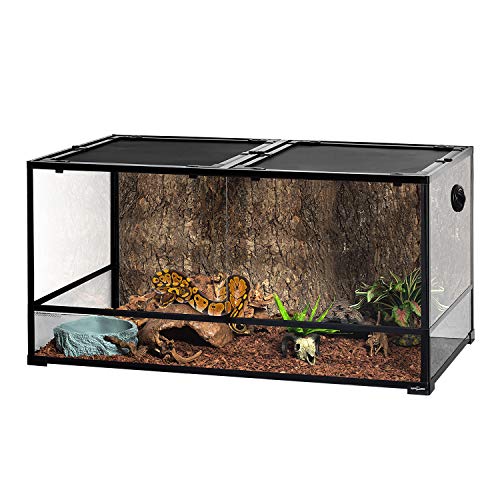

If you keep crested geckos, small chameleons, or arboreal lizards, the REPTI ZOO 30 Gallon Rainforest Terrarium is purpose-built for your animals. The 18" x 18" x 24" footprint prioritizes vertical height — exactly what climbing species need. The front-opening door gives you unobstructed access without reaching over the top and stressing out your reptile, which is a meaningful quality-of-life upgrade over traditional hinged-lid designs.
Ventilation is where this tank truly excels. The removable top screen handles UVB and infrared penetration effectively, while the left and right side mesh panels create cross-ventilation that prevents the stagnant air pockets that cause respiratory infections in humidity-sensitive species. The raised bottom frame fits standard substrate heaters without modification, and the waterproof base is a practical touch for amphibian setups or bioactive builds with drainage layers. The knock-down assembly design means you can break it down and move it without a second person — a real bonus for apartment keepers who rearrange frequently.
For the price point, the tempered glass quality is impressive. Panels are thick, edges are finished cleanly, and the frame locks together with satisfying rigidity. This is not a budget tank that flexes when you pick it up. It's a proper enclosure that will last years of daily use.
Pros:
Cons:
The REPTI ZOO 67 Gallon is the upgrade-version tank that serious hobbyists have been asking for. At approximately 48" x 18" x 18", it gives terrestrial and semi-arboreal reptiles serious floor space while keeping a manageable profile on your stand. The tempered glass base is notably thicker than competitors at this price tier — you can feel the difference when you handle the panels during assembly. This is the enclosure you buy when you want to stop thinking about the enclosure and start thinking about the animal.
The sliding front doors are the standout feature here. Each door opens independently, which matters more than most buyers realize until they're trying to spot-clean one side while keeping the other door closed to retain heat. The lock mechanism is positive and secure — a legitimate anti-escape system, not a flimsy tab that a determined monitor lizard will defeat in an afternoon. The screen top handles UVB penetration reliably, and the waterproof bottom means this tank flexes between desert setups with sand substrate and rainforest builds with drainage layers.
Assembly is straightforward on the knock-down design, though two people make it considerably easier given the panel size. Once assembled, the frame is rigid and shows no flex under the weight of heavy substrate or décor. This is a workhorse enclosure built for long-term use with medium to large terrestrial species.
Pros:
Cons:
For veiled chameleons, Jackson's chameleons, and any arboreal species that demands exceptional airflow, the Zoo Med ReptiBreeze is the definitive choice. The all-screen construction creates airflow that no glass enclosure with mesh vents can replicate — fresh air moves through every wall surface, eliminating the stagnant micro-environments where respiratory pathogens thrive. The 18" x 18" x 36" dimensions prioritize height appropriately for animals that spend their entire lives off the ground.
The corrosion-resistant black anodized aluminum frame is built to last. Zoo Med has been manufacturing this cage for years, and the design has barely changed because it doesn't need to. The large front door gives you full access for feeding and maintenance, and the bottom door simplifies substrate removal without disturbing the upper portion of the enclosure. All hardware is included, and assembly requires only a screwdriver — no specialized tools, no confusing hardware bags.
The tradeoff is humidity retention. If your species requires humidity above 60-70%, you will need to mist multiple times daily or invest in an automated misting system. This is not a design flaw — it's the physics of open-air enclosures. For chameleons and other high-ventilation species, this is a feature, not a bug. For humidity-loving geckos or tropical frogs, look elsewhere.
Pros:
Cons:
Exo Terra's reputation in the herpetology world is built on precision design, and the Nano Tall (8" x 8" x 12") exemplifies that engineering philosophy. European herpetologists consulted on this enclosure's design, and that expertise shows in the details. The natural background color matches the broader Exo Terra decoration ecosystem seamlessly, creating a cohesive setup that adds visual appeal without any additional work.
The front-opening dual door system is a hallmark Exo Terra feature executed particularly well at the nano scale. Both doors can be opened independently, with a specially designed lock that prevents escape from even the most determined small reptile or amphibian. The extra-high fixed front window is the design element that separates this from competing nano tanks — it accommodates thick substrate layers for burrowing species, aquatic paludarium partitions, or Exo Terra's reptile den accessories without cutting into usable interior height.
At 8" x 8" x 12", this is purpose-built for dart frogs, small geckos, juvenile amphibians, or micro-fauna bioactive setups. It is not a species-flexible tank — you're buying this for a specific animal in a specific size class. Do that, and it performs flawlessly. The build quality is premium, the glass is clear and thick, and the design has proven durable through years of daily use in the hobby. If you're building a planted vivarium or bioactive enclosure, this pairs beautifully with a drainage layer and live plants — similar considerations to choosing the right containers for succulent arrangements where drainage and airflow are equally critical.
Pros:
Cons:
When your animal has outgrown everything else on this list, the REPTIZOO 120 Gallon is the logical destination. At 48" x 24" x 24", this enclosure provides genuine living space for adult bearded dragons, juvenile sulcata tortoises, ball pythons, boa constrictors, and adult hedgehogs. The all-glass side panels (no mesh) create the 360° full-view display that makes this enclosure as much a showpiece as a habitat — you will not find a better viewing experience at this price point.
The tempered glass construction throughout is not a marketing point — it's a structural reality. These panels are heavy, strong, and optically clear. The front sliding doors give you full access for feeding and maintenance, and the removable top screen handles UVB penetration effectively while giving you easy access during habitat decoration or deep cleaning. The larger-woven screen mesh is a deliberate design choice that balances ventilation with UVB transmission better than fine-mesh competitors.
One critical note: do not drill holes in tempered glass. The product documentation warns against this, and for good reason — tempered glass fractures unpredictably when drilled. Plan your electrical routing through the front door gaps or top screen openings. For large species setups where you're managing complex heating zones, this is an important workflow consideration before you start building out the interior.
Pros:
Cons:
For first-time reptile keepers, the equipment sourcing phase is where most people get overwhelmed and make expensive mistakes. The REPTIZOO 5-in-1 Starter Kit eliminates that problem entirely by bundling everything essential into a single, coherently designed package. The 20-gallon tank comes with a built-in 48W PID heating system, a 5W UVB lamp switchable between 5.0 and 10.0, a resin hide cave, and a resin feeding dish. This is not a "starter kit" with budget fillers — every included component is legitimately functional.
The PID digital thermostat is the standout element. Unlike cheaper on/off thermostats that allow temperature swings of several degrees, the PID system maintains your set temperature within ±1°C accuracy by continuously adjusting heating output. Temperature precision is one of the most underappreciated factors in reptile health, particularly for metabolic processes and immune function. The adjustable range of 20°C to 50°C (68°F–122°F) covers virtually every common pet reptile species.
The switchable UVB lamp is equally thoughtful. Forest species like geckos and anoles need 5.0 UVB, while desert species like bearded dragons and uromastyx require 10.0 — the ability to switch between them with a single lamp makes this kit genuinely versatile across species. The resin accessories are non-toxic, durable, and designed to integrate naturally into the enclosure without looking like afterthoughts. For a beginner who wants to do everything right from day one, this kit removes the guesswork at a competitive combined price.
Pros:
Cons:
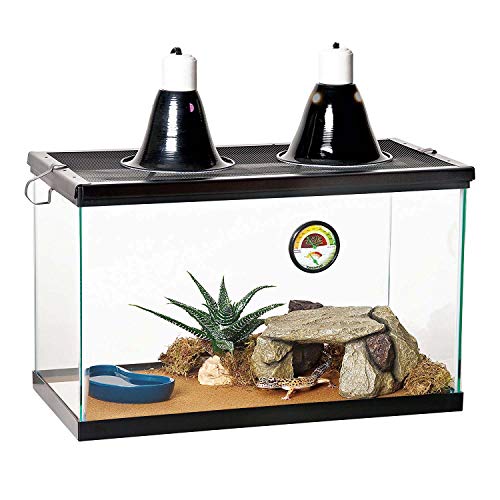
The Zilla 10 Gallon Starter Kit occupies the entry-level desert setup niche with the credibility of American manufacturing behind it. The glass tank is Made in the USA — a meaningful quality assurance point that you'll notice in the seam quality and glass clarity compared to some imported alternatives at similar price points. This kit is explicitly designed for small desert-dwelling animals: juvenile leopard geckos, small skinks, juvenile blue-tongued skinks, and similar species.
The included terrarium liner is a thoughtful inclusion. The biodegradable enzyme treatment actively fights odor, which matters considerably in a small enclosure where waste can concentrate quickly. The non-abrasive surface is gentle on the animals that live on it, eliminating the impaction risk that comes with loose particle substrates for young or small desert reptiles. The kit includes light and heat components to round out the habitat without requiring additional purchases at the outset.
At 10 gallons, you understand what you're getting: a starter enclosure. This is the right choice when you want to start small, verify you enjoy reptile keeping, and then upgrade as your animal grows and your confidence builds. It's also a legitimate permanent home for adult animals that stay small, like certain gecko species. For the broader category of terrarium and garden container reviews, the same principles of drainage, material quality, and appropriate sizing apply whether you're housing a reptile or a plant. The Zilla delivers on all three at an accessible price point.
Pros:
Cons:
The single most important decision you'll make is whether to buy a glass enclosure, a screen cage, or a hybrid design — and it should be driven entirely by your animal's humidity requirements.
General rules hold: arboreal species need height, terrestrial species need floor space, and all reptiles need room to establish temperature gradients. But the specifics matter enormously.
Ventilation and UVB access are engineering factors that determine which equipment will work in your enclosure — plan this before you buy.
A terrarium is a multi-year investment. Evaluate it like one.
An adult bearded dragon needs a minimum 120-gallon enclosure — 48" x 24" x 24" is the current hobby standard recommendation. Juvenile bearded dragons can start in a 40-gallon breeder tank, but they grow rapidly and will need the larger enclosure within 12-18 months. The REPTIZOO 120 Gallon on this list is purpose-built for exactly this species at adult size. Undersized enclosures create thermoregulation problems that manifest as digestive and immune system issues over time.
No. Chameleons require the continuous, high-volume airflow that only screen enclosures provide. Glass enclosures — even those with mesh tops and side vents — do not move enough air to prevent the respiratory infections that kill chameleons in stagnant conditions. The Zoo Med ReptiBreeze is the standard entry-level enclosure for veiled and Jackson's chameleons for this reason. If you're keeping a chameleon species, a screen cage is not a preference — it's a biological requirement.
A 10-gallon can house a juvenile leopard gecko temporarily, but adult leopard geckos need a minimum 20-gallon long enclosure, and 40-gallon is increasingly the recommended standard in 2026 husbandry practice. Floor space is what matters for leopard geckos, not height — they are terrestrial animals that do not climb significantly. The Zilla 10 Gallon Starter Kit is suitable for getting started with a juvenile, but plan your upgrade enclosure before your gecko reaches adult size at 12-18 months.
The numbers refer to UV output intensity. A 5.0 UVB bulb produces UVB levels appropriate for forest and shade-dwelling species — crested geckos, anoles, day geckos, and most amphibians. A 10.0 UVB bulb produces the higher-intensity UVB needed by desert species like bearded dragons, uromastyx, and tegus that receive intense direct sunlight in the wild. Using the wrong UVB intensity causes metabolic bone disease over time in either direction — too little causes deficiency; some evidence suggests prolonged excess can be damaging. The REPTIZOO 5-in-1 Starter Kit's switchable lamp handles both, which is one of its best features.
For most reptiles, yes — but the specifics depend on your species. Overhead heat lamps (and ceramic heat emitters for night heat) establish the basking gradient that drives natural thermoregulation behavior. Under-tank heaters and substrate heaters supplement belly heat, which is important for digestion in many species, particularly snakes and some lizards. For desert species, overhead heat is primary. For tropical species, ambient warmth distributed throughout the enclosure matters more than a single hot spot. Verify your specific species' thermal requirements from a reputable husbandry guide before finalizing your heating strategy.
Spot-cleaning — removing waste, uneaten food, and contaminated substrate — should happen daily or at minimum every 2-3 days. Deep cleaning, which involves removing the animal, all décor, and substrate, followed by disinfection with a reptile-safe cleaner, should occur monthly for most setups. Bioactive setups with established microfauna colonies can extend the interval between deep cleans significantly, but still require regular spot maintenance. Front-opening enclosures like those from REPTI ZOO and REPTIZOO make daily spot-cleaning dramatically faster than top-access designs — factor this into your purchasing decision.
 |
 |
 |
 |

About Christina Lopez
Christina Lopez grew up in the scenic city of Mountain View, California. For eighteen ascetic years, she refrained from eating meat until she discovered the exquisite delicacy of chicken thighs. Christina is a city finalist competitive pingpong player, an ocean diver, and an ex-pat in England and Japan. Currently, she is a computer science doctoral student. Christina writes late at night; most of her daytime is spent enchanting her magical herb garden.


Get new FREE Gifts. Or latest free growing e-books from our latest works.
Disable Ad block to reveal all the links. Once done, hit a button below
|
|
|
|
 rinjal