Indoor growers who skip a dedicated timer lose an average of 30% more electricity compared to those who automate their light cycles — and that gap widens fast when you're running multiple grow lights around the clock. Whether you're tending a small herb shelf or a full-scale grow box setup, the right grow light timer is the single cheapest upgrade you can make to protect your plants and your power bill. In 2026, the market ranges from simple analog dials to Wi-Fi smart plugs that respond to voice commands, which means there's a genuine choice to make before you buy.
Plants respond to light duration the same way they respond to seasons — a biological process called photoperiodism — and interrupting that cycle even once can delay flowering or trigger early bolting. That's why growers of every level, from weekend herb hobbyists to serious hydroponic operators, rely on timers to enforce strict on/off schedules without manual intervention. You set it once, and the lights obey every single day without you having to remember.
This guide reviews seven of the most popular grow light timers available today, covering digital programmable models, old-school analog options, 240V ballast timers, and smart Wi-Fi plugs. We've organized everything you need to know — from the standout picks to a detailed gardening reviews buying guide — so you can choose the right timer for your specific setup. If you're also feeding your plants properly, check out our list of the best fertilizers for indoor plants to round out your grow room toolkit.

Contents







If you're running two separate grow lights on different schedules — say, a seedling tray on 18 hours and a flowering zone on 12 hours — the Autopilot Dual Outlet timer gives you independent control over both outlets from a single device. The 1-minute on/off resolution is tighter than most analog timers on the market, which typically bottom out at 15-minute increments, and that precision matters when you're dialing in a specific photoperiod for light-sensitive crops. The 1725W, 15A rating handles most standard grow light setups without breaking a sweat, and the digital display makes programming straightforward even if you're new to timers.
The unit supports up to 8 on/off cycles per day per outlet, which is more than enough for growers who want to simulate natural sunrise and sunset ramp-up patterns across a week-long custom schedule. Build quality on Autopilot products has been consistent since the brand was acquired by Hydrofarm, and the grounded three-prong design is a practical safety feature you'll appreciate once you see how much current HID (high-intensity discharge) lighting draws. The LCD screen is clear, though a backlight would be a helpful addition in dim grow rooms.
For the price, the dual-outlet functionality alone sets this apart from single-outlet digital timers in the same category. If you need to run two zones independently or connect both a grow light and a CO2 controller to one timer, this is a practical choice that doesn't require buying two separate units.
Pros:
Cons:
The Titan Controls Apollo 9 is a hydroponics staple that has earned its reputation through consistent performance in demanding indoor grow environments. The two-outlet design at 15 amps is the same core feature you'd expect at this price point, but what really separates the Apollo 9 from generic digital timers is the battery backup feature — if power goes out and comes back, your programmed schedules are still intact and the timer resumes without you having to reprogram anything. That feature alone saves growers from the frustration of waking up to find their lights have been off for six hours because of a brief overnight outage.
The timing flexibility on the Apollo 9 is genuinely broad, and Titan Controls designed it to handle configurations that go well beyond basic 18/6 or 12/12 schedules, which is why it's popular among growers running nutrient dosing pumps and fans on complex staggered cycles. The 120V design is standard for North American outlets, and the unit is compact enough that it doesn't block adjacent outlets on a power strip. Programming is menu-driven with a clear display, and most growers figure it out within about ten minutes of unboxing.
Titan Controls backs this product with solid customer support, and the brand's track record in the hydroponics space since the early 2000s gives you confidence that the unit is built for real grow room conditions rather than light household use. If you're setting up a serious hydroponic system and you want a timer that won't let you down when the stakes are high, this one belongs on your shortlist.
Pros:
Cons:
Most timers on this list are built for standard 120V North American household outlets, but if you're running a high-wattage 240V ballast (the transformer-like device that powers HID grow lights like metal halide or high-pressure sodium), the Apollo 5 is one of the few purpose-built options you'll find at a reasonable price. Running a 1000W HID lamp on a standard 120V timer is both dangerous and likely to void your equipment warranty, so this product exists to fill a real safety gap in the market.
The Apollo 5's package dimensions of roughly 8 by 5 by 3 inches give you an idea of the solid construction — this is not a flimsy device, and it's designed to handle the heavy inrush current that 240V ballasts draw at startup, which can be several times the running load. The country of origin is China, which is standard across the timer category at this price point, and Titan Controls maintains quality control standards that keep this product competitive with more expensive alternatives. If you're operating a greenhouse and your infrastructure is already wired for 240V circuits, this timer fits naturally into your existing setup.
Keep in mind that 240V wiring and connections should always be handled with appropriate caution, and if you're upgrading from a 120V setup you may need to review your greenhouse infrastructure before installing this timer. For growers who are already on 240V, the Apollo 5 is a purpose-built, reliable solution that doesn't require a workaround.
Pros:
Cons:
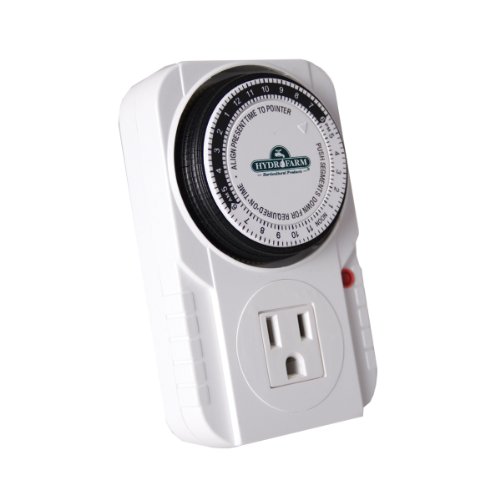
There is something genuinely appealing about an analog timer when you want absolute simplicity and zero programming frustration. The Hydrofarm Autopilot TM01015 works on a 24-hour rotating dial with physical push-in tabs that you flip to set your on and off times — no LCD, no menus, no batteries required to maintain settings. For a grower running a basic 18/6 vegetative schedule or a 12/12 flowering cycle, this is as fast to set up as any timer gets, and there's simply nothing to go wrong from a programming standpoint.
The 15-minute on/off increment means you can't get the precision you'd get with a digital timer that goes down to 1 minute, but for standard light cycle applications — where your plants don't care whether the lights turn on at 6:00 AM or 6:15 AM — that granularity is completely sufficient. The 15A, 1725W rating handles most single-light setups including LEDs, CFLs (compact fluorescent lamps), and many T5 fluorescent arrays. The grounded three-prong design is a must for any grow light application, and Hydrofarm includes it as standard here.
Where this timer falls short is in flexibility — you get one on/off event per day, which is a deal-breaker for anyone running supplemental lighting schedules, DWC (deep water culture) pumps on timed intervals, or any setup that requires multiple daily cycles. For a single grow light on a simple schedule, however, the Autopilot analog timer is a proven, no-nonsense workhorse that costs less than most digital alternatives and lasts for years of daily use.
Pros:
Cons:
VIVOSUN has built a strong reputation among entry-level and mid-tier growers by delivering feature-rich products at competitive prices, and the 7-day digital timer is a good example of that approach. Twenty programmable on/off groups across a 7-day cycle is genuinely generous at this price point — most timers in the budget-to-mid range top out at 8 events — and the 1-minute minimum interval gives you the same precision as more expensive options. The dual-outlet design at 15A (1875W maximum) means you can run two devices simultaneously, which is a practical feature for pairing your grow light with a ventilation fan or a humidifier.
The updated LCD display on this version is larger and more readable than older VIVOSUN timer models, and the side-entry plug design is a thoughtful detail that makes it usable in tight spaces where a front-entry plug would block access to adjacent outlets. The child-safety aspect of the side-entry design is mentioned by the brand, and while that may not be your primary concern in a grow tent, it's a signal that the overall industrial design was considered carefully. The eight preset day-combination options — including weekday-only and weekend-only patterns — add flexibility for growers who adjust their schedules based on the day of the week.
For the price you're paying, the VIVOSUN timer punches well above its weight in raw feature count. The tradeoff you accept is that it's a newer brand without decades of grow-room-specific testing behind it, but the specs are solid and the user reviews across 2025 and into 2026 have been consistently positive for reliability. This is the timer to consider if you want digital precision and dual-outlet convenience without paying a premium for a hydroponics-specific brand name.
Pros:
Cons:
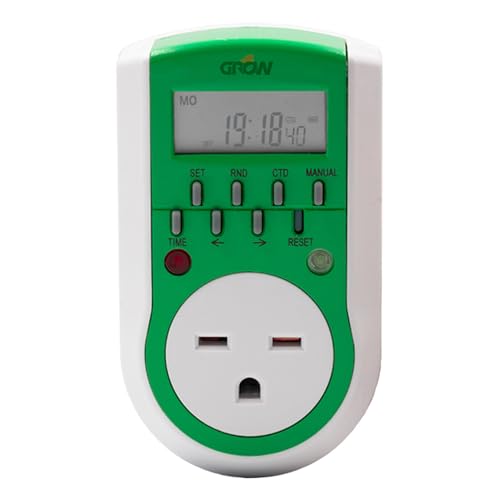
The Grow1 240V timer fills a specific but important niche: it's a plug-in digital timer that works across 220V, 230V, and 240V outlets, which makes it compatible with a wide range of international and domestic high-voltage applications. Where the Titan Apollo 5 is purpose-built for ballast applications, the Grow1 is a more general-purpose 240V solution that also works well for aquarium setups, reptile enclosure heat lamps, and greenhouse accessories — essentially anything running on a 240V circuit that needs automated on/off control.
The 7-day digital programming gives you the same weekly schedule flexibility you'd expect from a modern digital timer, and the 15A capacity is appropriate for the majority of grow lights designed for 240V operation. The "reliable and hassle-free" positioning from Grow1 is backed up by the product's straightforward single-outlet design — there are no dual-zone complications here, just a clean, well-made timer that does its job on a higher-voltage circuit. This is the timer to consider if you've outgrown the standard 120V world and need a plug-in solution rather than a hardwired timer relay.
One practical note: always confirm your outlet type and voltage before ordering any 240V timer, since the plug configuration for 220V, 230V, and 240V varies by country and by circuit type within the United States, and a mismatched plug is a frustrating problem to solve after delivery. The Grow1 is a solid, straightforward device for the right application, and it serves aquarium and reptile keepers just as well as it serves plant growers.
Pros:
Cons:
The Kasa HS103P2 is a fundamentally different kind of timer from everything else on this list — it's a Wi-Fi smart plug that turns your smartphone or voice assistant into the programming interface. You connect it to your 2.4GHz home network through the Kasa app (no separate hub required, which is a significant practical advantage), and from that point you can schedule your grow lights, turn them on or off remotely from anywhere in the world, and even ask Alexa or Google Assistant to control them by voice. If you're already running a smart home ecosystem, this integration is genuinely useful rather than just a novelty.
The pack of two at 15A each means you get two independently controllable smart outlets for a single purchase price, which is competitive value when you consider that you're essentially buying two Wi-Fi-connected devices with full app scheduling, timer countdowns, and voice control baked in. The UL certification (a safety standard issued by Underwriters Laboratories) is an important quality signal for any device that will be controlling grow lights, which draw significant current and run for many hours each day. Kasa's app is consistently rated as one of the cleaner smart plug interfaces in 2026, and the away mode — which simulates occupancy by turning devices on and off randomly — is a bonus feature that many users appreciate for home security.
The tradeoff is real, though: this timer depends on your Wi-Fi network and your router's uptime. If your network goes down, the physical button on each plug still works for manual override, and any schedules already programmed run locally on the device, but you lose remote access and app control until connectivity is restored. For a grow room where reliability is critical, you should weigh this dependency against the convenience before committing to a smart plug over a purpose-built standalone timer.
Pros:
Cons:
The very first thing you need to confirm before buying any grow light timer is the voltage of your grow light and your outlet. Most home grow setups in North America run on standard 120V circuits, and virtually every timer on this list except the Titan Apollo 5 and Grow1 240V is designed for that standard. High-wattage HID grow lights — particularly 600W and 1000W metal halide and high-pressure sodium setups — are often wired for 240V because running that much power on a 120V circuit would require a very high amperage and create a significant fire risk. If your ballast says 240V on the label, you need a 240V-rated timer, period. Using the wrong voltage timer on a 240V circuit is dangerous and will destroy the timer at minimum.
The choice between an analog dial timer and a digital programmable timer comes down to how complex your lighting schedule needs to be. An analog timer is the right call if you need one simple on/off cycle per day and you want zero programming overhead — flip the tabs, set the clock, done. A digital timer is worth the small additional cost and setup effort as soon as you need any of these things:
For most growers running a standard vegetative or flowering schedule, a digital timer with 1-minute resolution is the right baseline purchase even at the entry level, because the precision and flexibility it offers costs very little extra over a basic analog unit.
Every timer has a maximum amperage (measured in amps, abbreviated A) and a corresponding maximum wattage (measured in watts, abbreviated W) rating. You need to stay below both figures with your connected equipment. The standard 15A / 1725W rating you see on most timers in this category handles the majority of residential grow light setups, but if you're running multiple devices through a single outlet — say, a grow light plus a fan plus a CO2 system — add up the wattages and verify you stay under the timer's rated maximum. Exceeding the rated load is a fire hazard and will damage the timer. The VIVOSUN timer's 1875W rating is slightly higher than the 1725W standard, which gives you a small additional safety margin for higher-draw LED systems.
Single-outlet timers are fine for one device, but if you're managing a grow room with multiple pieces of equipment, a dual-outlet timer like the Autopilot or VIVOSUN models can simplify your setup significantly. Consider also whether smart home integration matters to you — the Kasa HS103P2 is the only Wi-Fi-enabled option on this list, and it opens up remote monitoring and voice control that standard timers don't offer. The practical question to ask yourself is whether you'll actually use remote access, because if you're always physically present in your grow room, a $15 analog timer and a $60 smart plug deliver the same end result for your plants. The difference is in your convenience and peace of mind, not in the quality of the light cycle your plants receive.

For most plants, the minimum useful interval is 15 minutes, which is what analog timers provide. Digital timers that go down to 1 minute give you more flexibility for supplemental lighting schedules or timed irrigation cycles, but for standard vegetative (18/6) and flowering (12/12) schedules, any timer with 15-minute or finer increments will work perfectly well. The interval precision matters more for pump timers than for grow light timers, since plants don't respond to 1-minute differences in light duration.
Yes, with an important caveat: the timer must be rated for the wattage and amperage of your grow light. Most standard household timers are rated at 15A / 1725W, which covers the majority of residential grow lights including LED panels up to about 1500W. Where you run into trouble is with 240V HID (high-intensity discharge) ballasts — those require a timer specifically rated for 240V, and a standard 120V household timer will fail and potentially create a fire hazard. Always check your grow light's power requirements before selecting a timer.
For any grow light application, a grounded three-prong timer is strongly recommended. Grow lights draw significant current and are often used in humid greenhouse or grow tent environments where moisture can increase electrical risk. A grounded timer provides a safe path for fault current and protects both you and your equipment. Every timer reviewed in this 2026 guide uses a grounded three-prong design for this reason.
On most digital timers, you would set one ON event for the time you want your lights to turn on — say, 6:00 AM — and one OFF event 12 hours later at 6:00 PM. Program this event to repeat every day of the week, and the timer handles the rest automatically. On timers with multiple program groups, you only need to set one group for a simple 12/12 cycle; the remaining program slots can be left unused or used for a second device like a fan or CO2 controller on a different schedule.
This depends entirely on the timer. Analog dial timers will resume from the correct time if the power outage is short enough that the dial doesn't spin to a different position — though in practice, a brief outage rarely disrupts them. Digital timers without battery backup will typically lose their clock setting and may reset to default, requiring you to reprogram the schedule. Digital timers with battery backup, like the Titan Controls Apollo 9, retain their programmed schedules and clock setting through power outages. Smart plugs like the Kasa HS103P2 retain locally programmed schedules but lose remote access until Wi-Fi is restored.
For a simple single-light setup, one outlet is enough. If you want to control your grow light and another piece of equipment — a ventilation fan, a CO2 controller, or a water pump — from a single timer unit, a dual-outlet timer like the Autopilot or VIVOSUN models saves you from buying a second timer. Keep in mind that both outlets on a dual-outlet timer typically share the same total amperage capacity, so if you're loading both outlets heavily, check that the combined wattage stays under the rated maximum.
The right timer is the one that matches your voltage, your schedule complexity, and your tolerance for technology — because a $15 analog dial and a $60 smart plug both keep your plants on schedule if you choose correctly.
 |
 |
 |
 |

About Truman Perkins
Truman Perkins is a Detroit-based SEO consultant who's been in the business for over a decade. He got his start helping friends and clients get their websites off the ground, and he continues to do so today. In his free time, Truman enjoys learning and writing about gardening - something he believes is a natural stress reliever. He lives with his wife, Jenny, and their twins in Detroit.


Get new FREE Gifts. Or latest free growing e-books from our latest works.
Disable Ad block to reveal all the links. Once done, hit a button below
|
|
|
|
 rinjal