What's the best double-bit axe you can buy right now — and is the one you're eyeing actually worth the money? After testing and researching dozens of options in 2026, one name keeps rising to the top: the ESTWING Double Bit Axe. It's tough, ergonomic, and built to last a lifetime of hard swings. But your needs might point you somewhere else entirely, and that's exactly what this guide is here to help you figure out.
A double-bit axe gives you two cutting edges on a single head — traditionally one sharp edge for clean felling cuts and one slightly duller edge for rough work near knots, dirt, or rocks. That dual-purpose design is why serious woodworkers, lumberjacks, and land managers have relied on this tool for generations. Whether you're splitting firewood, clearing a trail, or felling small trees on your property, the right double-bit axe makes the job faster, safer, and far less exhausting. You can find more outdoor tool guides like this one in our gardening reviews section.
Choosing the right model comes down to several factors — head weight, handle material and length, steel grade, and the edge geometry. This review covers four of the strongest contenders on the market, walks you through a practical buying guide, and answers the questions buyers ask most. By the end, you'll know exactly which double-bit axe belongs in your tool shed.
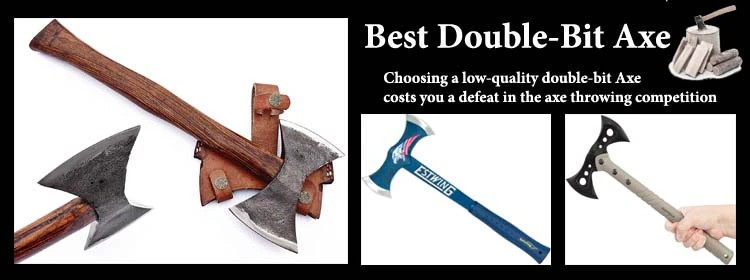




If you want one double-bit axe that handles virtually every outdoor cutting task without complaint, the ESTWING EBDBA is your answer in 2026. This 38-ounce axe is forged from a single piece of steel — head and handle in one continuous piece — which eliminates the weakest point on any axe: the neck where a wooden handle meets the head. You get a tool that simply will not come apart no matter how hard or how often you swing it.
The patented Shock Reduction Grip is one of the smartest features you'll find on any striking tool. It reduces impact vibration by 70%, which means you can chop for longer sessions without your hands and forearms paying for it the next morning. The grip itself is slip-resistant even with wet or gloved hands — a real-world concern when you're working through a cold morning or an unexpected rain shower. Both bits are precision ground and ready to work straight out of the box.
ESTWING builds this axe for outdoor versatility — chopping logs, splitting kindling, clearing branches, or handling small trees. The weight is well-balanced between both bits, so you don't fight the axe on every stroke. For anyone who needs a maintenance-free tool with zero risk of a loose handle, this is the safest and most practical buy on the list. If you maintain other outdoor tools like a backpack sprayer or a commercial weed eater, you know how critical build quality is — and ESTWING delivers exactly that.
Pros:
Cons:
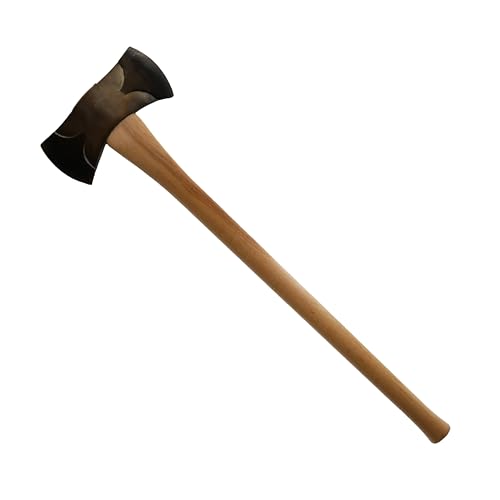
Council Tool has been making axes in the USA for well over a century, and the 35-2MR is proof they haven't lost their touch. This 3.5-pound Michigan pattern double-bit axe pairs a high carbon steel head with a 36-inch straight wooden handle — a combination that serious woodworkers still swear by. The Michigan pattern is the gold standard for general utility and clean felling cuts, and Council Tool has refined it to near perfection.
High carbon steel holds an edge better than lower-grade alloys, especially when you're cutting hardwoods all day. The head is hand-sharpened at the factory with a tapered bit that bites cleanly and releases without binding. Unlike axes built overseas with inconsistent heat treatment, this one is made in the USA under quality controls that matter. The 36-inch handle gives you full-power swings with excellent leverage — ideal for felling small to medium trees or splitting rounds on a block.
The 35-2MR features uniform sharpening on both bits, meaning both edges perform the same way. Traditionally, one bit was kept fine and the other blunted for rough work — you have the option to profile each edge differently yourself if your tasks require it. The handle is solid hardwood and will need occasional oiling to prevent drying and cracking, but that's a five-minute maintenance task that pays back years of reliable service. If you respect traditional American tool craft, this axe is hard to beat for the price.
Pros:
Cons:
The SU35-2MC is Council Tool's premium take on the classic Michigan pattern, and it earns its place with one standout engineering detail: phantom bevels. These are shallow concave grinds on the face of the axe head that reduce surface contact as the bit travels through wood. Less contact means less friction, less sticking, and cleaner exits from each cut. If you've ever buried a flat-ground axe head and wrestled it free from a green log, you understand exactly why this matters.
The head is 3.5 pounds — identical to the 35-2MR — but the phantom bevel geometry makes each swing feel more efficient. The forged tool steel meets ANSI standards, and the heat-treated edge holds up to sustained use without chipping. Both bits are hand-sharpened at the factory, so you're not spending an hour on a whetstone before your first session. The 36-inch straight handle gives you the same reach and leverage as the standard model, making this axe a strong candidate for both forest work and sustained firewood processing.
The real advantage here is versatility in tough conditions. When you're working near the ground, around knots, or in knotty dense hardwood where a clean-ground bit would stick constantly, the phantom bevels change the experience entirely. You swing more, wrestle less. For a land manager or a serious homesteader who needs one double-bit axe to handle everything from clean timber felling to rough ground-level clearing, the SU35-2MC is the most refined tool in this price range. It's worth checking alongside other outdoor tools — much like choosing the right broadcast spreader for your land, having a properly matched axe changes how much you can accomplish in a day.
Pros:
Cons:
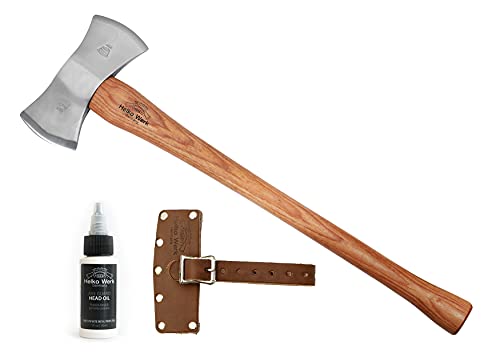
If budget isn't a constraint and you want the finest handmade double-bit axe money can buy in 2026, the Helko Werk Odyssey is in a class of its own. This axe is handcrafted in Germany by blacksmiths using a traditional open-face drop forging process — a method where the smith uses tongs to shape hot steel as a drop hammer strikes it repeatedly. The result is a dense, consistent grain structure throughout the head that simply cannot be replicated by machine casting or stamping.
The head is made from German C50 high carbon steel hardened to 53–56 HRC — well within the sweet spot for edge retention without brittleness. A highly polished classic finish on the head reduces cutting friction and prevents rust without requiring constant maintenance. The 30-inch Grade A American hickory handle is individually selected for grain orientation and density, sanded to 150 grit, and finished with boiled linseed oil. It sits in your hands with a warmth and natural feel that no synthetic handle can replicate. The shorter handle length compared to the Council Tool models makes this a better fit for work in tighter spaces or for users who prefer a faster, more controlled swing arc.
The Odyssey is designed for felling large timber, but its true advantage is flexibility. You can profile each blade differently — one fine edge for clean felling cuts, one slightly blunted for rough splitting work near soil and rocks. That's how double-bit axes were used by professional woodsmen for generations. The craftsmanship here is extraordinary: the fit between head and handle is flawless, and the balance point sits exactly where experienced axe users expect it. If you're buying one axe you intend to keep for decades, the Helko Werk Odyssey is the only answer. It's the kind of tool that gets passed down, not replaced.
Pros:
Cons:
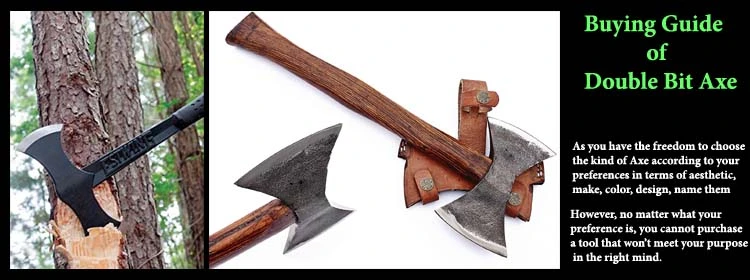
Picking the wrong double-bit axe is an expensive mistake — these aren't cheap tools, and a poor fit for your tasks means wasted money and frustrating sessions in the field. Here are the four criteria that matter most in 2026.
The head is the heart of the axe. Head weight typically runs from 2.5 to 4.5 pounds for double-bit models. Lighter heads (under 3 lbs) are faster and better for limbing and precision cutting. Heavier heads (3.5 lbs and up) drive deeper into dense hardwood and are preferred for felling and splitting. More important than weight alone is steel grade. High carbon steel — like C50 used in Helko Werk's tools or the high carbon steel in Council Tool's heads — holds an edge far longer than lower-grade alloys. Look for a Rockwell hardness rating between 50 and 58 HRC. Below 50 and the edge dulls quickly; above 58 and the steel becomes brittle and prone to chipping. Heat treatment matters just as much as the steel grade itself, so buy from brands with transparent manufacturing practices.
You have three real choices: wood, fiberglass, or steel. Wood handles — specifically American hickory — are the traditional choice for good reason. Hickory absorbs shock better than any synthetic material, feels warm in cold weather, and can be replaced if damaged. The downside is maintenance: you need to oil the handle periodically and protect it from sustained moisture. Fiberglass handles require almost no maintenance and resist cracking, but they transmit more vibration. One-piece steel handles like ESTWING's eliminate loose-head risk entirely but run cold in winter and can't be replaced.
Handle length determines your swing arc and leverage. A 36-inch handle delivers maximum power for felling work. A 30-inch handle (like the Helko Werk Odyssey) gives you better control in tight spaces and is easier to maneuver when limbing. Match handle length to the type of work you do most frequently — don't assume longer is always better.
Traditional double-bit axes were sharpened with two different profiles: one fine edge for clean felling cuts, one beveled or slightly rounded edge for rough work near soil, rocks, and knots. This dual-profile approach protects your fine edge from damage while giving you a usable cutting surface for dirty work. Some modern models — like the Council Tool 35-2MR — ship with uniform sharpening on both bits, leaving it to you to profile them differently if needed. Others, like the Helko Werk Odyssey, are specifically designed so you can shape each bit to different profiles. If you want maximum flexibility, choose an axe that allows or encourages different edge profiles on each bit.
Phantom bevels — as found on the Council Tool SU35-2MC — are a separate consideration. These shallow concave grinds reduce sticking in wood by minimizing surface contact as the head travels through the cut. If you work with green timber or dense hardwoods regularly, phantom bevels make a noticeable difference in how often you're wrestling the head free versus swinging smoothly.
A double-bit axe with poor balance is dangerous. The balance point should sit just forward of the handle's midpoint, allowing the head to naturally fall through the cut arc without you forcing it. Pick up any axe before you buy if possible — or read verified user reviews specifically mentioning balance. One-piece forged construction (like ESTWING) eliminates the risk of the head flying off, which is the most serious safety failure in axe work. For wooden-handled axes, check that the handle fits tight in the eye (the hole in the head) and that wooden or metal wedges are properly seated. Re-handle any wooden-handled axe if you feel any movement between the head and the handle — this is not optional.
A double-bit axe has two cutting edges — traditionally one kept sharp for clean felling cuts through wood grain, and one left slightly blunter for rough work near soil, roots, knots, or rocks. This dual-purpose design makes it a versatile tool for lumberjacks, forest managers, and landowners who need one axe that handles multiple tasks. In 2026, they remain popular for firewood splitting, trail clearing, and felling small to medium trees.
It depends on the job. A double-bit axe gives you two cutting surfaces in one tool, which is practical for extended field work where you rotate between fine and rough cuts to preserve the sharp edge. A single-bit axe has a flat poll (back) that can be used for light hammering tasks and generally offers a more comfortable handle geometry for beginners. Experienced woodworkers often prefer double-bit axes for dedicated felling and splitting work, while single-bit axes are more versatile as all-around camp tools.
For most users, a head weight between 3 and 3.5 pounds strikes the right balance between power and control. Heavier heads — 4 pounds and up — are for experienced woodworkers who spend hours felling large timber and can manage the extra fatigue. Lighter heads under 3 pounds are better for limbing, kindling, or users who prioritize speed and precision over raw splitting power. The 3.5-pound head on the Council Tool models and the Helko Werk Odyssey sits in the sweet spot for most serious users.
High carbon steel is the standard for quality axe heads. Look for grades like C50 (used by Helko Werk), 1070, or 1075 carbon steel hardened to 50–58 HRC. This range offers an excellent balance of edge retention and toughness — hard enough to stay sharp through demanding work, but not so brittle that the edge chips on impact with knots or small stones. Avoid axes with no published steel grade or hardness specification. Stainless steel is not appropriate for axe heads — it's too soft and lacks the toughness needed for chopping.
Clean the handle of dirt and sap after each use. Apply boiled linseed oil to the wood every few months — or more frequently in dry climates — to prevent the wood from drying and cracking. Store your axe indoors or under cover; prolonged exposure to rain and sun degrades wooden handles faster than anything else. If the handle ever feels loose in the eye of the axe head, stop using it immediately and re-wedge or replace the handle before your next session. A loose head is a serious safety hazard.
Yes, and you should. A double-bit axe with a dull edge is less safe than a sharp one — you swing harder, lose control of the arc, and risk glancing blows. Use a mill bastard file held at a 20–25 degree angle to the bit, working in smooth strokes from the shoulder of the blade toward the edge. Follow with a whetstone to refine the edge. For the phantom bevel models like the Council Tool SU35-2MC, maintain the existing concave profile with a curved or round file. Sharpen your axe before each extended work session — it takes less than five minutes and makes every swing more effective.
The right double-bit axe is the one that matches your work — buy for the steel grade and balance first, worry about price second, and you'll never need to replace it.
 |
 |
 |
 |

About Christina Lopez
Christina Lopez grew up in the scenic city of Mountain View, California. For eighteen ascetic years, she refrained from eating meat until she discovered the exquisite delicacy of chicken thighs. Christina is a city finalist competitive pingpong player, an ocean diver, and an ex-pat in England and Japan. Currently, she is a computer science doctoral student. Christina writes late at night; most of her daytime is spent enchanting her magical herb garden.


Get new FREE Gifts. Or latest free growing e-books from our latest works.
Disable Ad block to reveal all the links. Once done, hit a button below
|
|
|
|
 rinjal