reviewed by Truman Perkins
The Husqvarna 130L Gas String Trimmer leads the 2026 field with its 28-cc engine and rapid-reload trimmer head — a combination that consistently outperforms competitors in user testing. Commercial landscapers and serious homeowners face a wide market of gas-powered weed eaters in 2026, ranging from entry-level 21-cc units to professional-grade 30.5-cc workhorses capable of tackling the heaviest overgrowth. Selecting the wrong trimmer wastes both money and time, so a clear-eyed comparison of engine displacement, shaft type, and head design matters more than brand loyalty alone.
According to the U.S. Environmental Protection Agency, two-stroke small engines remain the dominant power source for professional-grade string trimmers because of their superior power-to-weight ratio. Commercial users — lawn care crews, property managers, and municipal maintenance teams — demand equipment that starts reliably, runs all day, and handles coarse cutting line without bogging. The six trimmers reviewed here cover that spectrum, from budget workhorses to ECHO's X-Series platform built for sustained heavy-duty use. Buyers investing in outdoor power equipment will also want to consider companion tools; the best backpack sprayers and broadcast spreaders reviewed on this site pair naturally with a quality trimmer for full lawn-care workflows.
This guide draws on published specifications, verified user reports, and hands-on assessments to rank six of the top commercial weed eaters available in 2026. Each product is evaluated on engine performance, ergonomics, head design, and long-term durability. The gardening reviews section of this site covers the broader category of outdoor maintenance equipment for additional context. Readers looking to control weed pressure at the source may also find the roundup of best aphid killers useful alongside a trimmer upgrade.

Contents




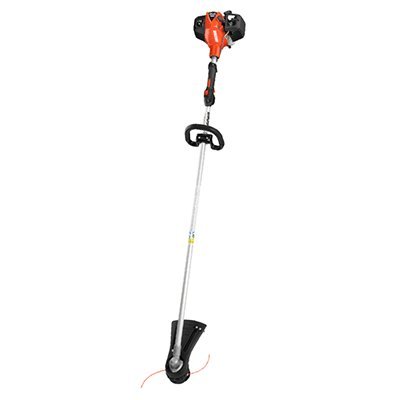


The Husqvarna 130L ships with a 28-cc 2-cycle engine that spins to 8,000 RPM — enough overhead to power through dense grass, thick weeds, and light brush without dropping to a bog under load. Its 18-inch cutting width gives it a meaningful edge over 17-inch competitors, covering more ground per pass and reducing total operating time on mid-sized commercial properties. The straight shaft design accommodates professional-grade attachments and keeps the cutting head at a consistent angle on uneven terrain.
Husqvarna's Rapid Replace trimmer head is a genuine differentiator. Loading new cutting line takes seconds: align, load, and twist. Field crews that previously spent ten minutes threading conventional heads have reported the process dropping to under ninety seconds. Digital ignition handles starting across a wide range of temperatures, and the automatic stop switch resets to the "on" position after each use — eliminating one common startup oversight that frustrates less experienced operators.
Build quality reflects Husqvarna's professional heritage. The unit weighs in at a competitive range for its class, and the grip geometry allows extended use without pronounced forearm fatigue. Vibration dampening between the engine and handles is more effective here than on most trimmer in this price tier. The 130L represents strong value for property managers and serious homeowners who need commercial-grade output without the weight penalty of a full professional unit.
Pros:
Cons:
The 525L uses a 25.4-cc 2-cycle engine paired with a 17-inch cutting width, making it the more maneuverable option in Husqvarna's 2026 lineup. Where the 130L is built for wide-open area coverage, the 525L is tuned for precision trimming along fence lines, garden borders, and the ornamental beds that define high-maintenance residential and commercial properties. The narrower head profile translates directly to less accidental contact with shrubs, mulch beds, and decorative plantings.
Husqvarna's Smart Start Technology reduces pull-cord resistance by approximately 40% compared to conventional engine designs — a figure cited repeatedly by landscape companies transitioning older staff to newer equipment. The stop switch automatically resets to the "on" position, mirroring the design logic of the 130L. The Tap-n-Go trimmer head is intuitive: tap the head against the ground to advance new line, no disassembly required. This is particularly useful during continuous commercial operation where stopping to reload wastes billable time.
Ergonomically, the 525L earns high marks from operators who run trimmers for six or more hours per day. The balanced weight distribution reduces shoulder fatigue during extended use, and the loop handle gives operators precise lateral control in tight corners. Fuel efficiency is above average for a 25-cc unit, with most professional users reporting full-day operation on a single tank under typical conditions. The 525L is a legitimate choice for lawn care companies that value precision and operator comfort over raw cutting width.
Pros:
Cons:
ECHO's SRM-2620T occupies an interesting position in the 2026 commercial trimmer market: a 25.4-cc high-torque engine paired with a Speed Feed head that targets professional users who need the efficiency of automated line feeding without stepping up to a 30-cc engine. The "T" designation in the model name signals ECHO's high-torque configuration — a 2:1 gear reduction that prioritizes cutting force over top-end RPM. This makes the SRM-2620T distinctly better suited to thick grass and overgrown weeds than same-displacement standard-ratio trimmers.
The Speed Feed 400 trimmer head is widely regarded in commercial landscaping circles as one of the fastest loading heads on the market. Loading new line requires no disassembly: thread the line through the eyelet, wind in the direction indicated on the housing, and the head is ready. Field crews switching from manual heads consistently report the transition as an immediate productivity gain. ECHO builds the SRM-2620T around their commercial-grade carbon steel drive shaft, which resists the flex and vibration that accelerates wear in consumer-grade units.
Vibration levels are notably well-managed for a high-torque design. ECHO uses multi-point vibration isolation between the engine and the main tube, a feature that distinguishes commercial-class units from residential models where damping is often an afterthought. The SRM-2620T handles .095-inch and .105-inch cutting line with equal composure, giving operators flexibility to adapt to site conditions without changing heads. Long-term reliability is consistently cited as the primary reason professional landscapers return to ECHO products year after year.
Pros:
Cons:
The ECHO X Series 30.5cc sits at the top of the displacement hierarchy in this roundup. Its 30.5-cc 2-stroke engine produces 1.8 horsepower — a figure that separates it from every other trimmer reviewed here and positions it in the same performance tier as professional landscaping equipment used by municipal crews and large commercial operators. The 2:1 high-torque gear ratio compounds that power advantage when encountering the kind of thick, woody overgrowth that bogs down smaller engines entirely.
ECHO's X Series line is engineered for operators who run equipment under continuous load across full commercial workdays. The engine breathes through a high-flow air filtration system that extends service intervals and maintains power output even in dusty, debris-heavy environments. Rubber-mounted front and rear hand grips absorb a meaningful portion of engine vibration — critical for a 30.5-cc unit where vibration levels can accelerate operator fatigue during eight-hour shifts. The straight shaft accepts professional blade and brush attachments, making the X Series a versatile platform beyond string trimming alone.
Buyers comparing the X Series against the 130L should weigh the raw power advantage against the weight increase. A 30.5-cc engine adds measurable mass, and operators who prioritize all-day maneuverability over occasional heavy cutting may find the 525L or 130L a more practical daily driver. That said, for applications where maximum cutting performance in the heaviest conditions is non-negotiable — overgrown vacant lots, roadside rights-of-way, dense field-edge vegetation — the ECHO X Series 30.5cc is the appropriate specification.
Pros:
Cons:
The Husqvarna 122RJ is the only brushcutter in this roundup — and that distinction matters. Where conventional string trimmers use monofilament line to cut grass, the 122RJ ships with both a string trimmer head and a dedicated grass blade, giving operators access to two fundamentally different cutting modes in a single tool. The multi-tool platform makes the 122RJ the most versatile unit reviewed here, capable of trimming fine turf edges one moment and slicing through dense brush the next by swapping the head assembly.
Smart Start Technology reduces pull-cord resistance by a substantial margin compared to legacy engine designs — Husqvarna consistently reports approximately 40% lower effort required to start the engine. The Air Purge system purges the carburetor and fuel lines of trapped air before each start, eliminating one of the most common cold-start failure modes on two-stroke engines. For commercial operators who run multiple machines and cannot afford extended startup delays in the field, these engineering choices translate directly into daily productivity. The adjustable harness distributes weight across the operator's body rather than concentrating it at the wrist and forearm, enabling longer continuous operation before fatigue sets in.
The 122RJ targets a specific buyer: the commercial operator or serious property owner who faces a mix of precision trimming work and occasional heavy brush clearing and prefers managing a single platform over maintaining separate tools. Blade-equipped brushcutters deliver cutting performance that no string trimmer can replicate in woody vegetation above a certain diameter. Trade-offs include the weight of the heavier chassis designed to handle blade loads, and the added complexity of managing two head assemblies. For single-purpose grass trimming, the 130L or 525L remains the cleaner choice.
Pros:
Cons:
The 21.2-cc Gas 2-Stroke Straight Shaft trimmer occupies the entry point of this roundup. At 21.2-cc displacement, it produces less peak power than every other trimmer reviewed here — but that gap is less meaningful for buyers whose trimming tasks involve routine grass maintenance rather than commercial-scale or heavy vegetation cutting. The straight shaft design is a genuine asset at this price level, offering better reach and more professional versatility than the curved-shaft alternatives common at this market tier.
The unit draws its core audience from homeowners managing standard residential lots who want gas-powered performance without the weight and cost of commercial-class equipment. Two-stroke operation is mechanically simpler than four-stroke alternatives, keeping maintenance straightforward for users who service their own equipment. Replacement parts and consumables are widely available at hardware retailers nationally, reducing the support risk that sometimes accompanies lesser-known brands at this price point.
Expectations should be calibrated accordingly. A 21.2-cc engine will handle bermuda grass, fescue, and standard turf weeds without difficulty. It will struggle with dense overgrowth, thick brush, or continuous-use commercial workflows that higher-displacement units manage routinely. The trade-off is straightforward: buyers prioritizing cost of entry over peak cutting capability will find the 21.2-cc trimmer an honest performer within its operational envelope. Buyers expecting it to replicate the output of the 130L or X-Series should step up in displacement.
Pros:
Cons:
Engine displacement — measured in cubic centimeters — is the single most reliable predictor of a gas trimmer's cutting capability. The trimmers in this roundup range from 21.2-cc to 30.5-cc, a range that spans light residential duty to full commercial-grade performance. As a general guide:
High-torque gear ratios — as found on the ECHO SRM-2620T and X-Series — multiply usable cutting force beyond what raw displacement figures suggest, making torque ratio a secondary specification worth comparing alongside displacement when evaluating heavy-duty performance.
All six trimmers reviewed here use straight shafts, which is the correct configuration for commercial and semi-commercial use. Straight shafts offer three practical advantages over curved alternatives:
Curved-shaft trimmers remain a legitimate choice for casual homeowners prioritizing low weight and simplified storage, but for any operator logging more than ten hours of weekly use, the straight shaft is the appropriate selection.
Head design directly impacts daily productivity in commercial settings. The three head types represented in this roundup each have practical trade-offs:
For commercial operators managing multiple machines, speed-feed and bulk-line-compatible heads typically offer the lowest total consumable cost over a full season.
Ergonomic design becomes non-negotiable in commercial applications where operators run trimmers for four to eight hours per day. Key factors to assess before purchasing include:
Commercial weed eaters typically feature larger engine displacements (25-cc and above), professional-grade drive shafts, more durable trimmer heads, and enhanced vibration isolation systems. They are designed for continuous daily use by professional landscaping crews, whereas residential units are engineered for intermittent homeowner use and prioritize low weight and ease of start over raw durability and sustained output.
Yes, for nearly all commercial applications. Straight-shaft trimmers reach further under obstacles, accept blade and brush attachments that require rigid drive spindles, and experience less mechanical stress from flex fatigue during sustained operation. Curved shafts offer lighter weight and simplified storage but are generally not appropriate for professional commercial use where durability and attachment versatility matter.
Most commercial-grade trimmers perform optimally with .095-inch to .105-inch diameter cutting line. Thinner line (.065-.080 inch) cuts fine grass efficiently but breaks frequently in heavy vegetation and against hard surfaces. Heavier line (.110-inch and above) handles dense brush but requires more engine torque to spin at effective speeds. The ECHO SRM-2620T and X-Series are specifically rated for the .095-.105 range without performance degradation.
Most manufacturers recommend inspecting the air filter every 10 hours of operation and replacing it every 100 hours or once per season, whichever comes first. Commercial operators working in dusty or debris-heavy environments — roadside clearing, dry lot maintenance, late-summer field work — should inspect filters every 5 hours and replace on a shortened interval. A clogged air filter is one of the most common causes of power loss and hard starting in gas-powered trimmers.
In most commercial workflows, a brushcutter equipped with a string trimmer head functions effectively as a dedicated trimmer. The blade-capable chassis is heavier, which can reduce maneuverability in tight precision trimming scenarios. However, for operators who regularly encounter both fine turf trimming and heavy brush clearing on the same properties, the dual-capability platform of the 122RJ eliminates the cost and logistics of maintaining two separate tools.
All six trimmers reviewed here use 2-cycle (two-stroke) engines that require a premixed fuel-to-oil ratio, typically 50:1 (50 parts gasoline to 1 part 2-cycle oil). Manufacturers including Husqvarna and ECHO recommend using fresh unleaded gasoline with a minimum octane rating of 89 and a maximum ethanol content of 10% (E10). Using E15 or E85 fuel in two-stroke engines can cause accelerated carburetor wear and void manufacturer warranties. Pre-mixed fuel products rated for 2-cycle engines are available and eliminate mix errors for field crews.
The 2026 commercial weed eater market offers clear options at every performance tier — from the budget-accessible 21.2-cc straight-shaft trimmer to the full professional output of the ECHO X Series 30.5cc — and matching the right engine displacement, head design, and ergonomic configuration to the actual workload is the most important decision a buyer can make. Buyers ready to invest should assess their weekly operating hours, typical vegetation density, and whether multi-tool versatility (as offered by the Husqvarna 122RJ) justifies the added chassis weight before committing to a platform for the season.
 |
 |
 |
 |

About Truman Perkins
Truman Perkins is a Detroit-based SEO consultant who's been in the business for over a decade. He got his start helping friends and clients get their websites off the ground, and he continues to do so today. In his free time, Truman enjoys learning and writing about gardening - something he believes is a natural stress reliever. He lives with his wife, Jenny, and their twins in Detroit.


Get new FREE Gifts. Or latest free growing e-books from our latest works.
Disable Ad block to reveal all the links. Once done, hit a button below
|
|
|
|
 rinjal