reviewed by Christina Lopez
The Scotts Turf Builder EdgeGuard DLX tops the 2026 broadcast spreader rankings for home lawns — its precision rate control and EdgeGuard technology deliver consistent, edge-clean coverage that most walk-behind spreaders simply cannot match. Whether the goal is seeding a bare patch, applying fertilizer ahead of spring growth, or laying down ice melt before a winter storm, the right broadcast spreader makes the difference between a uniform, professional-looking result and a patchy, burned lawn. After evaluating seven top-selling models across performance, build quality, and value, the picks below represent the strongest options available this year.
Broadcast spreaders work by spinning a disc or dual rotors that fling material outward in a wide arc — typically 6 to 12 feet — as the operator walks or tows the unit across the lawn. This distinguishes them from backpack sprayers designed for liquid applications or drop spreaders that deposit material in a narrow band directly below the hopper. The broadcast mechanism allows faster coverage across large areas, making these tools indispensable for anyone managing more than a quarter acre. Pairing a quality spreader with the right fertilizer or seed product is the fastest route to a dense, healthy lawn.
According to the U.S. Environmental Protection Agency, over-application of fertilizer is one of the leading causes of nutrient runoff that harms local waterways. A calibrated broadcast spreader with a reliable shutoff mechanism is not just a convenience — it is a responsible lawn care decision. The models reviewed here range from battery-powered hand-held units for small urban lots to tow-behind hoppers sized for farms over an acre, giving buyers at every scale a clear path to the right tool.
Contents







The Scotts Turf Builder EdgeGuard DLX earns its position as the best overall broadcast spreader for residential lawns in 2026. The headline feature is Scotts' proprietary EdgeGuard technology, which blocks the right side of the spreader disc to prevent fertilizer, seed, or weed control product from landing on driveways, flower beds, and sidewalks. This eliminates the painstaking process of sweeping up excess product from hard surfaces — a minor but genuinely satisfying quality-of-life improvement on every pass near a border.
The control panel sits at the handle and features clearly marked precision rate settings calibrated specifically for Scotts product lines. The hopper is large enough for most residential jobs without requiring mid-job refills, and the overall build strikes a sensible balance between durability and lightweight maneuverability. The spreader folds for compact storage, a practical detail that matters in a crowded garage. Assembly is straightforward and tool-free, and most users report being operational within fifteen minutes of opening the box.
One insider note: the rate settings are optimized for Scotts-branded products, and users applying third-party fertilizers will need to cross-reference a separate spreader setting guide. This is a common trade-off with branded spreader systems and not a dealbreaker, but it adds a calibration step for those running generic inputs. For homeowners already invested in the Scotts lawn care ecosystem, the DLX is the most turnkey solution on the market.
Pros:
Cons:
The EarthWay 2150 is built for operators who need a commercial-grade spreader without the commercial-grade price tag. The defining feature is the set of 13-inch high-flotation pneumatic stud tires with rustproof poly rims — these are not the lightweight plastic wheels found on consumer models. They absorb the vibration and resistance of rough, uneven ground, making the 2150 the go-to choice for properties with slopes, ditches, or compacted soil sections that would bog down a less capable unit.
EarthWay's 3-hole-drop system with side-spread control is the engineering detail that separates this spreader from the pack. The three-hole configuration promotes an even spread pattern with feathered edging — meaning less product concentrates at the center line and the edges are not sharp cutoffs. The drop rate is adjustable directly on the spreader body, and a removable clog-free grate separates oversized clumps before they block the hopper outlet. The 50 lb. hopper capacity handles serious jobs without constant refilling.
The 2150 is heavier and bulkier than most homeowner units, which is a fair trade-off for the durability and capacity it provides. Buyers with flat quarter-acre lots and a preference for lightweight gear may find simpler options sufficient. For anyone managing a half acre or more of challenging terrain, however, the 2150's performance advantage quickly justifies the investment. It is a workhorse spreader that will outlast several generations of budget alternatives.
Pros:
Cons:
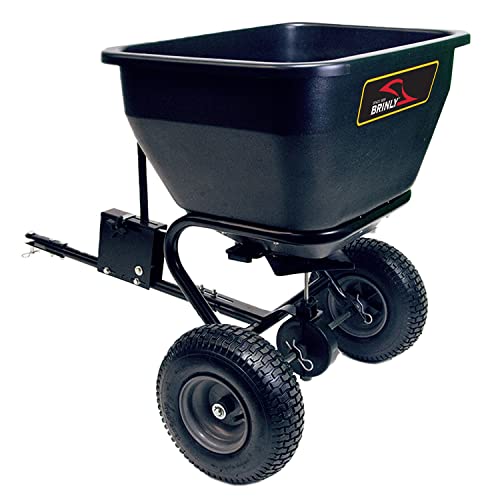
For properties of one acre or larger, a walk-behind spreader becomes a physical endurance event rather than a lawn care task. The Brinly BS36BH-A solves this with a 175 lb. polyethylene hopper that hitches to any standard riding mower or lawn tractor, covering ground in a fraction of the time required by foot-pushed alternatives. The extra-large hopper minimizes refill stops across an acre-plus spread job — a critical factor when working with time-sensitive applications like pre-emergent herbicides or ice melt before a storm.
Brinly's patented AutoFlow technology is the standout engineering feature. When the tractor stops, material flow stops automatically — no manual shutoff required. This eliminates the concentrated burn spots and product waste that plague lesser tow-behind spreaders when the operator pauses at a turn or obstacle. The directional spread pattern control allows users to center and balance the distribution for any material, from fine seed to coarse ice melt. All components that contact fertilizer use stainless steel hardware, a glass-filled nylon gearbox, and a heavy polyethylene hopper — corrosion resistance is designed in from the ground up.
Assembly requires more effort than a walk-behind unit, and buyers will need a compatible hitch on their tractor. The 175 lb. capacity also demands a stable attachment point; lighter-duty equipment may not be ideal. That said, for large-lot owners already operating a riding mower, the Brinly BS36BH-A represents the single highest-efficiency upgrade available in the spreader category for 2026.
Pros:
Cons:
The Lesco High Wheel is the spreader of choice among lawn care professionals and serious homeowners who refuse to compromise on mechanical precision. The enclosed gearbox with a 5:1 gear ratio delivers consistent disc rotation speed regardless of walking pace — a feature that most consumer spreaders omit entirely, resulting in uneven application when operators slow down at corners. The 80 lb. hopper capacity is substantial without becoming unwieldy, and the high-wheel design rolls over clumps, soft spots, and uneven ground that would slow down smaller-wheeled competitors.
The included manual deflector kit is a professional-grade edge control solution. Rather than the automatic side-blocking approach of consumer models, the Lesco deflector allows the operator to precisely redirect the spread pattern at property boundaries, driveways, and ornamental beds. This gives experienced users finer control over edge definition — a capability that landscape contractors depend on for a polished finished appearance. Calibration settings are material-agnostic, unlike systems tuned to specific branded inputs.

The Lesco is not the most beginner-friendly spreader in this roundup. The professional-grade calibration system rewards users who take the time to understand spreader settings and dial in their specific product. For those willing to invest that effort — or who already operate professionally — this spreader delivers results that consumer-grade equipment cannot replicate. Understanding how to properly calibrate and use any spreader is covered in depth across lawn care resources, including guides on gardening tool reviews for related equipment. It is worth noting that pairing a precision spreader with quality inputs like premium bagged compost compounds the results significantly.
Pros:
Cons:
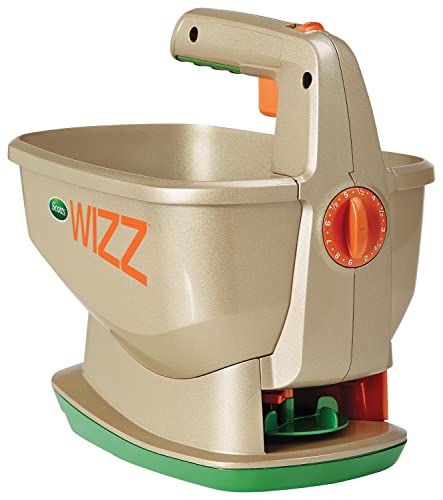
Not every lawn requires a walk-behind spreader. The Scotts Wizz is a battery-powered hand-held spreader purpose-built for small urban and suburban lots where a full-size unit would be overkill. The electric motor drives a small spinning disc that broadcasts material up to 5 feet wide, providing meaningful coverage speed compared to hand-broadcasting while remaining compact enough to store in a cabinet or closet. One set of batteries handles multiple application sessions without issue.
EdgeGuard technology is incorporated directly into the Wizz's design, controlling material dispersal on the right side to protect paved surfaces and beds — the same feature that makes the full-size DLX a top pick, scaled to a hand-held form factor. The unit is rated to cover up to 2,500 square feet using Scotts product, which encompasses most urban townhouse lots, side yards, and garden patches. Year-round use is the practical proposition here: seed in fall, fertilize in spring, spread ice melt in winter — all from the same compact tool.
The limitations are proportional to the format. Buyers with yards over 3,000 square feet will find the frequent refilling tedious, and the limited hopper capacity means this is not a tool for spreading large amounts of product efficiently. For its intended audience — small lot owners who want professional-looking results without storing a full spreader — the Wizz is exactly the right tool at the right price.
Pros:
Cons:
The EarthWay 2600A-PLUS hits the practical sweet spot for homeowners who want more machine than a branded consumer model without crossing into full commercial territory. The rust-proof polypropylene hopper and epoxy powder-coated steel frame are the durability credentials that set it apart from similarly priced competitors — both materials resist the corrosive chemistry of granular fertilizers that tends to prematurely degrade lower-grade components after a few seasons of use.
The 3-hole drop shut-off system with solid linkage is EarthWay's precision delivery mechanism, providing a balanced and even spread pattern without the feathering inconsistencies associated with single-hole designs. The all-terrain pneumatic tires handle grass, gravel, and transition zones between lawn and landscape without wheel-sink or resistance. At 40 lb. hopper capacity, the 2600A-PLUS suits yards in the half-acre to three-quarter-acre range — enough capacity for most suburban lots without the weight penalty of a 50 lb. commercial unit.
This is a spreader that earns consistent five-star reviews from buyers who used it as a direct upgrade from big-box consumer models. The calibration dial is material-agnostic, and the rust resistance means this tool remains functional and accurate through multiple years of outdoor storage. For the buyer who wants a serious walk-behind without the professional-grade price or learning curve, the 2600A-PLUS is the answer. Buyers interested in comprehensive lawn inputs might also explore how pairing this spreader with quality products like those covered in guides to the best fertilizers can dramatically improve results season over season.
Pros:
Cons:
The Scotts Elite Spreader is Scotts' flagship walk-behind model and it earns that designation through a genuine mechanical innovation: dual rotor technology that drives two separate spinning discs simultaneously, producing a 6-foot broadcast pattern with accuracy that single-disc spreaders cannot match. The dual rotor system also eliminates the uneven distribution that occurs when granule size or density varies within a bag — a subtle but consequential performance gap visible in the finished lawn weeks after application.
The hopper is rated for up to 20,000 square feet of Scotts lawn product per fill — a specification that translates to roughly half an acre of grass seed or a full acre of fertilizer depending on the application rate. Never-flat tires are a premium practical detail: no checking tire pressure before a job, no flats on a gravel path, no mid-session interruptions. The Elite handles grass seed, fertilizer, salt, and ice melt equally well, making it a genuine four-season tool for the serious homeowner.
The Elite sits at the top of Scotts' consumer lineup in terms of price. Buyers who apply Scotts products exclusively will extract the full benefit from the calibrated settings; those mixing in third-party inputs will need to do additional calibration homework. For buyers who want the highest-accuracy residential walk-behind on the market and are willing to pay for it, the Elite delivers on the promise. It is a genuine long-term investment — built to last well beyond the typical three-to-five-year lifespan of budget consumer spreaders.
Pros:
Cons:
Matching hopper capacity to yard size is the single most important buying decision. Undersizing forces constant refilling that breaks application rhythm and increases the risk of uneven coverage. The general guidelines:
A spreader that throws product onto driveways, sidewalks, or ornamental beds wastes money and can damage hardscapes with corrosive fertilizer residue. Two approaches dominate the market:
Fertilizers, ice melt, and soil conditioners are chemically corrosive. Components that contact these materials must be rated for corrosive exposure or they will degrade within two to three seasons, leading to unreliable application rates and eventual mechanical failure. Key materials to evaluate:
Every broadcast spreader has a rate adjustment mechanism — typically a dial, lever, or sliding gate — that controls how much material exits the hopper per pass. The gap between spreader models lies in how precisely this mechanism can be set and how consistently it maintains that setting under varying conditions. Buyers should consider:
A broadcast spreader uses a spinning disc or rotor to fling material outward in a wide arc — typically 6 to 12 feet — making it faster for covering large areas. A drop spreader deposits material directly beneath the hopper in a narrow band equal to the unit's width, providing more precise placement but requiring many more passes to cover the same area. Broadcast spreaders are preferred for open lawns; drop spreaders suit narrow strips, borders, or applications where precise containment matters.
Most fertilizer and seed packaging includes a spreader settings chart that lists the recommended dial position for common spreader brands. For products without a chart, the standard calibration method involves measuring a test area, applying the spreader at a known setting, collecting the material, and weighing it against the target application rate per square foot. Adjusting the setting up or down until the output matches the target rate delivers accurate calibration for any product and any spreader.
Yes — most quality broadcast spreaders handle ice melt and rock salt effectively, including the Scotts Elite, Brinly BS36BH-A, and EarthWay models reviewed here. The critical caveat is thorough cleaning after every use. Ice melt and road salt are highly corrosive and will degrade metal hardware, steel frames, and uncoated components rapidly if left in the hopper or on the spreader body. Empty, rinse, and dry the spreader after every salt application without exception.
Spread width varies by model. Hand-held units like the Scotts Wizz broadcast approximately 5 feet. Standard walk-behind consumer models typically cover 6 to 8 feet per pass. The Scotts Elite's dual rotor system delivers a consistent 6-foot pattern. Commercial walk-behind units and tow-behind spreaders can broadcast 10 to 12 feet or more depending on disc speed and gate opening. Wider spread patterns reduce the number of passes required but increase the risk of overlap application, which can burn grass if rates are not adjusted accordingly.
The Brinly BS36BH-A Tow Behind Broadcast Spreader is the definitive answer for properties of one acre or larger. Its 175 lb. hopper capacity, patented AutoFlow shutoff, and tow-behind design allow a single operator to cover substantial ground in a fraction of the time required by any walk-behind alternative. For buyers in this category, attempting to manage more than one acre on foot with a standard walk-behind spreader creates unnecessary physical strain and significantly increases application time per season.
After every use is the professional standard — particularly when spreading fertilizer, ice melt, or weed control products. Empty the remaining material back into its original bag, then rinse the hopper, grate, and disc with water. Allow the unit to dry completely before storing to prevent rust on steel components and corrosion on hardware. Annually, inspect the disc, gearbox, and calibration mechanism for wear, and lubricate moving parts per the manufacturer's recommendation. A properly maintained quality spreader should remain accurate and functional for a decade or more.
Every lawn deserves a spreader matched to its scale — the Scotts Turf Builder EdgeGuard DLX for the classic suburban lot, the Brinly BS36BH-A for the acre-plus property, and the Scotts Wizz for the compact urban yard that just needs a fast, clean application pass. Pick the model that fits the property size and budget, clean it thoroughly after every use, and the right broadcast spreader will deliver consistent, professional-quality results through the 2026 season and well beyond.
 |
 |
 |
 |

About Christina Lopez
Christina Lopez grew up in the scenic city of Mountain View, California. For eighteen ascetic years, she refrained from eating meat until she discovered the exquisite delicacy of chicken thighs. Christina is a city finalist competitive pingpong player, an ocean diver, and an ex-pat in England and Japan. Currently, she is a computer science doctoral student. Christina writes late at night; most of her daytime is spent enchanting her magical herb garden.


Get new FREE Gifts. Or latest free growing e-books from our latest works.
Disable Ad block to reveal all the links. Once done, hit a button below
|
|
|
|
 rinjal