The Safer 5118-6 Insect Killing Soap Concentrate earns the top spot in this roundup — it delivers broad-spectrum aphid control with an OMRI-certified organic formula that is gentle enough for daily garden use. Aphids are among the most destructive soft-bodied insects you will encounter as a gardener, capable of colonizing a healthy plant within days and transmitting viruses that no pesticide can reverse after the fact. Whether you maintain a sprawling outdoor vegetable garden, a curated indoor herb collection, or a greenhouse operation, selecting the correct aphid killer in 2026 is one of the highest-leverage decisions you can make for your plants' long-term health.
Understanding the mechanism behind each product category — contact insecticides, systemic treatments, botanical extracts, and horticultural oils — allows you to match the solution to your specific infestation level and plant type. The U.S. Environmental Protection Agency classifies many of the products reviewed here as minimum-risk or reduced-risk pesticides, a designation that reflects their lower toxicity profile relative to conventional synthetic insecticides. For gardeners who also invest in quality grow environments, pairing an effective aphid treatment with a well-ventilated space — such as those covered in our guide to the top 5x5 grow tent reviews — can significantly reduce the conditions that favor aphid reproduction. You will also find useful context in our overview of top air-purifying indoor plants, several of which carry natural pest-resistance properties worth factoring into your integrated pest management strategy.
This review covers seven of the most effective aphid killers available on Amazon in 2026, evaluated across criteria including active ingredient quality, ease of application, plant safety, coverage area, and value per treatment. Each product has been assessed on its published specifications and practical performance data so that you can make a confident, informed purchase. For additional gardening product evaluations, visit our gardening reviews section. The products are ranked with the strongest all-around performers at the top, but each option has a defined use case that may align precisely with your situation.

Contents
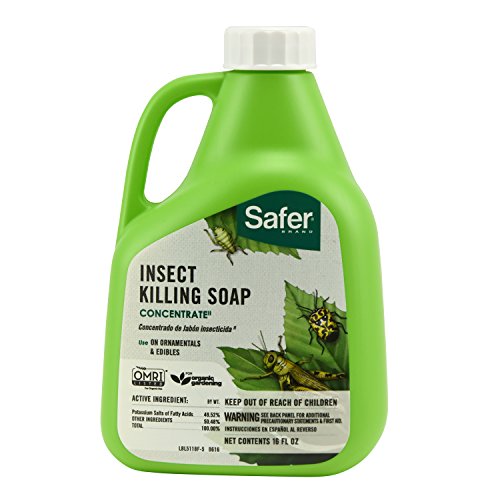






The Safer 5118-6 Insect Killing Soap Concentrate is the benchmark against which most organic aphid treatments are measured. Its active ingredient, potassium salts of fatty acids, works by penetrating the soft outer cuticle of aphids, mealybugs, whiteflies, leafhoppers, and spider mites, causing rapid dehydration and cell disruption at the point of contact. The concentrate formula gives you extraordinary cost efficiency — a single bottle yields multiple gallons of finished spray, making it one of the lowest cost-per-application options in this entire category. Because it carries OMRI certification for organic use, you can apply it to edible crops right up until harvest day without concern for synthetic residues.
Application is straightforward. You dilute the concentrate with water according to label instructions, fill a standard pump or hose-end sprayer, and thoroughly coat the upper and lower leaf surfaces where aphids congregate. Coverage of the leaf undersides is critical — aphid colonies typically shelter there to avoid predators and environmental exposure. Safer recommends repeat applications every five to seven days while insects are active, and the formula is tolerant enough for flowers, herbs, vegetables, houseplants, trees, shrubs, and lawn areas. The key limitation is its contact-only action: it kills insects present at the time of spraying but provides no residual protection once it dries, which is why consistent reapplication during active infestations is essential.
For gardeners managing organic operations or those growing edibles for family consumption, the Safer soap concentrate represents the most responsible combination of efficacy and safety available at this price point in 2026. It does not harm plant tissue when used as directed, and when paired with good cultural practices such as removing heavily infested leaves and encouraging beneficial insects, it integrates seamlessly into a holistic pest management plan. If your garden also benefits from a structured growing environment, reviewing our guide to the benefits of electrolyte water for plants can help you maintain the plant vigor that makes pest recovery faster.
Pros:
Cons:
The Natria Insecticidal Soap Ready-to-Use formula removes all dilution guesswork from the aphid control process. You pick up the 24-ounce bottle, flip the nozzle, and begin spraying — there is nothing else to prepare. This makes it the ideal solution for apartment dwellers with balcony container gardens, casual home gardeners who treat plants infrequently, and anyone who finds concentrate math or mixing equipment inconvenient. The active ingredient is the same potassium salts of fatty acids platform used in professional-grade insecticidal soaps, properly pre-diluted to an effective working concentration that balances pest kill rate with plant safety.
Natria's ready-to-use format performs equally well on indoor and outdoor plants, making it one of the few aphid killers in this list that you can safely deploy on houseplants without dragging them outside. The trigger sprayer delivers a fine mist that clings well to foliage, and the formula is approved for use in organic gardening through harvest day. Target populations of aphids, mealybugs, mites, and whiteflies are controlled on contact, with the fatty acid salts disrupting cell membrane integrity within minutes of exposure. As with all contact insecticides, thorough leaf-surface coverage — including undersides — determines the success of each application.
The primary trade-off with Natria is the per-ounce cost relative to concentrate products. You are paying for formulation convenience, and for gardeners who treat large areas or manage heavy infestations requiring frequent application, this adds up quickly. For small to medium plant collections or as a quick-response emergency treatment, however, the Natria ready-to-use bottle delivers genuine value. It is one of the cleanest, simplest aphid control options available for the home gardener in 2026.
Pros:
Cons:
Bonide Captain Jack's Neem Max Concentrate is the most versatile product in this roundup, functioning simultaneously as an insecticide, fungicide, miticide, and nematicide. The active ingredient is cold-pressed neem oil, derived from the seeds of the Azadirachta indica tree, with azadirachtin as the primary bioactive compound. Azadirachtin works through multiple mechanisms: it disrupts insect hormone signaling to prevent molting and reproduction, acts as a feeding deterrent, and kills eggs, larvae, and adult insects on contact. This multi-stage kill action makes Neem Max especially effective against established aphid populations that have begun reproducing on your plants.
The concentrate formulation in Neem Max includes added surfactants and emulsifiers, which means you do not need to add dish soap or a separate spreader-sticker — a common requirement with raw neem oil products. You mix it directly with water according to label rates, which vary depending on the target pest and application method. The finished spray is suitable for use on vegetables, fruit trees, ornamentals, and most common garden plants, and it is approved for organic production. Beyond aphid control, the simultaneous fungicidal action makes it valuable in gardens where powdery mildew, black spot, or rust tend to accompany pest pressure.
Neem Max requires slightly more attention to application timing than insecticidal soaps. You should spray during cooler parts of the day — early morning or evening — to prevent potential leaf burn and to allow the oil to remain wet on leaf surfaces long enough for contact kill. Avoid applying when temperatures exceed 90°F or when plants are under drought stress. With those conditions observed, Neem Max delivers a breadth of protection that no single-mode contact insecticide can match, making it the strongest value proposition for gardeners dealing with mixed pest and disease pressure simultaneously.
Pros:
Cons:
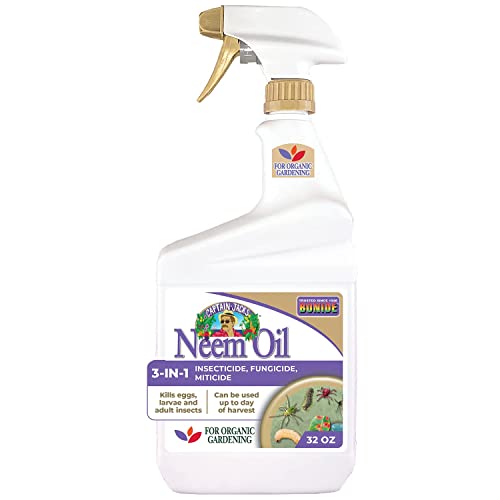
Bonide Captain Jack's Neem Oil Ready-to-Use brings the proven three-in-one fungicide, miticide, and insecticide capability of neem-based treatments into a pre-mixed, spray-and-go format. The 32-ounce bottle with integrated spray nozzle is significantly larger than the Natria ready-to-use option, giving you meaningfully more coverage per purchase. The product is formulated to the same effective concentration of clarified hydrophobic extract of neem oil that professionals use, and it carries the same all-stages kill claim — effective against aphid eggs, larvae, and adults upon contact and through hormone disruption of surviving insects.
The convenience factor here is genuine, not just marketing positioning. Emulsifying neem oil with water at home can be inconsistent without the right equipment and technique; this product eliminates that variable entirely. The integrated sprayer delivers a controlled mist that coats foliage evenly, and the 32-ounce volume is large enough to treat a substantial portion of a typical home garden without needing to refill. Like its concentrate sibling, it functions as a fungicide against powdery mildew and similar foliar diseases, giving you value beyond pure aphid management.
The trade-off versus the Neem Max concentrate is the same as any ready-to-use versus concentrate comparison: cost per treated area is higher, and you have no flexibility to adjust concentration for different pest pressures. For gardeners who want professional-quality neem protection without the preparation overhead — or for those managing a smaller garden where a 32-ounce supply will cover an entire season — this product is an excellent purchase. It can be used right up to the day of harvest, which makes it as suitable for vegetable gardens as it is for ornamentals.
Pros:
Cons:
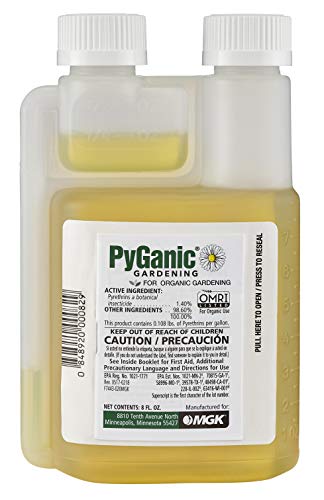
PyGanic Gardening occupies a distinct niche in this roundup as the only pyrethrin-based concentrate on the list. Pyrethrins are botanical insecticides derived from chrysanthemum flowers, and they deliver the fastest knockdown speed of any organic insecticide category. When you spray PyGanic directly on aphid colonies, the pyrethrin disrupts the insects' sodium channel function almost immediately, causing paralysis and death within minutes. This speed of action is unmatched by insecticidal soaps or neem oil products, which may take longer to achieve full kill on contact populations.
The 8-ounce concentrate is designed exclusively for outdoor use, which is an important constraint to note before purchasing. It is approved for certified organic production and is effective against a wide range of garden pests beyond aphids. The speed of action makes PyGanic particularly valuable for acute infestations where you need rapid population reduction before insects spread to adjacent plants or transmit disease. Pyrethrins are also notably short-residue compounds — they break down quickly in sunlight and the environment, which reduces the risk of accumulation but also means protection ends quickly after application.
The primary ecological consideration with pyrethrins is their broad-spectrum toxicity to beneficial insects, including bees and other pollinators, when applied at the wrong time. Responsible use requires spraying in the early morning or evening when pollinators are not actively foraging, and avoiding application to open flowers. When used with this timing discipline, PyGanic becomes a powerful emergency tool in the organic pest manager's arsenal — capable of reducing an overwhelming aphid population to manageable levels in a single treatment session, setting the stage for follow-up maintenance with a gentler contact insecticide.
Pros:
Cons:
Bonide Systemic Insect Control Concentrate operates on a fundamentally different principle than every other product in this list. Rather than killing insects on contact from the outside, this product is absorbed into plant tissue and transported systemically through the vascular system. When aphids feed on treated plants, they ingest the active ingredient and die. This systemic action provides residual protection that lasts weeks after a single application, rather than hours, making it the strongest choice for gardeners dealing with persistent, recurring aphid pressure that contact products have failed to control consistently.
The 16-ounce concentrate makes up to 16 gallons of finished spray — an extraordinary volume that reflects the highly concentrated nature of the active ingredient. A single application to ornamental trees, shrubs, or non-edible plants can protect them through an entire growing season, dramatically reducing the labor overhead associated with repeat contact treatments. The formula acts fast against active infestations and continues protecting against new arrivals as long as the active ingredient remains in plant tissue. Target pests include aphids, thrips, mealybugs, scale, two-spotted spider mites, whiteflies, and more — one of the broadest pest spectrums of any product reviewed here.
The critical limitation of systemic insect control is that it is intended for outdoor residential use on ornamental plants only — it is not appropriate for edible crops, herbs, or any plant whose leaves, fruit, or roots will be consumed by humans. This is a non-negotiable constraint that must guide your purchase decision. If your aphid problem is confined to ornamental trees, flowering shrubs, or decorative landscape plants, the Bonide Systemic Control is the single most efficient and long-lasting solution available. For vegetable or edible herb gardens, you must select one of the contact or neem-based options reviewed above.
Pros:
Cons:
Summit's 122 Year-Round Spray Oil is a highly refined horticultural oil product that kills insects by physically blocking their spiracles — the tiny openings through which they breathe — causing suffocation. Unlike insecticidal soaps or botanical extracts, it contains no synthetic toxins of any kind, relying entirely on mechanical action. This makes it exceptionally safe for use around children, pets, and beneficial organisms when applied correctly, and it is effective year-round as the product name suggests, usable in both dormant and growing seasons. A 1-quart ready-to-use bottle is a practical size for home garden applications, and the integrated sprayer makes deployment straightforward.
Beyond insect control, the Summit oil delivers a notable cosmetic and agronomic bonus: it imparts a healthy, shiny luster to treated plant leaves as the thin oil film coats the surface. It also prevents and treats powdery mildew, a fungal disease that frequently co-occurs with aphid pressure in humid or enclosed growing environments. Summit kills and repels aphids, scale, mites, and other soft-bodied pests across a wide plant type range without introducing any chemical residues. The lack of synthetic toxins means it is an appropriate choice even for highly sensitive ornamentals and for gardeners who prioritize zero-chemical growing philosophies.
The practical limitation of horticultural oils is phytotoxicity risk under certain conditions. Applying oil sprays when temperatures exceed 90°F or when plants are under drought or heat stress can cause leaf burn. You should also avoid spraying sulfur-based fungicides within two weeks of an oil application, as the combination can damage plant tissue. With these conditions observed, Summit Year-Round Spray Oil provides excellent suppression of established aphid populations and ongoing protection as a preventive treatment during high-risk seasons — making it a reliable cornerstone of a non-toxic integrated pest management program.
Pros:
Cons:
The single most important decision you will make when selecting an aphid killer is whether to use a contact-based organic product or a systemic synthetic insecticide. If any part of your garden produces food — vegetables, culinary herbs, fruit trees — organic contact products such as insecticidal soaps, neem oil, and horticultural oils are the only appropriate choices. These are approved for use up to harvest day and leave no harmful residues in plant tissue. Systemic products like the Bonide Systemic Insect Control reviewed here are absorbed into every part of the plant, including fruit and foliage you intend to eat, which makes them categorically unsuitable for edible production. For purely ornamental landscapes, however, systemic options deliver a level of long-duration protection that no contact product can match, and they are worth considering when repeat manual applications are impractical.
Both concentrate and ready-to-use formats produce effective results when used correctly, but they serve different user profiles. Concentrate products — such as the Safer Soap Concentrate and Neem Max — require mixing with water before use, a minor preparation step that delivers dramatically lower cost per gallon of finished spray. If you treat a medium to large garden, use the same product multiple times per season, or manage aphid pressure across multiple plant species simultaneously, concentrate formats are the economically rational choice. Ready-to-use products such as the Natria Soap and Bonide Neem Oil RTU are appropriate for small container collections, occasional emergency treatments, or situations where you cannot or do not want to maintain mixing equipment. The per-ounce cost is higher, but the elimination of preparation overhead has real practical value for time-constrained gardeners.
Not all aphid killers address only aphids. Several products in this list — particularly the neem oil options and Summit Year-Round Spray Oil — simultaneously control spider mites, whiteflies, mealybugs, scale, and fungal diseases such as powdery mildew. If your plants suffer from multiple pest or disease pressures simultaneously, choosing a multi-mode product eliminates the need to purchase and rotate several separate treatments. Conversely, if your problem is a pure aphid infestation with no concurrent disease issues, a simple insecticidal soap concentrate delivers effective, low-cost control without introducing unnecessary chemistry into the garden ecosystem. Assess what you are dealing with before purchasing — honest diagnosis of the problem type determines which product provides the best return on investment.
Regardless of which product you select, application timing is a major driver of real-world effectiveness. Spraying during the heat of the day causes many oils and soaps to evaporate before they make sustained contact with insects, and it increases the risk of phytotoxic leaf burn on sensitive plants. Early morning applications — after dew has evaporated but before temperatures climb — allow thorough leaf surface contact, give the spray time to act on present insects, and reduce disruption to daytime pollinators. For systemic products, soil drench or root application during the active growing period maximizes uptake speed. In 2026, with summer temperatures trending higher in many growing regions, heat-timing awareness is no longer optional — it is a fundamental part of responsible pesticide use.
For vegetable gardens, insecticidal soap concentrates — specifically potassium salts of fatty acids products such as Safer 5118-6 — deliver the best combination of effectiveness, organic certification, and safety for edibles. They kill aphids on contact, leave no harmful residues, and can be applied right up until the day of harvest. Neem oil products such as Bonide Captain Jack's Neem Max provide an additional advantage by also controlling fungal diseases that often accompany aphid pressure in vegetable beds. Never use systemic insecticides on plants grown for food consumption.
Neem oil is safe for the vast majority of common garden plants, including vegetables, herbs, fruit trees, ornamentals, and houseplants, when mixed and applied according to label directions. Certain delicate species — particularly some ferns and plants with very thin, waxy, or hairy leaf surfaces — can show sensitivity. Always conduct a small test application on one or two leaves and observe for 24 to 48 hours before treating the entire plant. Application during high heat or direct midday sun increases the risk of phytotoxicity regardless of plant type, so early morning or evening spraying is consistently recommended.
Contact-based products such as insecticidal soaps and horticultural oils require repeat applications every five to seven days while aphids are actively present. A single application kills insects on contact but provides no residual protection, so surviving insects and new arrivals from adjacent plants will repopulate without follow-up treatment. Neem oil products with azadirachtin provide slightly longer suppression through their hormone-disrupting effects, but reapplication every seven to fourteen days is still recommended during active infestation periods. Systemic products offer multi-week residual protection from a single treatment but are not appropriate for edible crops.
Direct spray contact with insecticidal soaps and horticultural oils can harm beneficial insects, including ladybugs, lacewings, and parasitic wasps, just as it harms aphids. The key distinction is that these products have no residual toxicity once dry — once the spray film dries on leaf surfaces, it is harmless to beneficial insects that subsequently land on treated plants. Timing applications when beneficial insects are not actively present — early morning or late evening — reduces this risk. Systemic products and broad-spectrum insecticides including pyrethrins carry more significant risks to non-target beneficial insects and should be used with particular care around flowering plants.
Yes. Insecticidal soaps, neem oil, pyrethrin, horticultural oils, and systemic insecticides all act through mechanisms that affect the basic biology of aphids regardless of species. The potassium salts of fatty acids in insecticidal soaps disrupt the cell membranes of any soft-bodied insect; neem oil's azadirachtin disrupts molting hormones common to all aphid species; pyrethrins affect sodium channel function that is conserved across insect groups. Green peach aphids, black bean aphids, woolly aphids, and cotton aphids all respond to the products reviewed here. Application thoroughness — particularly coating leaf undersides where colonies shelter — matters more than species-specific selection.
Treat at the first confirmed sign of aphid presence. Early intervention — when populations are small and concentrated on new growth or leaf undersides — requires far fewer product applications and prevents the exponential population growth that aphids are capable of when left unchecked. In practical terms, inspect susceptible plants at least once per week during the active growing season, paying particular attention to new shoot tips and the undersides of young leaves. If you observe even a small cluster of soft-bodied insects or notice honeydew residue (a sticky film left by aphid feeding), begin treatment immediately rather than waiting for visible plant damage to develop.
The gardener who acts on the first aphid sighting spends one afternoon treating a small problem; the gardener who waits spends an entire season trying to recover from a large one.
 |
 |
 |
 |

About Truman Perkins
Truman Perkins is a Detroit-based SEO consultant who's been in the business for over a decade. He got his start helping friends and clients get their websites off the ground, and he continues to do so today. In his free time, Truman enjoys learning and writing about gardening - something he believes is a natural stress reliever. He lives with his wife, Jenny, and their twins in Detroit.


Get new FREE Gifts. Or latest free growing e-books from our latest works.
Disable Ad block to reveal all the links. Once done, hit a button below
|
|
|
|
 rinjal