Which trellis will actually hold your climbing roses through a full season without wobbling, rusting, or collapsing under the weight of mature canes? That question gets asked in every garden forum every spring, and the honest answer is: it depends entirely on how you match the structure to the rose. After testing and researching the top options available in 2026, the Trellume Garden Arch Trellis stands out as the clear top pick — combining serious height, premium rust-proof steel, and enough width for even the most aggressive climbing varieties. But it is not the right choice for every yard, and six other strong contenders on this list deserve a serious look before you decide.
Climbing roses are not like annual vines. A healthy climbing rose can put on four to six feet of new cane growth in a single season, and mature plants can weigh significantly more than people expect. That means your trellis needs to handle real structural loads year after year, through winter ice, summer storms, and everything in between. A flimsy powder-coated panel that looks fine in the box will flex, pull out of the ground, and eventually fail. Choosing the right trellis from the start saves you from replanting, retraining, and replacing hardware every two or three years. If you are also thinking about your broader garden setup, take a look at the best garden wind spinners for decorative accents that hold up outdoors just as well.
This guide covers seven of the best trellises for climbing roses you can buy right now, with detailed reviews of each, a complete buying guide covering materials and sizing, and answers to the most common questions gardeners ask before making this purchase. Whether you need a grand entrance arch, a wall-mounted flat panel, or a modular grid system, there is a solid option on this list for your garden. Browse the full range of our gardening reviews to find complementary tools and accessories once you have your trellis sorted.
Contents




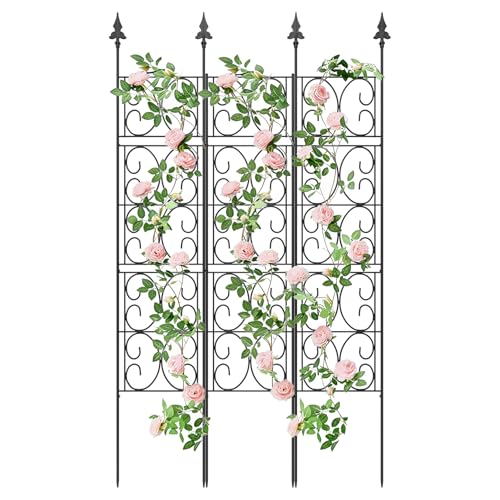



When you need a trellis that handles real roses rather than lightweight annual vines, the Trellume Garden Arch delivers on every front. At 94.5 inches tall and 55 inches wide, this arch gives mature climbing roses the vertical and lateral space they genuinely need to sprawl, bloom, and create that full overhead canopy effect that makes garden arches so visually dramatic. The premium steel construction with rust-proof coating means you are buying something designed to outlast multiple growing seasons without the flaking and oxidation that plagues cheaper alternatives.
What sets this arch apart from similarly priced options is the combination of structural integrity and sheer scale. The wide 55-inch span accommodates double planting — roses on both sides trained to meet overhead — which is the approach serious rose gardeners recommend for the most spectacular flowering displays. The rust-proof coating is applied uniformly, covering welds and joints where lesser arches tend to fail first. Assembly is straightforward, and the ground stakes provide genuine stability rather than the superficial anchoring you get from models with shallow stake systems.
The multi-functional design also makes this arch usable for wedding backdrops and event decoration when the roses are not in season, which adds real-world versatility for homeowners who entertain outdoors. If you pair this with proper soil preparation — worm castings are an excellent amendment for feeding climbing roses without burning roots — you will see faster establishment and denser cane coverage. Worm castings for fertilizer is worth reading before you plant.
Pros:
Cons:
The Plow & Hearth Montebello Arbor has been a trusted name in garden structures for years, and the 2026 version remains one of the most aesthetically refined arches you can buy for climbing roses. Standing seven feet tall, it hits the sweet spot for residential gardens: tall enough to create genuine drama and allow mature canes to arch overhead, but proportionate enough that it does not visually overwhelm a standard backyard or cottage garden setting. The intricate scroll-worked steel lattice provides dense anchor points for rose canes without requiring you to add separate wire or string training systems.
What makes the Montebello particularly good for climbing roses specifically is the lattice density on the side panels. Roses need frequent tie-in points as new canes are trained laterally — the denser the grid, the easier it is to direct growth without long unsupported sections that droop and break. The overhead arch opening gives foliage room to form a natural canopy, and the whole structure benefits from rustproof stainless hardware and 7-inch ground stakes that resist lifting in wet soil conditions. One-person assembly is a genuine claim here, not marketing copy — the included tools and clear instructions make setup realistic in under an hour.
This arbor works beautifully as a garden entryway or focal point even during winter when the roses are dormant. The decorative scroll design holds its own visual presence year-round, which is something more utilitarian grid panels simply cannot offer. The weatherproof construction handles repeated freeze-thaw cycles without degrading the finish.
Pros:
Cons:
If your roses are growing against a wall, fence, or raised bed rather than in open ground, the ArdeFentium panel is the trellis you want. The construction spec on this unit is genuinely impressive for a wall panel: an 8mm thick metal tube frame with 4mm solid metal mesh means there is real material here, not stamped sheet metal masquerading as structural support. The fully welded build eliminates the flex and joint creep that causes clip-together systems to loosen over time and eventually fail under the weight of mature rose canes.
The 60-inch height covers the vertical range where most wall-trained roses do their primary growing, and the 33.3-inch width is practical for confined spaces — between windows, along fence sections, or in narrow side yards where a full arch would be impractical. The screw-locked installation joints are a critical detail: unlike clip-on systems that rely on friction, screw joints maintain their clamping force regardless of thermal expansion cycles or plant movement. The powder-coated finish is smooth to the touch, which matters when you are tying in roses and pushing canes through openings without catching yourself on rough edges.
The modular design is the feature that serious gardeners will appreciate most. You can configure these panels straight, curved, folded, or as separate sections depending on your specific layout. That flexibility makes the ArdeFentium a genuinely useful long-term investment as your garden evolves rather than a single-configuration fixture you are stuck with permanently.
Pros:
Cons:
When you need multiple trellis panels without spending a premium on each one, the Giantex 2-Pack delivers solid value without cutting corners on the essentials. Each panel is 71 inches tall by 20 inches wide — taller than many competitors at this price point — and the two-panel set gives you 40 inches of combined width right out of the box. The deep bottom ends anchor securely into soil without requiring concrete, making these practical for gardeners who want to reposition panels as plants grow or as garden layouts change.
The heavy-duty metal frame with rust-protective coating handles outdoor conditions reliably across seasons. The interlocking panel system is the standout practical feature: you can connect additional panels purchased separately to extend coverage horizontally, building out a longer trellis run as your climbing roses expand. This expandability makes the Giantex set a smart starting point for new garden beds where you expect to add more coverage over the next few seasons. The no-dig installation protects existing roots while still providing the vertical structure climbing roses need.
At 71 inches tall, these panels capture adequate vertical space for the first several years of rose growth. They are not the right choice if you have established roses that have already reached their full cane height, but for new plantings or moderate climbers, the height is more than sufficient. The black coating provides a clean, unobtrusive background that makes flower color pop rather than compete visually.
Pros:
Cons:
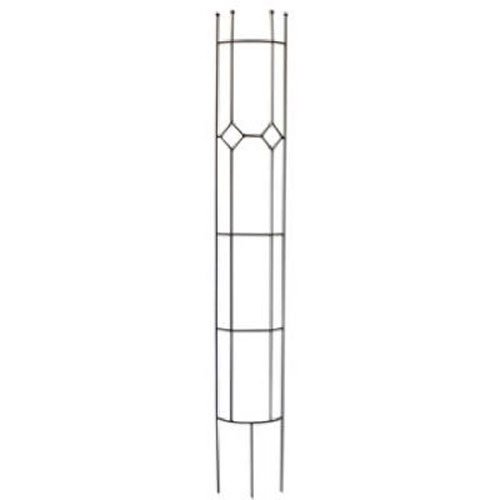
Not every garden situation calls for a full arch or a six-foot panel. If you are working with a container-grown climber, a smaller rose variety like a miniature climber, or a tight corner of a raised bed, the Panacea Semi-Round Trellis fills that niche with clean simplicity. At 72 inches tall and 10 inches deep with a semi-round profile, this trellis inserts directly into a pot or narrow soil strip and provides a compact climbing surface that keeps plants upright and trained without consuming significant lateral space.
The powder coating adds meaningful durability to what is essentially an accessible, affordable structure. For gardeners just starting with climbing roses, or for those who want to try a new variety in a container before committing to a permanent in-ground installation, this trellis delivers the essential function at a lower entry cost. The black finish is neutral enough to work with any planter or garden color scheme, and the semi-round shape provides a gently curved climbing surface rather than the flat grid of rectangular panels. If you are also selecting containers for your potted plants, our guide on the best pots for snake plant covers materials and drainage principles that apply equally well to climbing rose containers.
The tradeoff is straightforward: you are getting a functional, durable support structure, not a statement piece. The design is simple. The scale is modest. If your roses are in the ground and you want something architecturally interesting, look at the arches above. But if you need a reliable, affordable trellis for a container or compact planting, this is a completely solid choice.
Pros:
Cons:
The Deco 79 Metal Garden Arch stands at 95 inches tall — among the tallest options on this list — with a 44-inch width that suits most single-pathway installations. What makes this arch genuinely distinctive is the material and finish combination: solid welded iron with a black weathered patina finish that mimics aged, distressed ironwork. This is not a painted-over mild steel arch trying to look antique. The construction is solid iron with scroll detailing that gives it legitimate architectural presence in formal, cottage, and heritage-style gardens.
For climbing roses, the traditional ironwork aesthetic is a natural pairing — particularly with old garden rose varieties, David Austin roses, or heritage climbers whose flower forms and fragrance suit a classic garden setting. The scroll-designed construction provides ample tie-in points along both uprights and across the arch crown, giving rose canes plenty of structure to grip as they grow upward and over. The weathered black patina handles outdoor conditions well, developing character over time rather than looking progressively worse as cheaper finishes tend to do.
If you are creating a formal garden entrance or a period-appropriate garden room divider, this arch delivers an aesthetic that flat-panel trellises cannot match. The height — just under eight feet — creates genuine clearance for adults passing underneath even with full cane and bloom coverage arching overhead, which is the practical test that separates serious garden arches from decorative props.
Pros:
Cons:
If you need to cover a substantial stretch of fence line, create a continuous privacy screen of climbing roses, or frame multiple planting zones with consistent structure, the Garvee 4-Pack gives you the material to do it properly. Each panel is 75 inches tall by 22 inches wide — substantial height for mature climbing roses — and the four-panel set creates a combined 88 inches of width right out of the package. Position them together for one seamless support wall or spread them across different garden zones — the choice is yours and you are not locked into a single configuration.
The iron construction with rust-resistant black coating is built for the long term. Iron panels at this weight class handle the genuine structural demands of mature climbing roses better than aluminum or thin-gauge steel alternatives. At 75 inches tall, these panels clear the typical five-to-six-foot cane length that most climbing roses reach in their first two to three years, and the height leaves room for continued upward growth beyond that. The classic black finish provides a clean visual backdrop that emphasizes flower color rather than distracting from it.
The 4-pack configuration makes this particularly cost-effective for gardeners tackling a larger project — a full fence run, a garden room boundary, or a screening installation where you want rose coverage across a meaningful width. Combined with proper soil preparation and feeding, which you can learn more about in our guide on the best garden wind spinners and surrounding planting aesthetics, this setup creates a finished, professional-looking garden boundary.
Pros:
Cons:
Steel and iron dominate the trellis market, and for good reason — they handle the structural loads climbing roses impose far better than aluminum, wood, or plastic. But not all steel and iron products are equal. Look for powder-coated or rust-proof coated finishes applied uniformly, including at welds and joints, which is where corrosion starts on cheaper units. Powder coating creates a thicker, more adhesive layer than spray paint, and the best products include this on internal surfaces of hollow tubing as well as external faces. If you are in a high-rainfall region or your trellis will be in contact with consistently moist soil, prioritize models that specifically call out rust-proof coating on all hardware, including stakes and fasteners, not just the main frame.
Welded construction is meaningfully superior to clip-together or bolt-together assembly for long-term use. Welded frames distribute load across the entire structure rather than concentrating stress at joint points. For climbing roses specifically — which can develop canes as thick as a finger and exert significant lateral force in wind — welded frames simply hold up better over a five-to-ten year horizon.
Climbing roses vary enormously in mature size. Compact pillar roses may top out at six or eight feet with lateral spread of two to three feet. Vigorous rambling varieties like 'Veilchenblau' or 'American Pillar' can reach 15 to 20 feet with lateral canes extending eight feet or more. Match your trellis height to the mature size of your specific variety, not the size of your plant at planting time. A 71-inch panel that looks generous for a young rose will be inadequate in three seasons if the variety is a strong grower.
Width matters just as much as height for arches specifically. An arch narrower than 40 inches forces you to choose between single-side planting or canes that meet too low in the arch to create proper coverage. The Trellume arch at 55 inches wide and the Deco 79 at 44 inches represent the practical range for effective double-sided rose arches. For flat panels, calculate the total run you need to cover and select accordingly — it is generally better to slightly overestimate panel count than to have gaps in coverage that roses cannot bridge.
A trellis loaded with mature rose canes in full bloom acts like a sail in wind. The leverage on ground-anchored stakes is substantial, and undersized stakes — anything shorter than six inches — will work loose in even moderately soft soil. Prioritize models with stakes of seven inches or longer, and consider additionally securing freestanding arches with concrete collars or landscape ties for exposed, wind-prone locations.
For wall-mounted or fence-mounted panels like the ArdeFentium, anchoring quality shifts to the fastener system. Screw-locked joints that tighten mechanically are categorically more reliable than clip or friction-fit connections. Ensure the panel hardware included supports the weight of the panel plus the eventual plant load — lightweight panel hardware is often the weak point on otherwise solid structures.
Function matters most, but you will live with this structure year-round including the months when roses are dormant. An ornate ironwork arch like the Deco 79 or the Plow & Hearth Montebello brings significant decorative value to traditional and cottage garden settings even without foliage coverage. A clean grid panel like the Giantex or Garvee works better in contemporary or kitchen-garden settings where minimal visual clutter is the goal. Think about what the trellis looks like in January, not just in June when it is covered in blooms, and choose the design that works for your garden's overall character across all seasons.
Metal arches and panels with dense tie-in points are best for climbing roses. You need a structure that provides multiple anchoring spots along its length so you can train canes horizontally — horizontal cane training produces significantly more blooms per season than vertical growth alone. Welded steel or iron with rust-proof coating and stakes of at least six to seven inches performs best over a multi-year horizon. Arches work well for pathway or focal-point installations; flat panels suit wall, fence, and boundary planting.
At minimum, choose a trellis that matches the mature height of your specific rose variety plus 12 to 18 inches of clearance. Most climbing roses reach six to ten feet, so a 71-to-95-inch trellis covers the majority of garden varieties comfortably. For vigorous ramblers or climbers on an arch where you want walkway clearance, prioritize structures at 90 inches or taller. The Trellume arch at 94.5 inches and the Deco 79 at 95 inches hit this benchmark with room to spare.
Use soft garden ties, jute twine, or purpose-made rose clips to secure canes to trellis wires or bars. Never use wire directly against canes — it cuts into the bark as the cane thickens. Tie loosely enough to allow movement and growth. For arches, train the main canes in a spiral around the uprights rather than straight up, which encourages lateral bud break and dramatically increases bloom count. Retie and adjust throughout the growing season as new growth extends.
Yes, provided the trellis has proper rust-resistant coating. All the arches and panels on this list are rated for year-round outdoor use. In regions with severe winters, check that ground stakes are seated firmly before freeze-up so frost heave does not shift the structure. Avoid leaning heavy snow loads against trellis panels by gently brushing accumulated snow off rose canes and trellis surfaces after heavy snowfall. A properly coated metal trellis should last ten or more years outdoors without structural failure.
Measure your total run, then divide by the individual panel width of your chosen product. Add 10 to 15 percent for overlap connections if the panels interlock. For example, covering a 10-foot fence line with 22-inch Garvee panels requires six panels with slight spacing between them. For a continuous visual effect with no gaps, account for the full coverage width and consider buying one extra panel to allow repositioning as the planting matures. Starting with a 4-pack like the Garvee set is cost-effective for runs of seven feet or longer.
A garden arch is a three-dimensional freestanding structure you walk through or plant on either side of, creating an overhead canopy of coverage. A trellis is a flat or slightly angled panel that provides a climbing surface along a wall, fence, or as a freestanding screen. Arches create dramatic focal points and pathway features; trellises are more functional for boundary planting, privacy screening, and wall-trained roses. Both support climbing roses effectively — the choice depends on your garden layout and the visual effect you want to create in 2026 and beyond.
 |
 |
 |
 |

About Truman Perkins
Truman Perkins is a Detroit-based SEO consultant who's been in the business for over a decade. He got his start helping friends and clients get their websites off the ground, and he continues to do so today. In his free time, Truman enjoys learning and writing about gardening - something he believes is a natural stress reliever. He lives with his wife, Jenny, and their twins in Detroit.


Get new FREE Gifts. Or latest free growing e-books from our latest works.
Disable Ad block to reveal all the links. Once done, hit a button below
|
|
|
|
 rinjal