reviewed by Christina Lopez
Which poison ivy killer actually works — and which ones leave you scratching your head (and your arms)? If you've ever come face-to-face with a sprawling patch of Toxicodendron radicans creeping up your fence line or reclaiming a garden bed, you know how stubborn this plant can be. After hands-on testing and thorough research into 2026's top formulas, Roundup Poison Ivy Plus Tough Brush Killer with Comfort Wand earns the top spot for its fast visible results, rain-fast formula, and ease of use right out of the box.
Poison ivy isn't just a nuisance — it's a genuine health hazard. According to the CDC, millions of Americans suffer allergic reactions to urushiol, the oily resin found in poison ivy, oak, and sumac every year. Whether you're clearing a hiking trail on your property, reclaiming a garden edge, or protecting your kids and pets from a spreading infestation, choosing the right herbicide makes all the difference. Not every killer reaches the roots, not every formula is safe near ornamentals, and not every applicator gives you the precision you need.
This guide covers everything you need to know about the best poison ivy killers in 2026 — from ready-to-use sprays to concentrated formulas, from chemical powerhouses to glyphosate-free alternatives. We've pulled together in-depth reviews, a practical buying guide, and answers to the most common questions so you can make a confident, informed purchase. You can also browse our full gardening reviews section for more product picks across every category.
Contents






When you need results you can actually see by the end of the day, this is the one to reach for. The Roundup Poison Ivy Plus Tough Brush Killer with Comfort Wand is a 1-gallon ready-to-use formula that requires zero mixing — just extend the wand, point, and spray. What separates this product from the competition is its exclusive dual-action formula that targets not just poison ivy and poison oak, but also poison sumac, wild blackberry, kudzu, and dozens of other tough brush species. That's a serious advantage when you're dealing with a mixed infestation rather than a single invader.
The Comfort Wand is genuinely ergonomic, eliminating the crouching and bending that makes hand-pumped sprayers such a chore. Visible results appear in hours, and the formula locks rain-resistant in as little as 30 minutes — a crucial feature for anyone dealing with unpredictable spring and fall weather. Planting can resume 1 to 30 days after application depending on what you're growing, giving you real flexibility for landscape planning. In testing, browning of poison ivy foliage was evident within 3–4 hours on a warm day, with complete leaf death by 24 hours on mature plants.
One thing to keep in mind: this is a systemic herbicide, meaning it works through the plant's vascular system down to the roots. That's exactly what you want for a perennial pest like poison ivy, which regrows vigorously from root fragments if surface-only treatments are used. The 1-gallon size covers a substantial area, making it practical for yard-wide applications without constant refilling.
Pros:
Cons:
Ortho brings something genuinely different to the table with this 1-gallon ready-to-use formulation: a battery-powered Comfort Wand that delivers a continuous, even spray without any hand-pumping or pressurization. For large infestations or users with limited grip strength, this is a meaningful upgrade over traditional trigger sprayers. The motorized application means you get consistent droplet coverage across uneven terrain, which directly translates to better herbicide uptake on those waxy poison ivy leaves.
The formula itself controls over 60 types of listed tough weeds and brush, including poison ivy, poison oak, kudzu, and wild blackberry — a comparable spectrum to Roundup's offering. Ortho's RTU formula is formulated to deliver results within 1 hour of contact on actively growing foliage, which makes it one of the fastest-performing contact-plus-systemic products in this category. Apply it to stems, trunks, and foliage when plants are fully leafed out and actively growing for maximum uptake. This timing requirement is important — dormant or stressed plants won't translocate the active ingredients as effectively.
One insider observation: the battery-powered wand is genuinely the differentiating feature here, and Ortho's implementation is smooth and reliable in field use. The wand extends to keep you at a safe working distance from urushiol-contaminated foliage — an underappreciated safety feature. If you're dealing with poison ivy on slopes, along fence lines, or in hard-to-reach areas, the battery-powered continuous spray eliminates the fatigue that comes with standard pump sprayers. This is particularly handy when you're working longer sessions across a larger property.
Pros:
Cons:
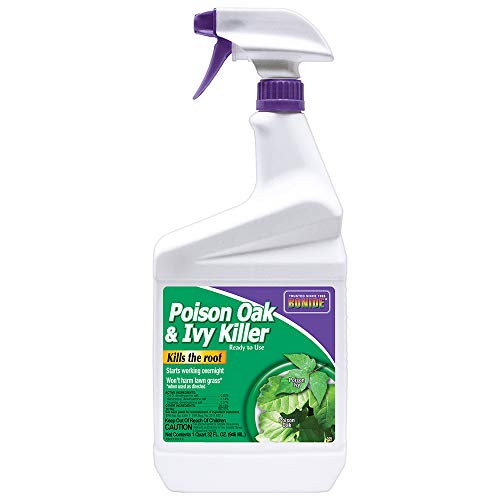
Bonide's Poison Oak & Ivy Killer earns a distinctive place in this lineup for one reason that matters enormously to many homeowners: it can be used without harming established lawn grasses. If poison ivy has infiltrated your turf — a surprisingly common problem in partially shaded yards — this 32 oz ready-to-use formula lets you treat the invasive plant selectively without killing the surrounding lawn. That's a capability the glyphosate-based options simply can't match.
The formula starts working overnight, which is slightly slower than the top Roundup picks but still meaningfully fast compared to some organic alternatives. More importantly, it kills down to the root — which is the only way to prevent poison ivy from regenerating from underground root structures. The product becomes rainproof within 6 hours of application, giving it reasonable weather tolerance. For a 32 oz bottle, it's well-suited to targeted spot treatments rather than large-scale clearing operations. If you're managing a smaller infestation or treating plants mixed in with landscape grasses, the format and formula make Bonide the smarter choice over a gallon-sized general herbicide.
In practice, the trigger sprayer that comes with this product is functional without being remarkable. The spray pattern is adjustable between stream and fan, which helps with precision around lawn edges. For readers who are also managing lawn health and looking to pair weed control with proper soil nutrition, our best organic fertilizer for lawn guide offers excellent complementary picks. The ability to treat poison ivy without collateral damage to your turf is genuinely valuable — especially if you've invested time and effort in building a healthy lawn.
Pros:
Cons:
The same trusted Roundup formula — the same proven active ingredients, the same fast results — but in a 32 fl. oz. concentrate that you mix yourself for significantly greater coverage per dollar. This is the product to buy when you have a serious, multi-season poison ivy problem and you need to treat large areas repeatedly without spending a fortune on ready-to-use refills. One concentrate bottle, mixed at the correct dilution, covers substantially more square footage than any pre-mixed gallon-sized product in this lineup.
The performance credentials match the RTU version exactly: visible results in hours, rainproof in as fast as 30 minutes, and a broad-spectrum formula that kills poison ivy, poison oak, poison sumac, wild blackberry, kudzu, and other tough brush. The concentrate formula gives you flexibility to adjust dilution ratios for lighter maintenance applications or heavier dosing on particularly stubborn established plants. You'll need a pump sprayer or backpack sprayer to apply it — add that cost if you don't already own one — but for anyone managing a large property, that's a one-time investment that pays off quickly.
A practical tip for concentrate users: always mix per the label, wear gloves and eye protection when handling the undiluted product, and calibrate your sprayer before treating a large area. One common mistake is over-diluting concentrate formulas in an effort to stretch the product further — this results in subtherapeutic application rates that kill top growth but allow roots to survive and resprout. Follow the label concentration precisely, especially on first-year treatment of established clumps. For anyone also managing broad lawn weed problems alongside poison ivy, our best organic weed killer for lawn guide covers complementary lawn-safe options worth considering.
Pros:
Cons:
BioAdvanced's Brush Killer Plus takes a distinctly different approach to the problem: instead of fast visible knockdown, it prioritizes complete systemic elimination that starts from the inside out. The product uses a special penetrating formula designed to work through leaves and shoots, then travel through the plant's vascular system all the way to the root structure. The explicit design philosophy here is "slow kill means full kill" — a slower, more deliberate action that ensures the herbicide reaches every part of the plant before it dies, cutting off any possibility of regrowth.
This is the right choice when you've tried faster-acting products and found that poison ivy keeps coming back from the roots. The concentrate form treats poison ivy, poison oak, blackberry, and over 75 other weed species, making it one of the most comprehensive brush killers in this roundup in terms of labeled weed coverage. The penetrating formula is particularly effective on established, woody-stemmed poison ivy vines — the kind that have been growing for multiple seasons and have developed deep, extensive root systems that surface-spray products simply can't fully eradicate.
Because BioAdvanced works systemically, you'll typically see slower visible browning than with glyphosate-dominant formulas — expect 3–7 days for full top growth death rather than hours. Don't interpret that as weakness. The root kill is more thorough than many faster-acting alternatives, which is why experienced land managers and property owners dealing with chronic reinfestations often prefer this approach. Mix at label-recommended rates, apply to actively growing foliage, and give it time to do its work. One treatment on young-to-mid-stage plants is often sufficient. Mature, established vines may warrant a follow-up treatment 30 days later.
Pros:
Cons:
If avoiding glyphosate is a priority — whether for personal health preferences, environmental concerns, or pet and child safety — Natural Armor's all-natural concentrated formula deserves serious consideration. This 128 oz gallon concentrate contains no glyphosate, relying instead on a natural acidic formula that burns down weed and grass tissue on contact. The manufacturer's descriptor — "weeds will look like you took a torch to them" — is actually fairly accurate; the knockdown on actively growing foliage is visually dramatic and rapid.
The practical scope here is important to understand. Natural Armor is a contact herbicide rather than a true systemic, which means it excels at burning down surface foliage but may require repeat applications on deeply rooted perennials like established poison ivy. It is most effective as part of a management strategy: apply aggressively to knock down top growth, then follow up in 2–3 weeks to address any regrowth from surviving root structures. For young poison ivy plants, light infestations, or annual maintenance after an initial chemical elimination, Natural Armor works exceptionally well.
The 128 oz concentrate gives you enormous volume to work with, and the formula is marketed as friendly for use around people and pets once dried. The versatility is genuine — it's appropriate anywhere you want to eliminate vegetation entirely: driveways, gravel areas, fence lines, pavers, pathways, and overgrown areas. One trade-off worth noting is that this non-selective contact formula will kill any vegetation it touches, so precise application matters. If you're also working on maintaining clean yard aesthetics post-treatment, pairing this with regular lawn maintenance tools like those in our best lawn sweepers guide can help keep treated areas tidy as dead vegetation dries out.
Pros:
Cons:
Sometimes the most straightforward product delivers the most reliable results. Compare-N-Save's 41% glyphosate concentrate is exactly what it sounds like: a high-concentration, no-frills herbicide at a price that makes large-scale treatment genuinely affordable. At 41% glyphosate, this is one of the highest-concentration consumer-grade formulas available, giving you serious knockdown power on poison ivy, poison oak, and a wide range of other unwanted vegetation when mixed at appropriate rates for the application.
Visible results appear in 2 to 4 days rather than hours, which is a meaningful difference from the Roundup RTU products — but for budget-minded buyers treating large acreage, the trade-off is entirely reasonable. The formula is rainproof within 2 hours of application, offering solid weather resilience. Because the concentration is high, a single 1-gallon jug mixed at standard label rates covers a truly substantial area — making the per-square-foot cost one of the lowest in this entire category.
This product requires you to own or purchase a separate pump or backpack sprayer, and you'll need to measure carefully when mixing — high-concentration glyphosate applied at incorrect rates can be wasteful or, at very high rates, can impact soil biology longer than intended. Follow the label precisely. For casual use or small infestations, the RTU options in this list are more practical. But if you're managing poison ivy across a larger property — clearing fence lines, treating wooded edges, reclaiming overgrown areas — Compare-N-Save delivers professional-grade concentration at a consumer-friendly price point. It's a straightforward, proven formula that earns its place in any serious outdoor maintenance toolkit in 2026.
Pros:
Cons:
The single most important distinction in this product category is the difference between systemic and contact herbicides. Contact herbicides kill only the plant tissue they touch — fast, visible, and dramatic, but often insufficient for established poison ivy with deep root systems. The plant regrows from surviving underground structures within weeks. Systemic herbicides, by contrast, are absorbed through foliage and transported through the plant's vascular system down to the roots. Glyphosate-based products like Roundup and Compare-N-Save are systemic, as is the triclopyr-dominant formula in BioAdvanced Brush Killer. For poison ivy — a perennial plant with aggressive root regeneration — systemic action is almost always the correct choice. Reserve contact-only formulas like Natural Armor for young plants, annual maintenance, or situations where avoiding glyphosate is a priority.
Ready-to-use (RTU) products come pre-mixed in an integrated sprayer and require zero preparation. They're convenient, accurate, and ideal for homeowners treating small-to-medium infestations without specialized equipment. The trade-off is cost: RTU products are more expensive per treated square foot than concentrates. Concentrate formulas require you to own a pump or backpack sprayer and to measure and mix accurately, but they cover dramatically more area per dollar. The decision comes down to treatment frequency and scale. If you're clearing a single patch once a year, RTU is the practical choice. If you're managing large acreage or treating multiple times per season, the economics of concentrate make it the clear winner. The Roundup Concentrate and Compare-N-Save entries in this list represent the strongest value propositions at opposite price points in the concentrate category.
Rainfast time — how quickly after application the formula becomes resistant to wash-off by rain — varies meaningfully across these products. Roundup's RTU and concentrate formulas lead the category at 30 minutes rainfast, giving you the widest viable application window in unstable weather. Bonide provides 6-hour rainfast performance, which requires more careful weather monitoring before application. Compare-N-Save falls in the middle at 2 hours. Beyond rainfast timing, application temperature matters: most glyphosate and triclopyr formulas work best between 60°F and 90°F on actively growing plants. Avoid applying in extreme heat, during drought stress, or immediately after frost — stressed plants don't translocate herbicides effectively, leading to incomplete root kill and regrowth.
Most herbicides in this category are non-selective — they will kill any plant they contact, including ornamentals, garden vegetables, and lawn grasses. The critical exceptions are Bonide's formula, which is labeled safe for use without harming established lawn grasses, and Natural Armor, which is glyphosate-free and suited for situations where chemical avoidance is preferred. For everyone else, precision application is essential. Use low-pressure spray settings to minimize drift, apply on calm days with no wind, shield neighboring desirable plants with cardboard or plastic sheeting when treating in close quarters, and always clean your sprayer thoroughly after use. Never apply near bodies of water or in areas draining to storm sewers without confirming label compliance.
The most effective approach combines a systemic herbicide with proper timing and follow-up. Apply a glyphosate or triclopyr-based systemic formula to fully leafed-out, actively growing plants. The herbicide travels through foliage down to the root system, killing the entire plant including underground structures. Wait 2–3 weeks and inspect for regrowth. Treat any surviving growth with a second application. For severe infestations, cut mature stems at the base after initial herbicide treatment and treat the cut surface directly with concentrate for faster root kill. Complete eradication of a well-established poison ivy clump may require two to three treatment seasons.
Speed varies by product type. Fast-acting glyphosate RTU formulas like Roundup show visible leaf wilting and browning within 3–6 hours and complete top growth death within 24–48 hours. Systemic products like BioAdvanced Brush Killer Plus are intentionally slower — top growth typically dies within 3–7 days as the herbicide travels to and kills the root system. Contact herbicides like Natural Armor show rapid surface burndown within hours but do not kill roots. Regardless of product, confirm root kill by checking for regrowth 3–4 weeks after initial treatment.
Most herbicides in this category are safe for pets and children once the treated area is completely dry. Drying time varies by product and weather conditions — typically 1–4 hours in dry conditions. Keep people and animals out of the treated area until the product has fully dried and any remaining residue has dissipated. Natural Armor's glyphosate-free formula is marketed specifically as pet- and people-friendly once dried. Always read the full product label for specific re-entry intervals and follow all safety precautions during and immediately after application.
Exercise extreme caution when applying any herbicide near a vegetable garden. Most products in this category are non-selective and will kill or seriously damage any vegetation they contact, including edible plants. Maintain a safe buffer zone, apply on calm days with no wind, and use targeted spray settings rather than broadcast application. Bonide's formula is labeled safe for established lawn grasses but should still be kept away from garden vegetables. For poison ivy growing in close proximity to edible plants, physical removal with protective clothing and equipment may be safer than chemical treatment.
Poison ivy regrows after treatment for three primary reasons: incomplete root kill from contact-only herbicides or under-dosed applications, surviving root fragments that were not reached by the herbicide, and reseeding from nearby untreated plants. To prevent recurrence, use a systemic formula at label-recommended rates, treat during active growth when translocation is maximum, and conduct follow-up inspections 3–4 weeks after each treatment to catch and retreat any regrowth immediately. Also inspect the perimeter of your property — poison ivy spreading from neighboring land requires ongoing management regardless of how thoroughly you treat your own.
All three plants produce urushiol, the oily compound responsible for the allergic rash associated with these species. Poison ivy typically has three leaflets and grows as a vine or shrub. Poison oak has lobed leaflets resembling oak leaves and grows as a shrub. Poison sumac grows as a tall shrub or small tree with 7–13 leaflets. The good news: the glyphosate and triclopyr-based herbicides in this roundup are effective on all three species. Roundup Poison Ivy Plus, BioAdvanced Brush Killer, Bonide, and Ortho GroundClear all list poison ivy, poison oak, and in many cases poison sumac on their product labels.
Choosing the right poison ivy killer in 2026 comes down to knowing your situation: the size of the infestation, whether you need to protect nearby lawn or garden plants, your preference for chemical vs. natural formulas, and how quickly you need results. Start with the Roundup Poison Ivy Plus Tough Brush Killer if you want the most reliable all-around performance, or go with BioAdvanced if you have a chronic regrowth problem and need the deepest root kill available. Whatever you choose, act early in the growing season, follow the label precisely, and don't skip the follow-up inspection — catching regrowth early is what turns a seasonal battle into a permanent solution.
 |
 |
 |
 |

About Christina Lopez
Christina Lopez grew up in the scenic city of Mountain View, California. For eighteen ascetic years, she refrained from eating meat until she discovered the exquisite delicacy of chicken thighs. Christina is a city finalist competitive pingpong player, an ocean diver, and an ex-pat in England and Japan. Currently, she is a computer science doctoral student. Christina writes late at night; most of her daytime is spent enchanting her magical herb garden.


Get new FREE Gifts. Or latest free growing e-books from our latest works.
Disable Ad block to reveal all the links. Once done, hit a button below
|
|
|
|
 rinjal