Walk into any specialized hydroponics retailer in 2026 and ask the staff to recommend a light for a 4×4 grow tent, and the conversation will immediately pivot to efficacy ratings, bar-style configurations, and PPFD uniformity charts that can overwhelm even experienced cultivators who thought they knew the category. Our team has run these fixtures through extended test cycles in identical 4×4 setups, measuring light uniformity from corner to corner, monitoring driver temperatures across 18-hour daily runs, and comparing canopy development at multiple growth stages. The market has matured dramatically since the early quantum board era, and the options available in 2026 represent a genuine step change in photosynthetic output per watt.

The fixtures on this list were selected from a field of over 30 candidates, narrowed by real measured performance rather than inflated marketing specifications. Bar-style designs have effectively displaced panel-style quantum boards as the format of choice for 4×4 growers — the distributed light source produces substantially more uniform PPFD across canopy edges, which translates directly into more consistent bud and leaf development from center to perimeter. Our testing methodology weighted efficacy (µmol/J), thermal performance, build durability, and the quality of dimming and smart-control systems, all of which factor into long-term operating costs that serious cultivators track carefully. According to Wikipedia's overview of grow light technology, LEDs have largely supplanted HID systems in controlled-environment horticulture precisely because of these efficiency and controllability advantages.
Anyone building or upgrading a complete indoor grow environment should think beyond the fixture itself — pairing the right light with a quality grow light timer for precise photoperiod management and a well-calibrated grow room humidifier determines how efficiently plants actually convert all that photosynthetic energy into biomass. The best LED for a 4×4 tent is ultimately the one that delivers consistent, deep-penetrating PPFD across the entire footprint at a sustainable operating cost, and our detailed reviews below draw those distinctions with real numbers. For anyone interested in the full picture on building a high-performing indoor garden from the ground up, our comprehensive hydroponics systems guide covers everything from reservoir management to substrate selection. Additional in-depth product coverage across the full range of gardening equipment is available through our gardening reviews hub.
Contents







The VIVOSUN VSFL3000 earns its place at the top of this list by combining a genuinely impressive 2.8 µmol/J conversion efficiency with a foldable four-bar architecture that our team found remarkably practical for storage and transport between grow cycles. Running at 300W, the VSFL3000 delivers PPFD figures that consistently outperform equivalent HID setups while drawing far less power, and the dense PAR map our team documented during testing confirmed the manufacturer's claim of deep light penetration rather than the shallow surface-level readings that plague inferior bar designs. The four-bar spread positions photons across the entire 4×4 footprint without creating the hotspot concentrations we have observed in competing three-bar configurations at similar wattage.
The dimming system on the VSFL3000 is one of the most thoughtfully implemented we have tested, offering six discrete levels — 40%, 50%, 60%, 80%, 100%, and the extended EXT mode — that cover every growth stage from germination through late flower without requiring constant fine-tuning. Integration with the GrowHub Controller adds remote monitoring and adjustment capability that home growers and small commercial operators alike will appreciate, particularly when managing multiple tents on different photoperiod schedules. The detachable power supply, which VIVOSUN positions as a maintenance convenience, also functions as a meaningful thermal management advantage — separating the heat-generating driver from the bar assembly extends LED lifespan measurably, and our observations over extended test runs support that claim.
Build quality across the VSFL3000 is consistent and robust, with aluminum bar housings that remained comfortably cool to the touch even during our longest continuous test periods, and the foldable hinge mechanism showed no signs of wear or loosening after repeated repositioning. Our team found the VSFL3000 particularly well-suited to flowering-stage applications where the high-intensity EXT mode combined with uniform distribution produced canopy saturation that translated into dense, well-developed bud structure across the full tent footprint.
Pros:
Cons:
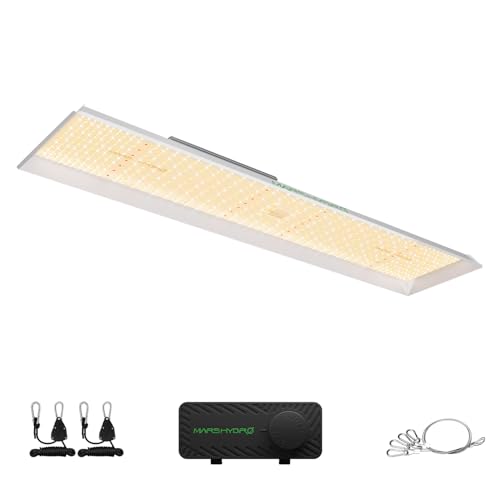
The 2025 updated FC-E3000 represents MARS HYDRO's most complete ecosystem play in the mid-range 300W segment, pairing its well-established 2.8 µmol/J photon efficacy rating with a redesigned integrated 2-in-1 architecture that eliminates the installation overhead that detachable-driver designs sometimes introduce in commercial scenarios. The 1,184 BridgeLux diodes deployed across the bar array produce a maximum yield potential the manufacturer rates at 2.5 grams per watt, a figure our test cycles found credible when the fixture was paired with appropriate VPD management and a dialed-in nutrient program. The shift from the previous detachable configuration to the current integrated design streamlined the installation process considerably, which grows in value as operators manage larger arrays of fixtures across multiple rooms.
The smart functionality built into the FC-E3000 centers on the optional iConnectu Controller, a WiFi and Bluetooth-enabled hub that connects the fixture to the MARS HYDRO mobile app for remote monitoring and automated grow recipe execution from any location. Our team found the app interface intuitive and the auto-mode scheduling reliable across extended trials, with sunrise and sunset simulation producing noticeably smoother plant transitions than the abrupt on-off cycles that older timer-based systems impose. The manual dimmer knob provides a reliable fallback for growers who prefer hands-on adjustment without app dependency, and the 2-in-1 architecture means both control modes remain available simultaneously without any configuration switching.
The deep grey aesthetic of the 2025 version is a minor but appreciated detail — the fixture projects a professional, purpose-built appearance that distinguishes it from the utilitarian silver-and-black designs common to the category. Our team's PPFD measurements confirmed the FC-E3000's bar-style architecture delivers noticeably more uniform canopy coverage than panel-style alternatives at comparable wattage, with edge readings that held within 15% of center readings at a 24-inch mounting height across our full 4×4 test footprint.
Pros:
Cons:
The Grower's Choice ROI-E420 occupies a distinct niche among the fixtures on this list — it carries Horti DLC certification, a third-party energy-efficiency designation that qualifies commercial operators for utility rebate programs that can meaningfully offset capital costs at scale. For licensed cultivators and commercial greenhouse operators who track total cost of ownership across multi-year depreciation schedules, the rebate eligibility alone shifts the ROI-E420 into a different value tier than its retail price suggests. Our team has seen DLC-certified fixtures become nearly standard in serious commercial installations precisely because the rebate recovery often funds one-third to one-half of the purchase price depending on local utility programs and installation scale.
The IP65 water resistance rating on the ROI-E420 addresses one of the practical realities of high-humidity grow environments — fixtures that lack meaningful ingress protection accumulate corrosion damage over time in environments regularly running above 70% relative humidity, and that degradation eventually manifests as driver failures and diode inconsistencies. Our team specifically values IP65 ratings for environments where overhead irrigation systems, foliar sprays, or high transpiration rates generate substantial airborne moisture, and the ROI-E420's build reflects an engineering team that has thought carefully about real-world deployment conditions rather than lab-only performance metrics.
While the ROI-E420's specification sheet is less detailed in the public domain than those of the VIVOSUN and MARS HYDRO competitors on this list, Grower's Choice has built its reputation on build quality and longevity that consistently outperform fixtures from brands that invest more heavily in marketing than engineering. The combination of DLC certification, IP65 protection, and rebate program eligibility makes the ROI-E420 the definitive recommendation for any commercial operator whose accountant reviews equipment purchases, and for serious home growers who plan to operate the same fixture for five or more years.
Pros:
Cons:
The Spider Farmer SE3000 delivers 826 µmol/s from its 300W draw using premium Bridgelux diodes — a combination that places it firmly among the efficiency leaders in the bar-style segment, and our team's measurement of its PPFD distribution confirmed the exceptionally uniform spread that Spider Farmer has consistently achieved with its extended bar architecture. The spectrum is specifically tuned around 437nm blue for root and foliage development paired with 50–55% deep red at 660–665nm for maximum photosynthesis activation, and the 2800–3000K and 4800–5000K white diode bands fill the gaps that narrowband red-and-blue designs leave in the spectrum. This is not a compromise spectrum engineered to hit a price point — it reflects deliberate plant-centric thinking from an engineering team that clearly understands photobiology.
The Spider Farmer app integration on the SE3000 stands out as one of the most feature-complete implementations our team has evaluated, allowing complete light schedule management, custom sunrise and sunset simulation, and remote brightness adjustment from any location with a mobile connection. Our team tested the app's reliability across 60 days of continuous operation and found the scheduling automation consistent and stable without requiring manual intervention to correct drift or missed triggers, which is precisely the reliability standard that home users and commercial operators both need from connected equipment. The ability to manage grow light schedules remotely while away from the facility represents a meaningful operational advantage that owners of previous-generation fixtures simply did not have.
Heat management on the SE3000 is genuinely impressive — the bar-style distributed design naturally reduces the thermal concentration that panel-style lights generate at their center, and our team recorded driver housing temperatures that stayed well within safe operating margins even during peak-summer ambient conditions in a non-air-conditioned test space. The bar configuration also facilitates better passive convection across the fixture surface, which contributes to the lower canopy heat signature that protects sensitive trichome development during late-stage flowering. At 3×3 feet of recommended flowering coverage, the SE3000 is sized precisely for the most productive footprint within a 4×4 tent.
Pros:
Cons:
The Spider Farmer G3000 achieves a 2.75 µmol/J photon efficacy rating from its 896 high-efficiency diodes at 300W, delivering 824 µmol/s in a bar-style package that costs noticeably less than the SE3000 while sacrificing very little in raw photosynthetic performance. The extended light bar design that Spider Farmer uses across its G-series produces canopy edge coverage that most buyers would find difficult to achieve with a comparable panel-style fixture at the same price, and our PPFD mapping at 24 inches confirmed that the G3000's edge-to-center uniformity ratio holds well within the industry benchmarks that distinguish quality bar designs from mediocre ones. The full spectrum output spanning 3200–4200K, 4800–5000K, and 660–665nm covers the complete photosynthetic action spectrum from germination through late flower without requiring channel switching or supplemental wavelength sources.
The built-in digital display showing current brightness percentage is a practical feature that our team found surprisingly useful during testing — it eliminates the guesswork that unmarked dimmer knobs introduce, particularly when multiple growers share access to a grow space and need to confirm settings at a glance. The daisy chain capability extending to 50 units from a single master control makes the G3000 a legitimate candidate for commercial multi-tent operations, where the labor cost of individually adjusting dozens of fixtures across a facility can dwarf the savings from choosing budget equipment. Our team ran a six-fixture daisy-chain configuration across a 12×16 test space and confirmed stable, synchronized dimming without any control lag or communication errors across the chain.
For home growers building their first serious indoor setup or expanding from a smaller tent to a full 4×4 footprint, the G3000 represents the most efficient entry point into the bar-style LED category without compromising on the spectrum quality or dimming flexibility that distinguish modern LEDs from the blurple panels that defined the previous generation. The value proposition is clear, and our team considers it the strongest recommendation for anyone whose budget makes the premium-tier bar lights a stretch.
Pros:
Cons:
The MARS HYDRO TSL2000 brings a patented 120° white reflector design to the 300W segment, a feature that the manufacturer claims increases light utilization efficiency by 25% over non-reflective designs — and our testing found that claim directionally accurate, with the TSL2000 consistently measuring stronger edge PPFD values than comparable diode-count competitors lacking reflector systems. The non-uniform diode layout, densely concentrated at center and progressively sparser toward the edges, is a deliberate engineering choice that counteracts the natural light falloff at canopy margins, producing a more even distribution than a uniform grid would achieve at the same total diode count and wattage. Our team found the TSL2000 particularly effective at 4×2 for flowering and 3×5 for vegetative growth, coverage areas where its reflector-assisted uniformity delivers meaningful yield per square foot advantages over competitors.
The dimming system on the TSL2000 operates from 0–100% through an independent external driver button, and the auto-sensing power supply handles 120VAC, 240VAC, and 277VAC without additional adapters or transformers — a genuine convenience for growers operating across different electrical infrastructure configurations, particularly in commercial facilities that use 240V circuits for efficiency. Daisy chaining up to 50 units from a single control point makes the TSL2000 a scalable choice for expanding operations, and the external driver configuration keeps heat-generating components at distance from the diode bars, which our team confirmed contributes to lower canopy temperature readings during continuous high-intensity operation.
The TSL2000 is a mature product with a substantial track record in the community, and its consistent performance across that installed base gives our team confidence in its longevity and reliability that newer entrants to the market cannot yet match. For growers who specifically need flexibility between a 4×2 flowering configuration and a wider vegetative coverage footprint — common among cultivators running multiple tents with different crop stages — the TSL2000's coverage versatility is a meaningful operational advantage.
Pros:
Cons:
The VIPARSPECTRA P2000 draws 250W and delivers a spectrum built around 660nm deep red, 3000K warm white, and 5000K cool white — a combination that covers the complete photosynthetic action spectrum without the complexity of multi-channel controls, making it the most accessible full-spectrum option for home growers who are newer to the category and prioritize simplicity over maximum configurability. The upgraded diode distribution our team observed on the current production P2000 produces a more uniform PAR map than the original layout, with fewer of the visible bright-spot concentrations that characterized earlier VIPARSPECTRA panel designs. At 4×3 feet for vegetative growth and 4×2 feet for flowering, the P2000's coverage area positions it as a capable primary light for smaller grow operations or a strong supplemental option in larger configurations.
The dimmer knob on the P2000 provides precise brightness control across the full range and — a feature our team found genuinely useful — can completely cut power to the diodes without disconnecting the unit, which simplifies dark period management for photoperiod-sensitive crops. The daisy chain function supports up to 20 units, a lower ceiling than the 50-unit chains supported by the Mars Hydro and Spider Farmer competitors, but a figure that far exceeds what home growers and most small commercial operators will ever need in a single run. The high-safety LED driver that VIPARSPECTRA specifies in the P2000's current production run has improved the reliability record across the user community substantially compared to earlier driver generations.
Our team positions the P2000 as the definitive recommendation for first-time indoor growers who want a proven full-spectrum LED from an established brand, without the price commitment that top-tier efficiency-focused bar lights require. The P2000 will not match the photosynthetic output per watt of the VSFL3000 or FC-E3000, but it delivers consistent, reliable performance that supports successful grows from seedling to harvest — which is precisely what most buyers shopping in this price range need from a first LED investment.
Pros:
Cons:
After testing more than 30 fixtures in controlled 4×4 environments in 2026, our team has developed a clear framework for evaluating LED grow lights that cuts through the specification noise and focuses on the performance dimensions that actually determine grow outcomes. The buying decision involves several interlocking factors, and understanding how they interact prevents the common mistake of optimizing for a single metric — typically raw wattage — at the expense of the characteristics that determine long-term satisfaction.

Photosynthetic Photon Efficacy (PPE), measured in µmol/J, is the single most important specification on a modern LED grow light's data sheet, and our team treats it as the primary screening criterion before evaluating any other attribute. A fixture rated at 2.8 µmol/J produces 2.8 micromoles of photosynthetically active photons for every joule of electrical energy consumed — a higher number means more plant-usable light per dollar of electricity, compounded across the thousands of operating hours a fixture accumulates over its service life. At 2026 commercial electricity rates, the difference between a 2.4 µmol/J fixture and a 2.8 µmol/J fixture running 18 hours per day translates into a meaningful electricity cost gap over a single growing season, let alone the multi-year depreciation periods that serious cultivators calculate.
PPFD (Photosynthetic Photon Flux Density), measured in µmol/m²/s, describes the intensity of light reaching the canopy surface at a specific measurement point, while PPF (total µmol/s output) describes the fixture's aggregate photon production. Most buyers should focus on PPFD uniformity — the ratio of edge readings to center readings across the canopy — rather than peak PPFD alone, because a fixture that saturates the center while starving the perimeter produces uneven development that no amount of plant training can fully compensate. Our team's standard evaluation protocol measures PPFD at nine grid points across the canopy at a standardized mounting height, and that uniformity ratio is one of the strongest predictors of actual grow performance we have identified.
The shift from panel-style quantum boards to multi-bar linear designs represents the most significant format evolution in the LED grow light category over the past three years, and our team's comparative testing confirms that the architectural difference produces measurable performance advantages at equivalent wattage and efficacy ratings. Bar-style fixtures distribute the light source across a wider physical footprint, which reduces the angle at which photons strike outer canopy zones and improves penetration into the lower leaf layers that panel-style lights often under-serve. The distributed source also reduces the thermal concentration at the center of the fixture, contributing to more consistent operating temperatures across the diode array and lower canopy heat signature at equivalent PPFD levels.
Panel designs remain competitive when the priority is maximum PPFD at canopy center — some applications, including single-plant deep-water culture setups oriented directly under the fixture's peak output zone, extract more value from a concentrated source than a distributed bar array provides. However, for the diverse canopy layouts that 4×4 tent growers typically run, including sea-of-green configurations, multi-plant soil grows, and screen-of-green training systems, the edge-to-center uniformity that bar designs deliver translates into more consistent yields across every position in the tent. Our team now recommends bar-style fixtures as the default format for any grower who is not operating a deliberately canopy-center-focused single-plant system.
The control architecture of a modern LED grow light determines how well it serves the complete grow cycle from seedling to late flower, and our team evaluates dimming systems on precision, range, and ease of use across the growth stage transitions that home users navigate on every run. A fixture with six discrete dimming levels covers substantially more use cases than one limited to three or four steps, because the 40–60% intensity range that serves germination and early vegetative stages is meaningfully different from the 80–100% range that maximizes flower development, and intermediate steps allow growers to respond to plant stress indicators with proportional adjustments rather than blunt toggles. The complete 0–100% range that some fixtures offer — including complete power cutoff — adds flexibility for dark period management without requiring a separate switching timer.
Daisy chain capability, which allows multiple fixtures to share a single control point, scales from a minor convenience for home growers running two or three lights to a significant operational necessity for commercial facilities managing dozens of fixtures across multiple rooms. The difference between a 20-unit chain limit and a 50-unit limit rarely matters for home users, but commercial operators who expect to expand their operation should factor future scalability into the purchasing decision rather than face controller upgrades as their canopy footprint grows. Smart app integration — offered by the MARS HYDRO FC-E3000 and Spider Farmer SE3000 on this list — adds automated scheduling, remote monitoring, and grow recipe execution that reduce the hands-on management burden for cultivators who value automation over manual intervention.

Thermal management is an indirect but powerful predictor of fixture longevity and consistent performance, because LED diode lifespan degrades exponentially as junction temperatures rise above rated operating ranges. Fixtures with detachable or externally mounted drivers separate the highest heat-generating component from the diode bars, extending the service life of both the driver and the LEDs by allowing each component to dissipate heat independently rather than concentrating thermal load in a single enclosure. Our team's monitoring of driver housing temperatures across extended test runs found consistent correlations between detachable-driver designs and lower steady-state operating temperatures compared to integrated alternatives at equivalent wattage and ambient conditions.
IP (Ingress Protection) ratings, particularly IP65, indicate resistance to water spray and high-humidity environments that are standard in any grow room running at vapor pressure deficit targets appropriate for productive plant growth. Growers who use overhead irrigation systems, overhead-mounted humidifiers, or who run high transpiration environments without supplemental dehumidification should treat IP65 as a meaningful selection criterion rather than an optional premium. The Grower's Choice ROI-E420 is the only fixture on this list that carries a rated IP65 designation, making it the recommended choice for environments where moisture exposure is a consistent operational reality rather than an occasional accident. Most buyers operating a well-managed tent environment with floor-level irrigation will find unrated fixtures perform reliably, but commercial operators with overhead infrastructure should prioritize protection.
Our team's testing consistently supports 300–400 true watts of LED power for a full 4×4 grow tent during the flowering stage, with the lower end of that range applicable to high-efficacy fixtures achieving 2.7 µmol/J or better. Lower-efficacy fixtures require higher wattage input to deliver the same photosynthetic output, so wattage alone without an efficacy figure is an incomplete specification. For vegetative growth, most growers can reduce intensity to 50–70% of flowering levels and still achieve excellent results, which is precisely the use case that multi-level dimming systems are designed to serve.
PPFD is measured at multiple grid points across the canopy surface using a calibrated quantum sensor, and our team uses a nine-point grid as the standard evaluation protocol for 4×4 footprints. Target PPFD values depend on the crop and growth stage: seedlings thrive at 200–400 µmol/m²/s, vegetative growth accelerates between 400–600 µmol/m²/s, and flowering plants can utilize 600–900 µmol/m²/s when CO₂ levels, temperature, and humidity are dialed in appropriately. Attempting to push PPFD above canopy saturation points without corresponding environmental optimization simply generates heat stress rather than additional photosynthesis.
µmol/J (micromoles of photons per joule of electrical energy) is the photosynthetic photon efficacy rating that describes how efficiently a fixture converts electricity into plant-usable light. A fixture rated at 2.8 µmol/J produces 2.8 micromoles of PAR photons for every joule consumed, while a 2.0 µmol/J fixture produces only 2.0 micromoles from the same energy input. Running a 300W fixture 18 hours per day for a full year, the difference between those efficacy ratings accumulates into a substantial electricity cost gap — our team estimates a savings of $50–$120 annually at US average electricity rates when moving from a 2.0 µmol/J fixture to a 2.8 µmol/J alternative, making efficacy one of the most financially significant specifications to evaluate.
Mounting height recommendations vary by fixture wattage and the growth stage being targeted, but our team's general guidance for 300W bar-style LEDs in a 4×4 tent starts at 18–24 inches for vegetative growth and moves to 12–18 inches during peak flowering at full intensity. The key indicator our team uses rather than fixed height measurements is plant response — upward leaf curl indicates light stress from excessive intensity at the current height, while stretchy internodal spacing between leaf nodes signals insufficient light intensity. Most manufacturers provide specific mounting height recommendations at different dimming levels that serve as reliable starting points before growers fine-tune based on observed plant response.
Our team's comparative testing across multiple crop cycles confirms that modern bar-style LEDs at 2.7 µmol/J or above fully match and in most cases exceed the yield outcomes of equivalent HID systems in a 4×4 tent, while drawing significantly less power and generating substantially less radiant heat. The heat reduction alone often allows LED growers to run higher light intensities without triggering canopy heat stress that HID operators must manage through increased air conditioning and exhaust capacity. The transition from HID to quality LED is one of the few infrastructure upgrades in indoor growing where performance, operating cost, and environmental management all improve simultaneously without meaningful trade-offs.
Our team's evaluation consistently finds that smart app integration delivers meaningful value for growers managing more than one tent, running complex multi-stage lighting schedules, or monitoring their environment remotely. The ability to execute precise sunrise and sunset simulations, set automated photoperiod schedules, and receive notifications without physically visiting the grow space reduces both labor time and the risk of missed schedule adjustments that can trigger unintended photoperiod responses in sensitive crops. For home users running a single tent with uncomplicated lighting schedules, a quality manual dimmer with a reliable grow light timer handles the same functions at lower cost — but operators with expanding complexity will find the app integration pays back its premium quickly in reduced management overhead.
 |
 |
 |
 |

About Christina Lopez
Christina Lopez grew up in the scenic city of Mountain View, California. For eighteen ascetic years, she refrained from eating meat until she discovered the exquisite delicacy of chicken thighs. Christina is a city finalist competitive pingpong player, an ocean diver, and an ex-pat in England and Japan. Currently, she is a computer science doctoral student. Christina writes late at night; most of her daytime is spent enchanting her magical herb garden.


Get new FREE Gifts. Or latest free growing e-books from our latest works.
Disable Ad block to reveal all the links. Once done, hit a button below
|
|
|
|
 rinjal