reviewed by Truman Perkins
Imagine standing in the garden center aisle, bags of soil stacked six feet high, every single one claiming to be "organic" and "premium" — and you just need something that won't kill your container tomatoes by August. It happens to every gardener at some point. The label promises are loud, but the actual results in your pots tell a very different story.
In 2026, the organic potting soil market is bigger than ever, which means more genuinely great options and more marketing noise to cut through. The right container mix does more than fill a pot — it manages moisture, feeds roots over time, and supports the microbial life that makes nutrients available to your plants. A cheap or poorly formulated bag can compact, repel water, or deplete your plants within weeks.
This guide covers seven of the top organic potting soils available right now, with honest notes on what each one does well and where it falls short. Whether you're growing herbs on a kitchen windowsill, vegetables on a patio, or tropical houseplants indoors, you'll find a soil here that fits. For more help pairing your soil with the right nutrients, check out our guide to the best indoor plant fertilizers in 2026. And if you're browsing the broader gardening reviews category, there's plenty more to explore.

Contents







Espoma has been a trusted name in organic gardening for decades, and this potting mix holds up to that reputation. The base is a rich blend of sphagnum peat moss, humus, and perlite — a combination that drains well while still holding enough moisture to keep container plants from drying out between waterings. On top of that, they've enriched the mix with earthworm castings, alfalfa meal, kelp meal, and feather meal, giving your plants a steady, slow-release nutrient supply right from the start.
What separates Espoma from a lot of competitors is the inclusion of Myco-Tone, their proprietary blend of both endo and ecto mycorrhizae. These beneficial fungi colonize plant roots and dramatically improve nutrient and water uptake — something you won't find in budget soil mixes. It's a genuine difference-maker for root development, especially in containers where roots can't spread far. This mix works equally well indoors and outdoors, making it one of the most versatile options on this list.
You can use this soil for virtually any container plant — herbs, vegetables, flowers, tropical houseplants. The 16-quart bag covers a few medium-sized pots, or one larger planter. For gardeners pairing this with supplemental nutrients, it pairs well with an organic fertilizer to push heavier-feeding crops like tomatoes.
Pros:
Cons:
FoxFarm Ocean Forest is one of the most recognized names in container gardening for a reason. This is a ready-to-use mix built for immediate planting — no amendments needed straight out of the bag. The formulation draws on both forest and ocean-sourced ingredients, creating a nutrient-dense foundation that supports a wide variety of container plants from the moment roots start spreading.
The 1.5 cubic foot bag gives you serious volume, making it a cost-effective choice when you're filling multiple pots or large planters. The mix is light enough to handle well but dense enough to anchor plants properly. It's been a go-to for cannabis growers for years, but it performs just as well for vegetables, herbs, flowers, and houseplants. The pH is adjusted to the optimal range for nutrient availability, which is something budget mixes frequently skip.
If you're setting up a container garden from scratch in 2026 and want a no-fuss starting point, Ocean Forest is a smart choice. It's forgiving for beginners but performs well enough for experienced gardeners too. Just note that its nutrient charge won't last indefinitely — plan to supplement with a quality organic fertilizer once plants are established and actively growing.
Pros:
Cons:
Miracle-Gro's Performance Organics line represents the brand's serious push into the organic gardening space, and this container mix delivers where it counts most — longevity. The formula is built to feed container plants for up to three months without any additional fertilization. That's a meaningful advantage for busy gardeners who don't want to track a feeding schedule through the growing season.
This mix uses organic and natural ingredients throughout, and Miracle-Gro backs it with data showing twice the yield compared to unfed plants — a claim that holds up well in practice for vegetables, herbs, and flowering annuals. The 2-pack of 6-quart bags makes it easy to try without committing to a massive volume, which is handy if you're testing it alongside other mixes. It works indoors and outdoors, so you can use it for both a windowsill herb pot and a patio container growing peppers.
The main trade-off here is that once the three-month charge is exhausted, you'll need to supplement just like any other soil. But for the first season, this is one of the most hands-off organic options available. It's particularly well-suited for container-grown vegetables where consistent nutrient availability directly translates to harvest size.
Pros:
Cons:
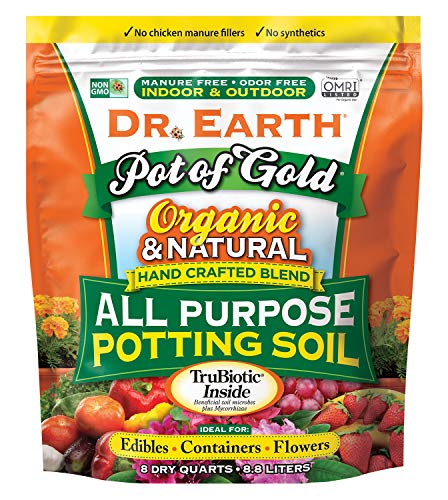
Dr. Earth has built a strong reputation for formulating soils that take organic horticulture seriously, and Pot of Gold is their flagship container mix. The 8-quart bag is a practical size — enough for a few smaller pots or one medium hanging basket without leaving you with a half-empty bag sitting in the garage. This mix is designed to work in any container type, from small 4-inch herb pots to large outdoor planters and hanging baskets.
The formula emphasizes versatility. You can run it indoors for houseplants, outdoors for patio herbs and vegetables, or use it in decorative container arrangements without any worry about it being too hot (over-fertilized) for sensitive plants. Dr. Earth relies on natural feed sources and beneficial microbes, and the soil structure remains open and workable even in smaller containers where compaction becomes an issue with cheaper mixes over time.
It's a good choice when you're juggling multiple container types and don't want to manage separate specialty mixes for each. One soil, used everywhere. The 8-quart size also means you're not lugging around a massive bag when you're working in a small space or on a balcony garden.
Pros:
Cons:
If your container plants struggle because you either overwater or underwater them — and most gardeners fall into one of those two camps — then Coast of Maine's Bar Harbor Blend deserves your attention. The formulation is built specifically around balancing moisture retention, aeration, and drainage in a way that forgives inconsistent watering habits. It uses sphagnum peat moss, compost, perlite, and crucially, lobster and crab shell meal sourced from Maine's coastal fishing industry.
That marine ingredient profile is what makes this mix distinctive. Lobster and crab shell meal is a natural source of chitin, which feeds beneficial soil microbes and adds calcium and other trace minerals over time. Combined with kelp meal, you get a nutrient profile that's genuinely broad-spectrum rather than just nitrogen-heavy. The perlite content keeps things airy enough that roots don't sit in waterlogged soil, while the peat and compost base retains enough moisture to reduce how often you need to water.
The 16-quart size gives you a good volume for filling several containers. This soil works particularly well for flowers, herbs, and vegetables in hanging baskets and window boxes, where moisture management is trickiest. It also makes a solid choice if you're potting plants that will be left outdoors through variable weather conditions.
Pros:
Cons:
Happy Frog is FoxFarm's more microbe-focused formulation, and it's worth understanding how it differs from their Ocean Forest line. Where Ocean Forest leads with ocean-sourced nutrients and a strong initial charge, Happy Frog leads with living soil biology — a custom blend of soil microbes designed to improve root efficiency and nutrient uptake over the entire life of your plants. This is the mix for gardeners who think about the long game.
The amendment list is impressive: earthworm castings, bat guano, and aged forest products work together to create an environment where beneficial organisms thrive. Those organisms break down organic matter continuously, making nutrients available to roots in a way that synthetic fertilizers simply can't replicate. Earthworm castings in particular are one of the most concentrated natural sources of available plant nutrition, and having them built into the base mix is a significant advantage. This soil is ready to use straight from the bag — no mixing or waiting required.
The 12-quart size is practical for medium containers. Happy Frog works well for a broad range of plants, but where it really shines is with ficus, geraniums, citrus trees, and other longer-lived container plants that benefit from a healthy root zone over multiple seasons. If you're also managing container plants alongside raised beds, pair it with our recommendations from the best liners for raised garden beds guide for a complete setup.
Pros:
Cons:
If environmental sustainability is a factor in your buying decision, Organic Mechanics Premium Blend is worth a close look. This is a fully peat-free formulation — a meaningful distinction given that sphagnum peat harvesting raises legitimate sustainability concerns. Instead of peat, this mix uses compost, aged pine bark, and coconut coir as its moisture-retentive base. Coconut coir actually outperforms peat in moisture retention in many conditions, and it breaks down more slowly, meaning the soil structure stays open and workable longer.
The ingredient list reads well across the board: compost, aged pine bark, coconut coir, perlite, and worm castings. Each of those components serves a specific function. The perlite keeps drainage moving. The worm castings add bioavailable nutrients and encourage beneficial microbial life in the root zone. The coconut coir holds moisture without becoming waterlogged. Together they produce a soil that's genuinely forgiving of both over and underwatering.
This 1 cubic foot bag is well-suited to houseplants, tropical plants, annuals, and window box arrangements. It's particularly good for small to mid-sized containers and for transplants that need a stable environment while roots establish. The moisture retention advantage is real — you will water less frequently compared to standard peat-based mixes, which is a practical benefit for container gardens in warmer climates or during dry summers.
Pros:
Cons:

The label on a bag of potting soil can be dense, but a few ingredients are worth spotting. Earthworm castings, bat guano, kelp meal, and mycorrhizae are markers of a quality organic mix. They indicate the manufacturer invested in soil biology, not just bulk fill material. Avoid mixes that list "composted forest products" as the primary ingredient with nothing else — that's a sign the mix is mostly filler with minimal nutritional value. Sphagnum peat moss and coconut coir are both solid base materials; the difference is sustainability. If that matters to you, look for coir-based formulas.
Containers don't have drainage the way garden soil does — the mix you choose has to do most of that work itself. Perlite is the standard additive for improving drainage and aeration, and any quality potting mix should contain a visible percentage of it. Bark and pumice are also used effectively. A soil that compacts into a solid block after a few waterings will suffocate roots and lead to root rot regardless of how good its nutrient profile is. When you open a bag, the soil should feel loose and slightly springy — not dense and wet.
Most container vegetables, herbs, and flowering plants thrive at a soil pH between 6.0 and 7.0. Quality organic mixes are adjusted to fall within this range before they're bagged. A pH that's too low or too high locks out nutrients even when they're present in the soil, which is why plants in cheap mixes often look pale and stunted despite regular watering. If you're growing acid-lovers like blueberries, look for mixes designed specifically for that — most general-purpose organic soils won't be acidic enough. For standard container plants, a pH-adjusted bag is worth the slight premium over the cheapest option on the shelf.
Think about how many containers you're filling before buying. A 6-quart bag fills roughly one 6-inch pot. A 1.5 cubic foot bag covers several medium containers or one large planter. Buying larger volumes per purchase is almost always more cost-effective, but not if you'll leave half a bag open in a garage for months — exposed potting soil loses moisture and can develop mold or pest issues. Match your bag size to your actual immediate needs, or seal unused portions tightly between uses.
An organic potting soil uses ingredients derived from natural sources rather than synthetic chemicals. That includes things like earthworm castings, bat guano, kelp meal, compost, sphagnum peat moss, and coconut coir. Organic mixes generally avoid synthetic fertilizers, pesticides, and artificial moisture-retention chemicals. The term isn't always strictly regulated on labels, so reading the full ingredient list is more reliable than trusting the word "organic" alone on the front of the bag.
Most of the mixes on this list are designed for both indoor and outdoor use, and they'll perform fine in indoor containers. The main consideration is that some outdoor mixes are formulated with heavier, denser base materials that work well in larger outdoor planters but can compact too much in smaller indoor pots. Look for a mix that explicitly lists indoor container use in its description. Lighter, more airy formulas — particularly those with higher perlite and coir content — tend to work better for smaller indoor pots.
For most container plants, replacing or refreshing the top few inches of potting soil annually is good practice. After a full growing season, organic matter breaks down, nutrients deplete, and the soil structure can compact. For perennial container plants that stay in the same pot for years, you can partially refresh by removing the top third of soil and replacing it with fresh mix each spring. Full replacement is a good idea every two to three years, or whenever you notice significant compaction or drainage problems.
Initially, no — most quality organic mixes contain enough nutrients to support plants for several weeks to a few months, depending on the formula. However, containers are a closed system. Nutrients wash out with watering over time and plants consume what's available. Heavy-feeding crops like tomatoes, peppers, and cucumbers will benefit from supplemental feeding once they're actively growing and the initial nutrient charge starts to deplete. A balanced liquid organic fertilizer applied every two to four weeks is a reliable approach for productive container plants in 2026.
Yes. In fact, organic mixes are specifically well-suited for edible plants because they avoid synthetic chemicals that could be absorbed by plant tissue. Ingredients like earthworm castings, kelp meal, and compost are safe for vegetables, herbs, fruits, and any other food crops grown in containers. Always check that any mix you use doesn't contain added synthetic fertilizers if you're growing food and want to keep the process fully organic from root to harvest.
The terms are used interchangeably in most retail contexts, but technically there's a distinction. True "potting soil" may contain actual soil (mineral particles from the ground), while "potting mix" is a soilless blend of organic materials like peat, compost, coir, and perlite. For container gardening, soilless mixes are generally superior because real soil compacts heavily in containers, restricts drainage, and can harbor pathogens. Most products labeled as potting soil today are actually soilless mixes, so the terminology matters less than reading the ingredient list.
The soil in your container is the one decision that affects every single thing that follows — get that right first, and the rest of container gardening gets a lot easier.
 |
 |
 |
 |

About Truman Perkins
Truman Perkins is a Detroit-based SEO consultant who's been in the business for over a decade. He got his start helping friends and clients get their websites off the ground, and he continues to do so today. In his free time, Truman enjoys learning and writing about gardening - something he believes is a natural stress reliever. He lives with his wife, Jenny, and their twins in Detroit.


Get new FREE Gifts. Or latest free growing e-books from our latest works.
Disable Ad block to reveal all the links. Once done, hit a button below
|
|
|
|
 rinjal