Viva Naturals Antarctic Krill Oil leads the 2026 lineup — delivering 1,250 mg per serving with one of the highest astaxanthin concentrations on the market. For buyers who have been bouncing between fish oil and krill oil, the difference in absorption and tolerability is not subtle. Krill oil binds omega-3 fatty acids to phospholipids rather than triglycerides, which means the body processes them more efficiently and with far less of the dreaded fishy burp that plagues conventional fish oil users.
The krill oil supplement market has matured considerably by 2026. What was once a niche alternative to fish oil has become a mainstay for health-conscious buyers targeting cardiovascular support, joint comfort, and cognitive function. According to the NIH Office of Dietary Supplements, EPA and DHA omega-3 fatty acids are among the most researched nutrients for heart and brain health. The phospholipid delivery system in krill oil gives it a structural advantage that continues to attract new converts from the fish oil camp. Buyers interested in other plant and marine-derived oils should also check out the roundup of 10 Best Flaxseed Oils and the guide on Top 14 Best Grapeseed Oils for complementary essential fatty acid sources.
This review covers seven of the top-selling krill oil supplements available in 2026, ranging from high-concentration single-softgel options to bulk-value 160-count bottles. Each product was evaluated on omega-3 potency, phospholipid and astaxanthin content, sourcing transparency, third-party testing, and value per serving. For a broader look at wellness and gardening health products, the gardening reviews section offers additional buying guides and expert picks. The list below represents the best options across price points and use cases — from the daily one-a-day user to the buyer who wants maximum potency in a clean formula.

Contents






Viva Naturals has built a reputation in the supplement space for delivering high-spec formulas at accessible price points, and this krill oil is no exception. Each serving delivers 1,250 mg of Antarctic krill oil, with 180 mg EPA and 90 mg DHA alongside 575 mg of phospholipids — a phospholipid content that ranks among the highest in the mid-range bracket. What sets this product apart from most competitors is the astaxanthin concentration: 1,600 mcg per serving, which edges out the majority of krill oil brands in the same price tier. Astaxanthin functions as a potent antioxidant that helps stabilize the omega-3 fatty acids and contributes to cellular defense support.
The capsules are small enough to swallow comfortably and carry no fishy aftertaste when taken with food. This is the phospholipid binding at work — the omega-3s attach to phospholipid molecules rather than triglycerides, which allows the body to absorb them through a different pathway than traditional fish oil. Long-term users report consistent tolerability with no gastric upset, which is one of the most common complaints associated with omega-3 supplementation in general. The 60-count bottle represents a standard 30-day supply at two capsules daily.
For buyers targeting joint health alongside cardiovascular support, this formula's combination of EPA, DHA, phospholipids, and high-dose astaxanthin covers multiple angles in a single product. Viva Naturals sources krill from Antarctic waters and the label reflects a commitment to no-burp formulation. This is the benchmark product in the 2026 krill oil category for buyers who want a fully loaded formula without moving into the premium price tier.
Pros:
Cons:
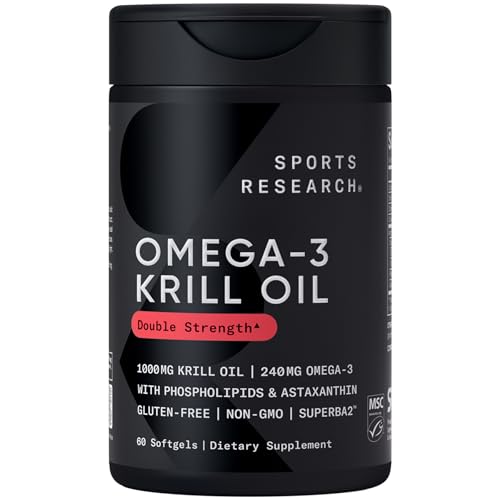
Sports Research has positioned this product as a true one-softgel-per-day solution, and the formula backs up that claim with substance. The Superba2 trademark krill oil ingredient is one of the most recognized and studied forms of krill oil available commercially. Superba2 is harvested from Antarctic krill with full traceability from sea to bottle — a supply chain standard that matters to buyers who care about sustainability and source transparency. The 1,000 mg delivered in a single liquid softgel includes concentrated EPA and DHA omega-3 fatty acids, choline, phospholipids, and astaxanthin, making this one of the most nutritionally complete single-capsule krill oil products tested in 2026.
Choline is the element most buyers overlook when comparing krill oil products. Unlike fish oil, krill oil naturally contains choline — an essential nutrient involved in liver function, brain development, and lipid metabolism. Sports Research highlights this in their marketing, and it is a legitimate differentiator. The softgel format also allows for a rapid-release delivery that liquid-phase absorption studies consistently favor over hard-shell gelatin capsules.
The fishy aftertaste issue is essentially absent here. Users with sensitive stomachs who failed with fish oil and even some lower-quality krill oils report clean tolerability with this Sports Research formulation. The 60-count bottle is a one-to-two month supply depending on whether users take one or two daily. For active buyers and athletes who want their omega-3s alongside choline support for cognitive performance, this is the most well-rounded single-dose option on the list.
Pros:
Cons:
MegaRed is one of the most recognized consumer brands in the krill oil category — widely available in pharmacies and big-box stores alongside its Amazon presence. The Extra Strength 500 mg formulation is the sweet spot in their product line, designed for buyers who want the well-documented cardiovascular benefits of omega-3 supplementation without loading up on per-serving milligrams. Clinical research cited on the label notes that MegaRed has been shown to significantly increase the omega-3 index in just 30 days — one of the few krill oil brands that references this specific metric, which is considered a more accurate biomarker for omega-3 status than serum levels alone.
The 90-count box provides a three-month supply at one softgel daily, making the per-dose cost competitive even though the per-milligram cost is higher than some 1,000 mg competitors. MegaRed sources krill exclusively from Antarctic waters where krill populations are most robust and subject to sustainable harvesting guidelines. The combination of omega-3 fatty acids and astaxanthin is optimized for heart health in particular, which is the primary stated benefit and the one backed by the most clinical evidence in the omega-3 literature.
This is the go-to pick for buyers whose primary concern is cardiovascular support and who want a trusted brand name with pharmacy-level brand recognition. The smaller 500 mg dose is also a practical entry point for users new to krill oil who want to assess tolerance before committing to higher daily doses. No fishy aftertaste is reported consistently across user reviews — a baseline expectation for quality krill oil that MegaRed meets reliably.
Pros:
Cons:
Dr. Mercola's krill oil targets health-conscious buyers with a strong preference for clean formulations — GMO-free, gluten-free, and soy-free certifications are prominently featured and independently verifiable. Each capsule delivers 1,000 mg of Antarctic krill oil with 220 mg of omega-3 fatty acids and organic astaxanthin. The use of organic astaxanthin rather than synthetic is a detail that distinguishes this formula for buyers who read supplement labels carefully. Organic sourcing for astaxanthin is uncommon in the krill oil category and represents a meaningful formulation decision rather than a marketing label.
Brain, heart, joint, and immune support are the four health targets listed on the label — a comprehensive scope that reflects the multiple mechanisms by which EPA, DHA, and astaxanthin contribute to systemic health. The 30-serving, 60-capsule bottle is a standard monthly supply at two capsules per day. Dr. Mercola has a long history in the direct-to-consumer supplement space, and this krill oil formulation has maintained consistent quality standards since its introduction. Third-party users with dietary restrictions consistently cite this formula as one of the few krill oils that meets multiple exclusion criteria simultaneously.
The omega-3 fatty acid content — 220 mg per capsule — is adequate for maintenance supplementation, though buyers who need therapeutic-level omega-3 intake may find the total EPA/DHA output modest compared to other 1,000 mg options that deliver higher omega-3 fractions. This product is best suited for buyers prioritizing ingredient purity and clean labeling over raw omega-3 milligram count.
Pros:
Cons:
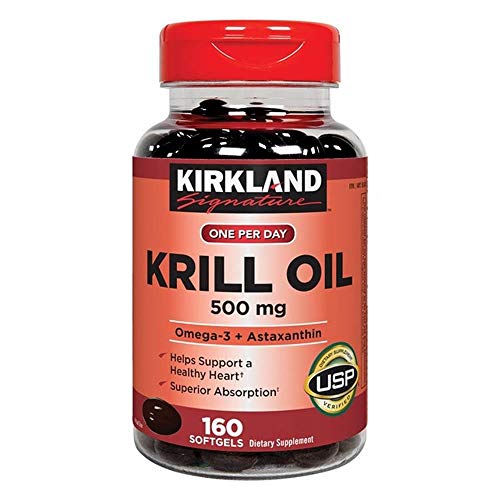
Kirkland Signature — Costco's house brand — applies its familiar value-first philosophy to krill oil with a 160-softgel bottle at a price point that delivers among the lowest per-dose costs on this list. At 500 mg per softgel containing omega-3 fatty acids, phospholipids, and astaxanthin, this is a clean and functional formula without unnecessary additives. The one-softgel-per-day dosing makes the 160-count bottle a more than five-month supply for consistent daily users — a buying frequency that benefits long-term supplementers who dislike reordering every month.
Kirkland's approach to supplements is known for Costco's quality standards: the Kirkland brand consistently meets or exceeds USP standards across product categories, and this krill oil is no exception. The formula is straightforward — 100% krill oil, phospholipids, astaxanthin, and omega-3 fatty acids in a single softgel. It does not carry the extra certifications or branded krill oil ingredients of some premium competitors, but for buyers whose primary goal is consistent daily omega-3 intake at a sustainable cost, the value calculation is difficult to argue against.
This product suits buyers who have already decided that krill oil works for them and want to settle into a long-term supply routine without premium pricing. First-time krill oil buyers may prefer a smaller bottle initially, but for existing users looking to optimize cost per serving, the 160-count Kirkland option is the clear bulk value winner in 2026. Buyers who also supplement with other natural health products may find parallel value guides useful, such as the comprehensive list of 15 Best Fractionated Coconut Oils.
Pros:
Cons:
Bronson Vitamins is a supplement brand with roots stretching back to 1960, and their approach to krill oil reflects that institutional commitment to quality. The 1,000 mg Antarctic krill oil formula is heavy-metal tested, non-GMO, gluten-free, and soy-free — verified through their New York cGMP registered and laboratory-tested facility. For buyers who have experienced quality inconsistency with lesser-known supplement brands, Bronson's manufacturing transparency is a meaningful differentiator. The 120-softgel bottle at a two-softgel serving size provides a 60-day supply, placing the per-serving cost in the competitive mid-range.
The formula delivers omega-3 fatty acids, omega-3 phospholipids, and natural astaxanthin in a 100% pure Antarctic krill oil base. The sourcing from Antarctic waters is standard for premium krill oil and ensures a harvest environment free from the industrial pollution concerns that affect some ocean species lower in the food chain. Krill's short lifespan and position at the base of the marine food web result in naturally low heavy metal accumulation — but Bronson's additional heavy metal testing provides an extra layer of verification that buyers focused on purity will appreciate.
This product performs best for buyers in the purity-conscious segment who want documented quality assurance without paying the premium of the top-shelf branded krill ingredients. The two-softgel serving is the primary practical downside for users who prefer a single daily capsule routine. Overall, Bronson delivers reliable potency with above-average manufacturing credibility for the price point, making it a solid choice for health-focused buyers who research their supplement sources.
Pros:
Cons:
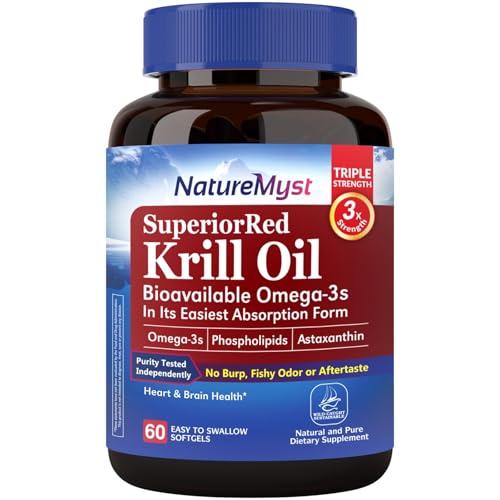
NatureMyst brings an unusually robust nutritional profile to the 1,000 mg category: each serving delivers 340 mg of omega-3 fatty acids (230 mg EPA and 110 mg DHA), 450 mg of phospholipids, and up to 1,500 mcg of astaxanthin. The omega-3 concentration — 340 mg per 1,000 mg of krill oil — is among the highest EPA/DHA yields tested in this price tier, and the 450 mg phospholipid content matches or exceeds most competitors at the same dose. This is a genuinely high-output formula for buyers who want maximum return per capsule.
The manufacturing story adds further confidence. NatureMyst produces this formula in a GMP-certified, FDA-inspected facility in the USA, using supercritical CO2 extraction — a cold-process method that preserves oil integrity and avoids chemical solvent contamination. Molecular distillation is applied to remove PCBs and dioxins, and the formula is free of soy, gluten, milk, sugar, egg, corn, wheat, peanuts, GMOs, artificial ingredients, fillers, binders, preservatives, and stearates. Few krill oil products match this length of clean-label claims with verifiable manufacturing documentation behind them.
Wild-caught, deep-ocean harvesting and cold processing are details that matter less in marketing than in reality: the freshness and purity of the finished oil are directly linked to processing conditions. NatureMyst's supercritical CO2 method is the gold standard for krill oil extraction. Buyers who are simultaneously exploring clean supplementation across categories — like those researching effective methods for herbal tincture and extract making — will recognize the CO2 extraction standard as one they trust. For the quality-per-dollar calculation in 2026, NatureMyst is the most impressive value proposition on this list.
Pros:
Cons:
The single most important number on a krill oil label is the combined EPA and DHA content per serving — not the total krill oil milligrams. A 1,000 mg softgel could deliver anywhere from 180 mg to 340 mg of actual omega-3 fatty acids depending on the krill oil quality and extraction method. Buyers targeting cardiovascular or cognitive support should look for at least 250 mg combined EPA/DHA per serving. Higher omega-3 fractions per milligram of krill oil indicate purer, better-extracted oil. Products that list only "omega-3 fatty acids" without breaking out EPA and DHA separately are providing less useful information — always look for the individual values.
Phospholipid content is the secondary metric that separates krill oil from fish oil structurally. The phospholipid-bound delivery system improves absorption efficiency, meaning a lower raw milligram count of krill oil omega-3s may deliver comparable bioavailable EPA/DHA to a much higher dose from a fish oil supplement. Look for products disclosing phospholipid content per serving — 400 mg or higher indicates a quality extract.
Astaxanthin occurs naturally in krill and is what gives krill and flamingos their distinctive pink color. In supplement form, astaxanthin functions as an antioxidant that helps protect the omega-3 fatty acids from oxidation — both in the capsule and in the body after absorption. Products delivering 1,000 mcg or more of astaxanthin per serving are in the upper tier; anything below 500 mcg is present more as a label feature than a functional dose. Organic-sourced astaxanthin, as found in the Dr. Mercola formula, is an additional quality tier available in the premium segment.
Astaxanthin content also functions as a freshness indicator for krill oil. A high-astaxanthin product from quality-sourced Antarctic krill with proper cold-chain handling will maintain potency through its shelf life. Rancid or improperly stored krill oil loses astaxanthin content before it reaches the consumer — another reason why supercritical CO2 extraction and proper packaging matter beyond the manufacturing story.
All seven products reviewed here source krill from Antarctic waters — the industry standard for commercial krill oil for good reason. Antarctic krill (Euphausia superba) lives in some of the coldest and most pristine waters on earth, with populations that represent one of the largest single-species biomasses in the ocean. The Marine Stewardship Council (MSC) certifies Antarctic krill fisheries, and buyers can look for MSC certification or equivalent sustainability verification on product labels.
Full traceability — the ability to track a batch of krill oil from the ocean to the finished capsule — is an emerging standard that Sports Research's Superba2 ingredient delivers in its most developed form. For buyers who want the highest supply chain assurance, branded krill oil ingredients like Superba2 provide third-party traceability documentation that generic Antarctic krill labels do not. The absence of a branded ingredient is not automatically a red flag, but the presence of one is a meaningful trust signal.
Supplement adherence is often determined by how convenient the daily routine is. One-softgel-per-day formulas — as offered by Sports Research, MegaRed, and Kirkland — appeal to buyers who take multiple supplements and want to minimize pill count. Two-capsule servings are standard for higher-dose products like Viva Naturals and Bronson. Neither is superior in bioavailability, but buyers who forget second doses consistently will get more benefit from a single daily softgel than from a two-softgel serving taken only half the time.
Softgel format — with a liquid-filled gelatin shell — is standard for krill oil and is preferable to hard-shell capsules for fat-soluble supplement delivery. The liquid interior ensures the oil remains in an undamaged, bioavailable form. All seven products on this list use softgel construction. Enteric coating is not typically necessary for krill oil given its natural anti-burp properties, though some users sensitive to capsule coatings may have product-specific reactions unrelated to the krill oil itself.
Krill oil is derived from small crustaceans called Antarctic krill (Euphausia superba), while fish oil comes from fatty fish like sardines, anchovies, and mackerel. Both supply EPA and DHA omega-3 fatty acids, but krill oil delivers them bound to phospholipids rather than triglycerides. This structural difference means the omega-3s in krill oil are absorbed through a more efficient pathway, resulting in higher bioavailability at lower doses. Krill oil also naturally contains choline and the antioxidant astaxanthin — neither of which appears in standard fish oil supplements.
Most krill oil products are formulated for 500 mg to 1,250 mg per day. For general cardiovascular and omega-3 maintenance, a daily dose delivering 250–500 mg of combined EPA and DHA is adequate for most healthy adults. Buyers with specific health targets — such as elevated triglycerides, joint inflammation, or cognitive decline concerns — may benefit from higher doses, ideally confirmed with a healthcare provider. Taking krill oil with a meal that contains fat improves absorption and reduces the likelihood of any digestive sensitivity.
Quality krill oil produces significantly less fishy aftertaste than fish oil. The phospholipid binding structure means the oil is processed quickly in the upper digestive tract rather than sitting in the stomach and releasing fishy odors. All seven products reviewed here carry no-burp claims, and user reviews consistently confirm tolerability across brands. Buyers who experienced fishy burps with fish oil will almost universally report a clean experience switching to krill oil, provided the krill oil is fresh and properly stored.
Krill are crustaceans, and individuals with shellfish allergies should approach krill oil with caution and consult an allergist or physician before use. The allergenic proteins in shellfish are primarily found in the meat rather than the oil, but individual sensitivity varies. Some people with mild shellfish sensitivities tolerate krill oil without incident, while others with severe crustacean allergies should avoid it entirely. This is one area where a medical consultation before supplementation is genuinely warranted rather than optional.
Astaxanthin is a carotenoid antioxidant that occurs naturally in krill, giving the crustacean its reddish color. In krill oil supplements, astaxanthin serves two functions: it acts as a natural preservative that protects the omega-3 fatty acids from oxidation during storage, and it functions as an antioxidant in the body after absorption. Research on astaxanthin as a standalone supplement has examined its potential for skin health, exercise recovery, and cellular defense. Products delivering 1,000 mcg or more per serving offer a functional dose; most krill oil brands fall in the 500–1,600 mcg range.
EPA and DHA omega-3 fatty acids have a well-documented relationship with cardiovascular health. Clinical evidence supports their role in reducing serum triglycerides, moderating blood pressure, and reducing platelet aggregation. The FDA has approved a qualified health claim noting that consumption of EPA and DHA may reduce the risk of coronary heart disease. Krill oil delivers these fatty acids in phospholipid form, which improves cellular uptake and has been shown in studies to raise the omega-3 index — a blood biomarker increasingly used by cardiologists — more efficiently than equivalent doses of standard fish oil. MegaRed's 30-day omega-3 index improvement data reflects this mechanism.
The 2026 krill oil market offers genuine quality at every price point — from the high-concentration Viva Naturals formula with its 1,600 mcg astaxanthin benchmark, to the clean-extraction NatureMyst option with its USA-manufactured, supercritical CO2 pedigree, to the no-frills bulk value of Kirkland Signature. Buyers ready to upgrade from fish oil or settle into a long-term omega-3 routine should start with the pick that matches their primary health target and daily dosing preference, then stay consistent — the cardiovascular and cognitive benefits of omega-3 supplementation compound over months, not days.
 |
 |
 |
 |

About Christina Lopez
Christina Lopez grew up in the scenic city of Mountain View, California. For eighteen ascetic years, she refrained from eating meat until she discovered the exquisite delicacy of chicken thighs. Christina is a city finalist competitive pingpong player, an ocean diver, and an ex-pat in England and Japan. Currently, she is a computer science doctoral student. Christina writes late at night; most of her daytime is spent enchanting her magical herb garden.


Get new FREE Gifts. Or latest free growing e-books from our latest works.
Disable Ad block to reveal all the links. Once done, hit a button below
|
|
|
|
 rinjal